


OLED TVs are among the most popular on the market. Thanks to OLED’s self-emissive pixels, it can produce perfect blacks while also delivering crisp textures, bold colors and strong contrast. Traditional TV OLED tech, known as Tandem WOLED now, has always struggled with its brightness, measuring significantly dimmer than mini-LED TVs.
Enter QD-OLED. Introduced by Samsung in 2022, QD-OLED adds quantum dots into the OLED equation, enabling very high brightness. While WOLED itself is getting brighter, QD-OLED continues to promise higher brightness increases than WOLED can generally manage each year – and we seem to know now the secret sauce that’s allowed a huge 35% claimed jump in 2026, which I’ll come back to shortly.
But QD-OLEDs advances aren’t helping it take over the industry. Both OLED and QD-OLED are used in some of the best TVs, but WOLED continues to be the most widely used, even though QD-OLED is the brighter of the two panel technologies. In 2023, I said that WOLED was dying thanks to the arrival of QD-OLED and since then, a QD-OLED TV has been named TechRadar’s TV of the Year each year since, last year won by the Samsung S95F.
So, why hasn’t QD-OLED fully taken over? Let’s explore.
QD-OLED vs OLED brightness

When it comes to brightness, QD-OLED usually comes out on top. Last year however, LG introduced a new OLED panel: the Primary RGB Tandem OLED, also known as ‘four-stack’ OLED. It delivered higher brightness and richer colors, and it even beat QD-OLED in one area when we tested LG and Samsung’s flagship models last year.
We measured the LG G5’s peak HDR brightness at 2,268 nits, which was higher than the Samsung S95F’s peak HDR brightness of 2,132 nits. However, where QD-OLED had the advantage was fullscreen HDR brightness, with the S95F hitting 390 nits and the G5 clocking in at 331 nits, and this is more impactful measure for real-life viewing.
It’s worth noting that the RGB Tandem OLED was reserved for the flagship models. The mid-range LG C5, and its older WOLED OLED EX panel, hit 1,180 nits peak brightness – whereas the 65-inch Samsung S90F, which used a QD-OLED panel, hit 1,400 nits. The mid-range is where the QD-OLED made the most difference.
QD-OLED vs OLED’s future
Image 1 of 2


At CES 2026, LG revealed its 2026 OLED TV lineup, announcing that both the LG G6 and LG C6H, the latter of which is basically the LG C6 at 77-inch and 83-inch sizes, will use a next-gen Primary RGB Tandem 2.0 panel. LG says that the G6 will be 20% brighter than its predecessor the G5.
While this is impressive, Samsung revealed its own 2026 OLED TV lineup and we learned that the Samsung S95H, its 2026 flagship, should deliver 35% higher brightness than its predecessor the Samsung S95F. That’s a big boost and dwarfs LG’s 20% higher brightness claim. How is such a boost possible?
Well, we actually learned from Nanosys, the manufacturer behind quantum dots, that QD-OLED will get brighter thanks (at least in part) to a new version of the Quantum Dot Color Conversion (QDCC). QDCC is a type of ink which is used in QD-OLED and this new version is more efficient, enabling higher brightness levels. Other factors probably play in too, but this seems like the key technical development.
So, with all these exciting updates, why is QD-OLED not the most widely used OLED tech?
QD-OLED’s downfall: price

It’s no secret that OLED TVs are some of the most premium priced on the market. While there are ‘budget’ options available such as the LG B5 and Samsung S85F, they’re still much pricier than mini-LED TVs. But, while WOLED TVs are getting cheaper and are available in more budget models, QD-OLED isn’t.
Price is QD-OLED’s biggest downfall. As QD-OLED appears to be a more costly panel to make, it hasn’t made its way to cheaper models. In fact, it’s also not available (at the time of writing) in anything smaller than 55-inch, leaving WOLED as the sole OLED panel tech in smaller 42 and 48-inch models. QD-OLED also isn’t available at 83-inch sizes.
At launch, a 65-inch Samsung S95F cost $3,399 / £3,399 / AU$5,295, very similarly priced to the 65-inch LG G5 cost $3,399 / £3,299 / AU$5,299. And while QD-OLED’s prices are similar in its available sizes, 55-77-inch, the lack of a smaller, more budget friendly model is noticeable. Samsung actually uses traditional WOLED in its entry-level S85F model, and in some sizes of the Samsung S90F, with QD-OLED seemingly not able to keep up with Samsung’s own demands.
What’s also very notable is how other manufacturers don’t seem desperate to use QD-OLED. Panasonic and Philips use LG’s Tandem WOLED displays. Sony has used QD-OLED for its flagship OLED TVs, but Sony has always sold TVs at a price premium compared to other manufacturers – so it being the only user feels telling.
With LG Display recently announcing a lower-cost OLED panel with impressive brightness, and no announcements from Samsung Display that it’ll be able to offer cheaper QD-OLED panels or new sizes (so far), it looks like LG still has the lead with other manufacturers where it matters: bang for buck.
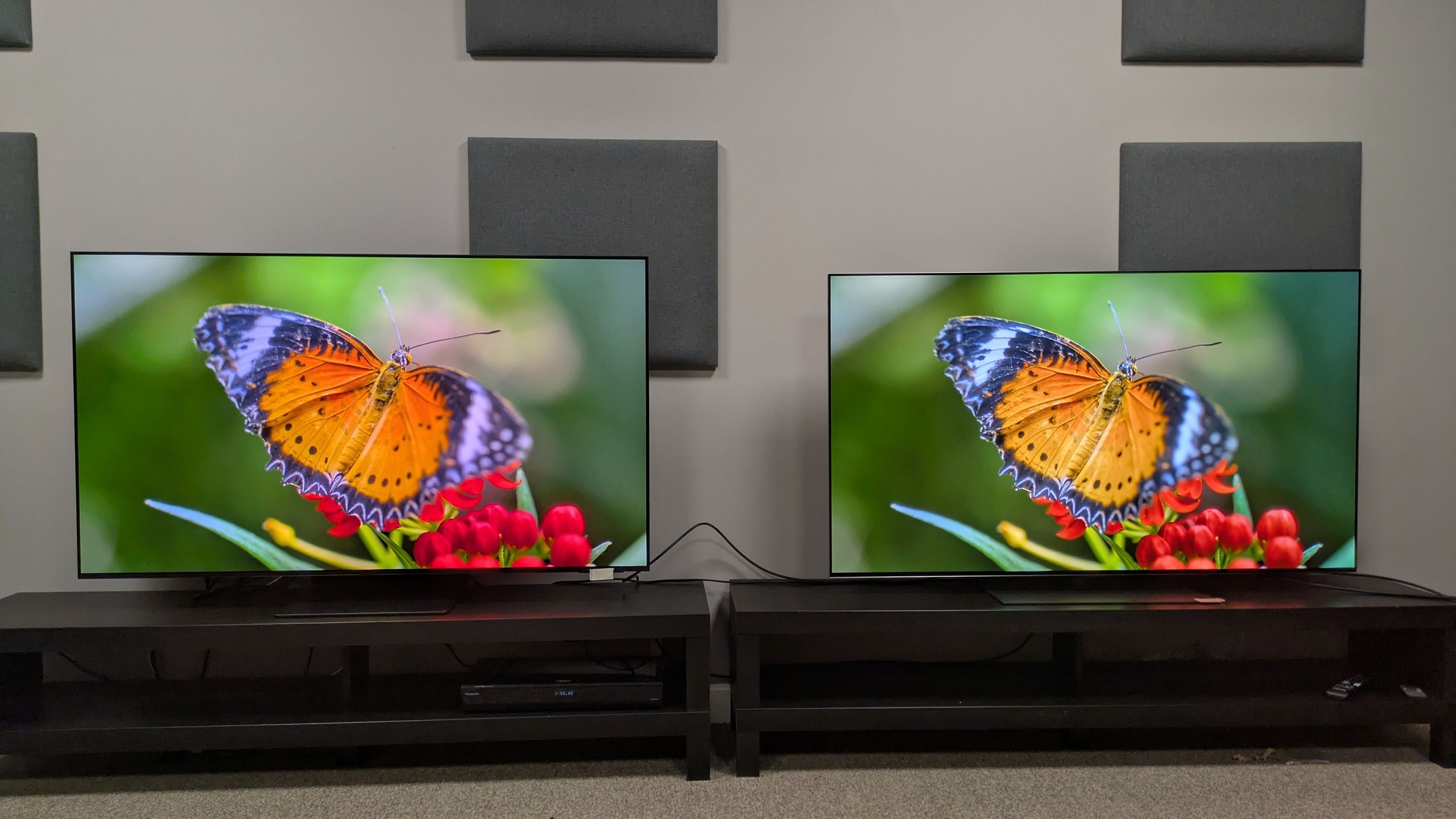
I put the LG G5 and Samsung S95F side-by-side and it was an extremely close fight, with both producing incredible pictures. Putting these two models in a four-way OLED showdown, they both came out on top, with the S95F scoring higher in most categories. But, as long as QD-OLED is pricier, I can’t help feeling it’s still one step behind WOLED. If it can get its price down, all bets are off.

The best TVs for all budgets
Follow TechRadar on Google News and add us as a preferred source to get our expert news, reviews, and opinion in your feeds. Make sure to click the Follow button!
And of course, you can also follow TechRadar on YouTube and TikTok for news, reviews, unboxings in video form, and get regular updates from us on WhatsApp too.
