

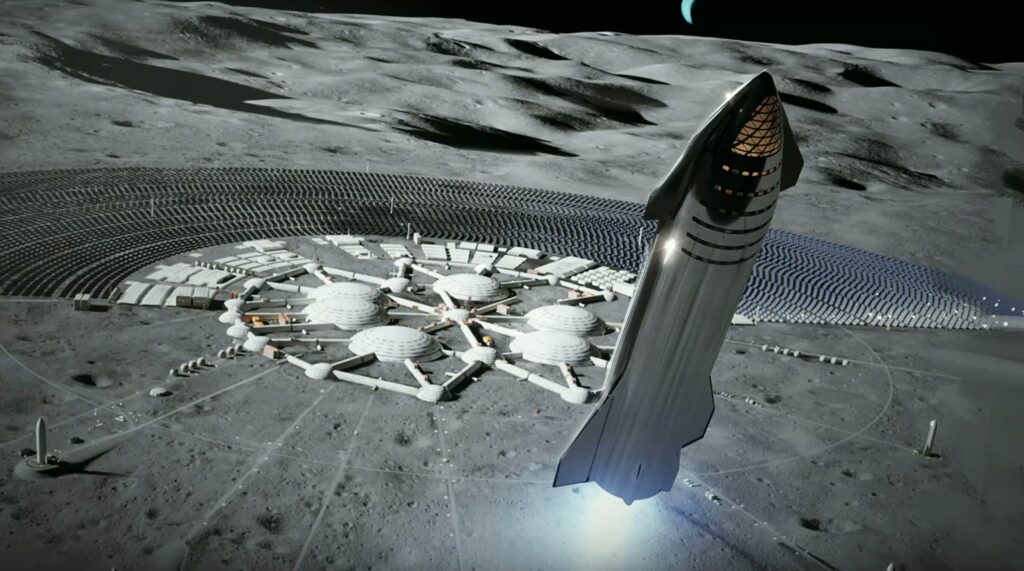

SpaceX has already shifted focus to building a self-growing city on the Moon, as we can potentially achieve that in less than 10 years, whereas Mars would take 20+ years. Elon Musk is talking about building a city on the Moon at a faster pace. The real reason is to make hundreds of trillions from AI data centers in space. Moon resources will increase AI satellites from 100 to 1000 gigawatts per year from earth by ten times by 2040 and then one hundred times by 2050. This will make SpaceX, XAi and Tesla thousands of trillions of dollars eacy.
It is only possible to travel to Mars when the planets align every 26 months (six month trip time), whereas we can launch to the Moon every 10 days (2 day trip time). This means we can iterate much faster to complete a Moon city than a Mars city.
For those unaware, SpaceX has already shifted focus to building a self-growing city on the Moon, as we can potentially achieve that in less than 10 years, whereas Mars would take 20+ years.
The mission of SpaceX remains the same: extend consciousness and life as we know it to…
— Elon Musk (@elonmusk) February 8, 2026
Elon noted that up to 1 petawatt (PW) per year could be launched from the Moon, compared to 1 terawatt (TW) per year from Earth—highlighting the Moon’s potential for resource-efficient energy and material output.
Up to 1TW/year can be launched from Earth and 1PW/year from the Moon
— Elon Musk (@elonmusk) January 31, 2026
Space-based industries could exceed Earth’s value by harnessing 100,000x more solar energy, using a tiny fraction of the Sun’s output.
Space-based industries will vastly exceed the value of all of Earth, given that you could harness roughly 100,000 times more energy than Earth and still be using less than a millionth of the Sun’s energy!
— Elon Musk (@elonmusk) January 25, 2026
AI generations scaled for space: AI5/AI6 for low gigawatt (GW)-scale ops, escalating to AI8/Dojo3 for over 100GW/year.
AI5/AI6 will be fine for space at the low GW/year scale.
AI7/Dojo3 for >10GW/year.
AI8/Dojo3 for >100GW/year.
— Elon Musk (@elonmusk) February 1, 2026
Lunar ISRU for Silicon, Aluminum, and Other Materials- Application to Space-Based AI Satellites
Lunar In-Situ Resource Utilization (ISRU) offers a pathway to extract key materials like silicon (Si), aluminum (Al), iron (Fe), titanium (Ti), and oxygen (O₂) from regolith, enabling on-site manufacturing of satellite components. This could revolutionize constellations like Starlink by shifting production to space, reducing Earth-launch mass, and supporting scalable AI compute infrastructure. Regolith is 45% O₂ by weight (bound in oxides), 21% Si, with significant Al (7-18% in highlands anorthite), Fe (5-15%), and trace Ti.
Molten Regolith Electrolysis (MRE)
Heats regolith to 1600-1800°C (via solar concentrators or nuclear power), then applies current to separate elements.
Yields
Si (up to 99.999% purity for solar cells/chips),
Al (pure within alloy 1100 standards for structures),
Fe (for electronics/magnetics), and
O₂ (96% recovery).
Blue Origin’s Blue Alchemist demo uses this for scalable extraction without chemicals, producing Si for photovoltaics and Al/Fe alloys.
Molten Salt Electrolysis (FFC-Cambridge Process)>b
Dissolves regolith in salts like CaCl₂ at 700-950°C. Electrolysis yields Al/Fe/Si alloys (Al-Fe-Si, Fe-Si-Ti).
Near-complete O₂ extraction; Al/Si for wiring/insulation. Less energy-intensive than MRE but requires Earth-sourced salts initially (Ca from lunar anorthite later).
Server Sky Analysis on Making Satellites from Lunar Resources
Server Sky is a proposal to build large arrays of 7 gram paper-thin solar-powered computer satellites launched into a 6400 kilometer altitude earth orbit. A server-sat is mostly a 100 micron thick, 6 inch solar cell, with processor memory and radio chips around the edges. Server-sats use light pressure for thrust and electrochromic light shutters for steering. Thousands of server-sats will be positioned in three-dimensional arrays, about 100 meters on a side. An array acts as a large phased array antenna transmitting thousands of communication beams simultaneously to ground receivers and to other arrays in space.
Brian Wang is a Futurist Thought Leader and a popular Science blogger with 1 million readers per month. His blog Nextbigfuture.com is ranked #1 Science News Blog. It covers many disruptive technology and trends including Space, Robotics, Artificial Intelligence, Medicine, Anti-aging Biotechnology, and Nanotechnology.
Known for identifying cutting edge technologies, he is currently a Co-Founder of a startup and fundraiser for high potential early-stage companies. He is the Head of Research for Allocations for deep technology investments and an Angel Investor at Space Angels.
A frequent speaker at corporations, he has been a TEDx speaker, a Singularity University speaker and guest at numerous interviews for radio and podcasts. He is open to public speaking and advising engagements.
