

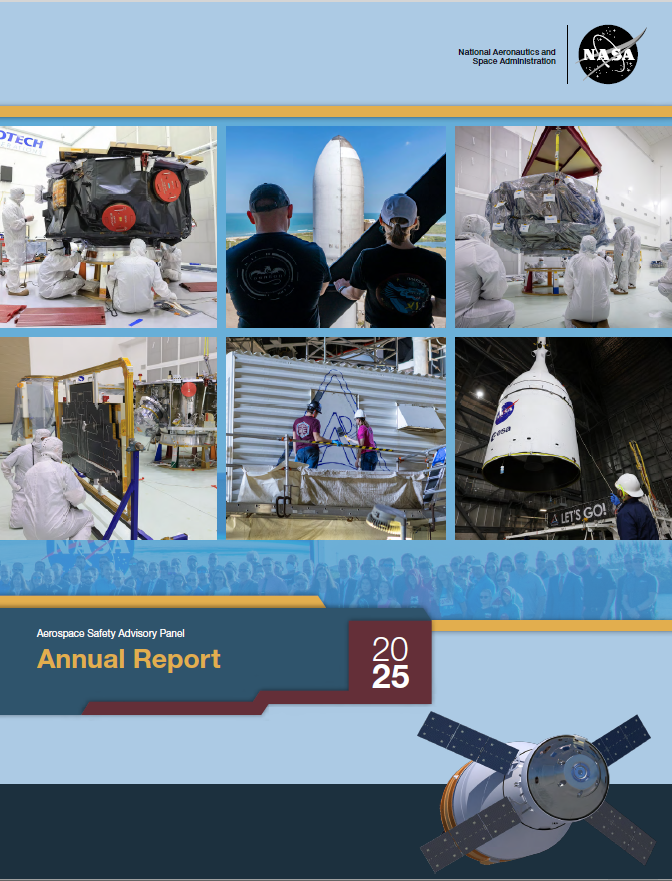

The Aerospace Safety Advisory Panel (ASAP), which advises NASA and Congress on safety, has released its 2025 annual report on NASA’s performance and challenges.
While the panel acknowledged NASA’s safety achievements, it warned that the agency’s biggest challenges stem from interconnected factors – workforce, acquisition, technical authority, budgets, and the growing complexity of human spaceflight – requiring sustained attention as missions become more ambitious.
“Independent assessments like this will make NASA better,” said NASA Administrator Jared Isaacman. “The panel’s report underscores areas where we must raise the bar, from how we structure oversight and manage integrated risk to how we declare and learn from anomalies. We are wholly committed to transparency. That’s how we protect crews, earn trust, and keep the Artemis lunar campaign and our transition to a commercial presence in low Earth orbit on a safe, sustainable path.”
This year’s report focused on the following topics:
- strategic vision and governance
- Moon to Mars program
- future U.S. presence in low Earth orbit
- health and medical risks in human spaceflight
- NASA’s X-59 Low-Boom Flight Demonstrator
The panel noted progress on Artemis II readiness and improved oversight through the Moon to Mars Program Office, as well as safe International Space Station operations, advances in astronaut health research, and the first flight of the X-59 Low-Boom Demonstrator. At the same time, it flagged significant challenges, including Artemis III’s high-risk posture, lessons from Boeing’s Starliner test, space station deorbit planning, and systemic concerns.
To respond to these new challenges, the panel recommends NASA:
- Realign its governance of acquisition strategies for human spaceflight-related capabilities agencywide.
- Re-examine the mission objectives and system architecture for Artemis III and subsequent missions to establish a more balanced approach to risk.
- Require timely declaration of mishap or high-visibility close call.
“We were already on the path to implementing change and this report only adds more urgency,” added Isaacman. “That means recalibrating our acquisition strategy — including a build versus buy versus service procurement approach — restoring core competencies through initiatives like converting contractors to civil servant roles and increasing our launch cadence. We’re also aligning our long-term vision for the agency and industry to guide priorities. This includes clarifying our plans for the Artemis architecture moving forward and accelerating proposals for human landing systems to preserve schedule margin. We’ve already shown what transparency and now accountability looks like — through the Boeing Starliner Program Investigation Team report, we owned our mistakes, classified the mission as a Type A mishap, and launched corrective actions to ensure they never happen again. These steps, along with addressing health and medical risk documentation and overhauling and accelerating programs like X-59, reflect our commitment to live up to the expectations of the world’s most accomplished space agency.”
On Feb. 19, Isaacman held a news conference to present the agency’s findings from the Starliner Crewed Flight Test. Earlier this month, he outlined a new workforce plan to strengthen NASA’s core competencies in technical, engineering, and operational excellence. The agency also is working with both its human landing system industry providers to streamline and accelerate America’s return to the surface of the Moon by 2028.
“The panel commends NASA for its impressive efforts in 2025 to strategically enhance the agency’s risk management posture despite turbulence in the agency’s organizational environment,” said retired U.S. Air Force Lt. Gen. Susan J. Helms, chair of ASAP. “We very sincerely thank NASA’s leaders and workforce for their passionate dedication to space exploration and their unwavering commitment to the safe pursuit of the nation’s lofty aims to the great benefit of the future of humanity.”
The annual report is based on the panel’s 2025 fact-finding and quarterly public meetings; direct observations of NASA operations and decision-making; discussions with NASA management, employees, and contractors; and the panel members’ experiences.
Congress established the panel in 1968 to provide advice and make recommendations to the NASA administrator on safety matters after the 1967 Apollo 1 fire claimed the lives of three American astronauts.
To learn more about the ASAP, and view annual reports, visit:
-end-
Bethany Stevens / Elizabeth Shaw
Headquarters, Washington
202-358-1600
bethany.c.stevens@nasa.gov / elizabeth.a.shaw@nasa.gov
