

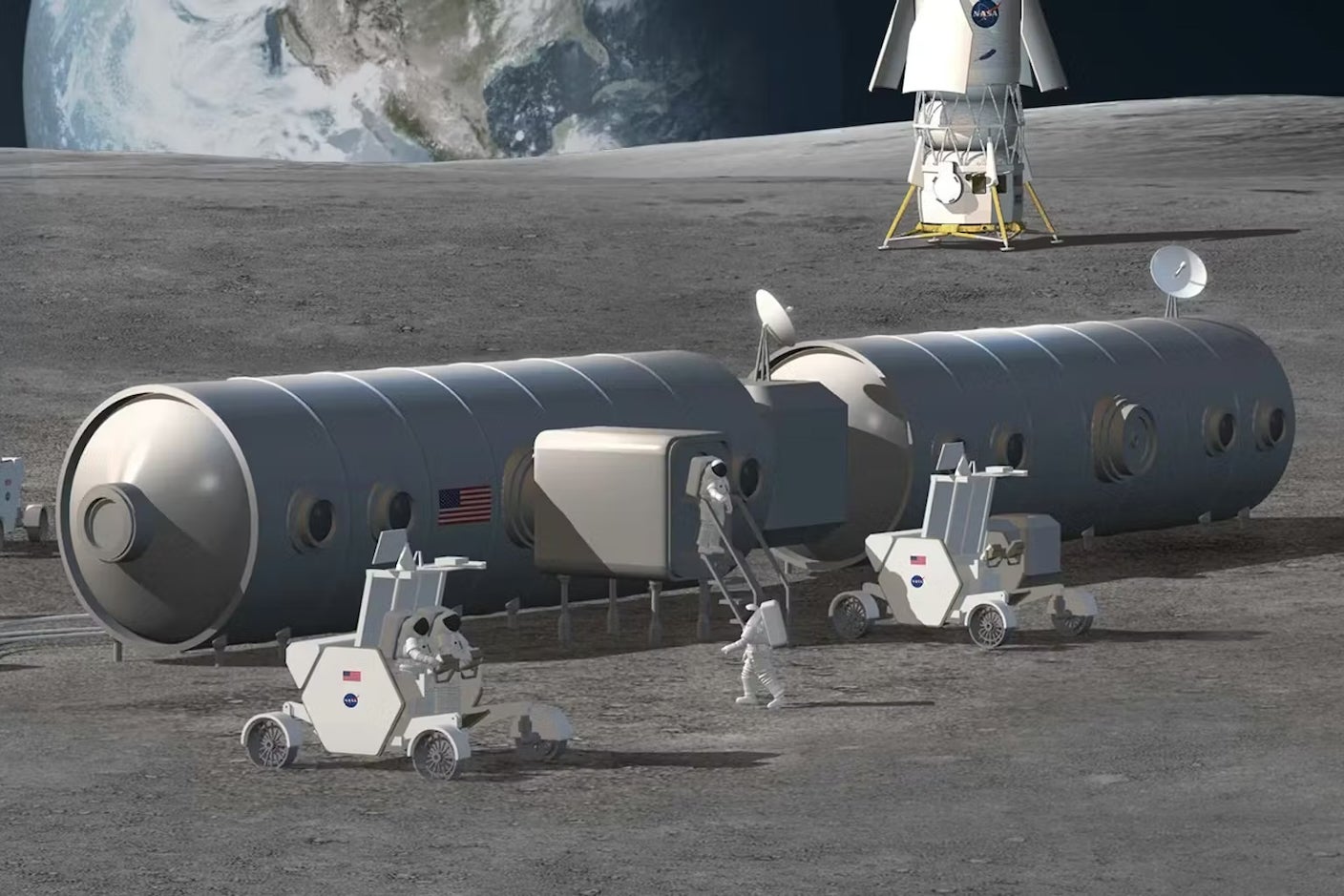

A US Senate committee has directed NASA to begin work on a moon base “as soon as is practicable.” Under legislation advanced by the Senate lawmakers, the outpost would serve as a science laboratory and proving ground, where astronauts would develop the capabilities to live and work beyond Earth’s orbit.
A recent executive order issued by the White House directs NASA to establish the initial elements of a permanent moon base by 2030.
Since 2017, Artemis has been the NASA-led program working towards a sustained human presence on the moon. This year, it will send astronauts around the moon for the first time in more than half a century. And following a shake-up of Artemis announced in late February, the space agency plans to greatly increase the frequency of Artemis missions and return humans to the lunar surface in 2028.
A vote will now decide whether Senate legislation, known as the NASA Authorization Act of 2026, is passed to Congress, where a second bill is also circulating. The bills, which both break down this year’s funding for specific NASA programs, will be reconciled and voted on in both houses to become law.
Underlying some of the announced changes is a deepening concern in Congress and the current administration about the challenge rival powers pose to US leadership in space. A Chinese-Russian led moon outpost known as the International Lunar Research Station is under development.
A one page summary accompanying the Senate bill calls for a US base “so we can get there before the Chinese” and to “dominate the Moon, control strategic terrain in space, and write the rules of the 21st century.”
Site Selection
The American habitat will be located at the moon’s south pole, a strategically important location which harbors valuable resources such as water ice. The water could support habitation systems at a lunar outpost and be turned into rocket propellant for onward exploration.
Where exactly the base is located will depend on the terrain, how much sunlight the site receives, how extreme the temperatures are, how easily astronauts can communicate with Earth, and their access to resources such as water. The rim of a 21-kilometer-wide depression known as Shackleton Crater (which may hold abundant ice deposits) and a flat-topped mountain called Mons Mouton are among the leading candidates. The leading locations combine several favorable factors.
At high latitudes, such as the lunar poles, elevated crater rims can receive near-constant solar illumination. This makes them more thermally favorable than many sites at the equator, providing a consistent supply of solar power. However, the strategic value of these sites lies in what are called permanently shadowed regions (PSRs). These impact craters, untouched by sunlight for billions of years, are believed to contain the water-ice deposits.
While the south pole remains a primary focus in upcoming missions, other targets near the equator, such as Marius Hills and Mare Tranquillitatis, offer alternative advantages. These regions feature massive underground lava tubes formed by ancient volcanic activity that can act as natural shields against solar radiation and micrometeorite bombardments. They could insulate human outposts against extreme swings in temperature from 127° Celsius to -173° Celsius.
The interiors of lunar lava tubes are estimated to remain at about 17° Celsius year-round, making them ideal sites for human bases. However, unlike at the lunar poles, water in these regions is typically trapped as molecules within volcanic glass beads or minerals. Extracting this water to sustain human activities would require intensive heating and significant technological development.
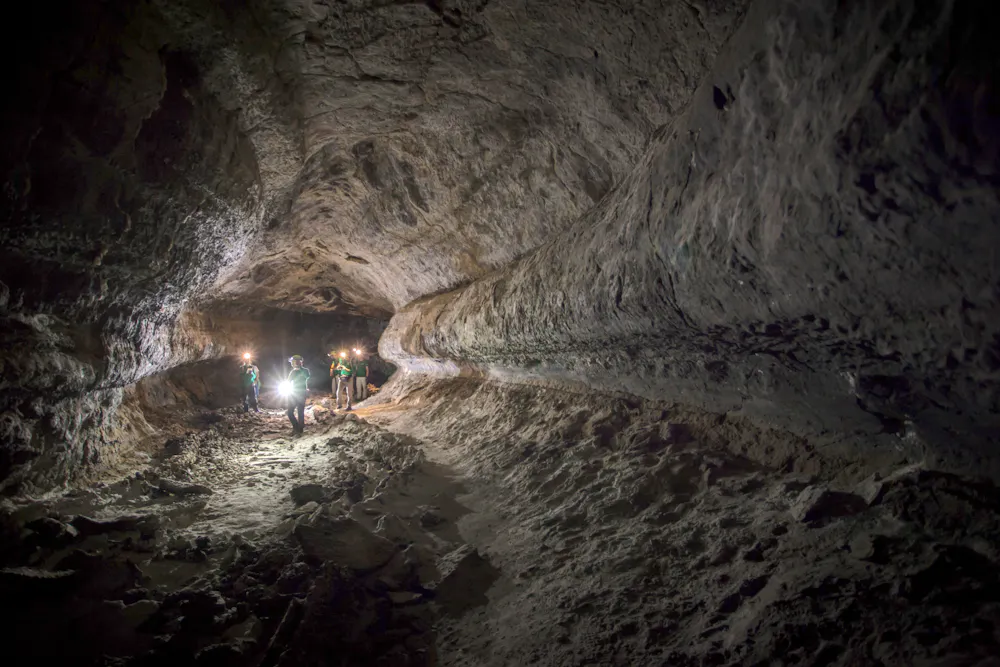
European astronauts explore a lava tube in the Canary Islands. Huge lava tubes on the moon could protect human habitats from radiation and micrometeoroids. Image Credit: ESA–L. Ricci
Powering an outpost
The moon’s day-night cycle means that a given point on the lunar surface sees roughly 14 Earth days of continuous daylight followed by 14 days of darkness. While solar power is a viable entry point, it cannot sustain a permanent human presence through the freezing lunar night. To achieve the 2030 mandate for a “sustained presence” NASA and the Department of Energy are developing nuclear fission reactors as a potential source of energy.
They have been working on 40-kilowatt-class reactors that are designed to be launched from Earth in an inert state and activated upon arrival. To protect the crew from radiation, the reactors will likely be placed at a distance or buried within the lunar regolith (soil), which serves as a natural radiation shield.
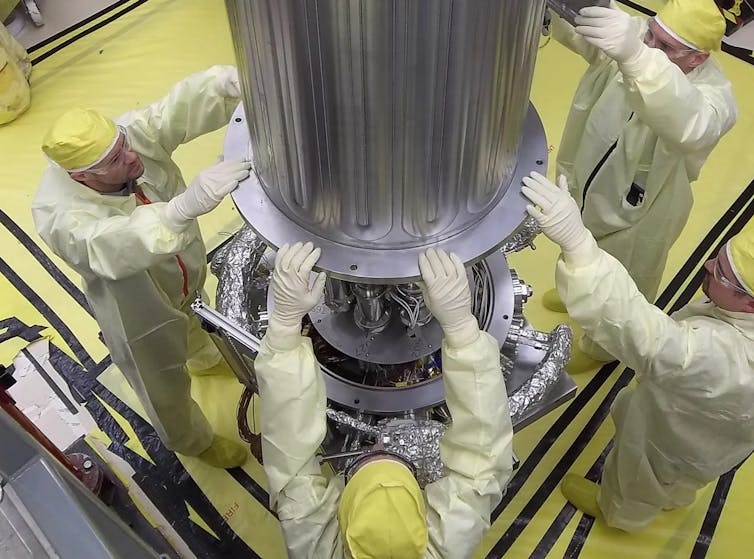
Engineers from NASA and the National Nuclear Security Administration lower the wall of the vacuum chamber around a demonstration fission reactor. Image Credit: Los Alamos National Laboratory
The deployment of lunar fission reactors raises practical governance questions under existing international space law. The US-led set of rules for operating in space, known as the Artemis Accords, establishes a framework for peaceful cooperation.
It calls for transparency about space agencies’ activities on the surface and proposes safety zones around nuclear infrastructure. However, this approach conflicts with the Outer Space Treaty of 1967, which guarantees the right of all nations to have unrestricted access to all areas of celestial bodies.
Given that energy security is a strong prerequisite for successful habitation systems, there is a clear need for the governance of the storage and disposal of the materials used for nuclear fission on the lunar surface.
Initial Assembly
A lunar base would likely be built up in stages. Early missions would use satellites and autonomous rovers to study the lunar surface, identify areas rich in resources, and confirm the presence of water. Under a 2030s timeline, robotic missions could be sent ahead to prepare landing sites by leveling the ground and melting the dusty surface into harder landing pads. This would help reduce the damage caused by highly abrasive lunar dust kicked up during landings.
The habitats themselves would probably be built by connecting different modules—a bit like the International Space Station. Current designs favor modules that can be reduced in size for transportation and then expanded after landing. One way to do this is with inflatable structures.
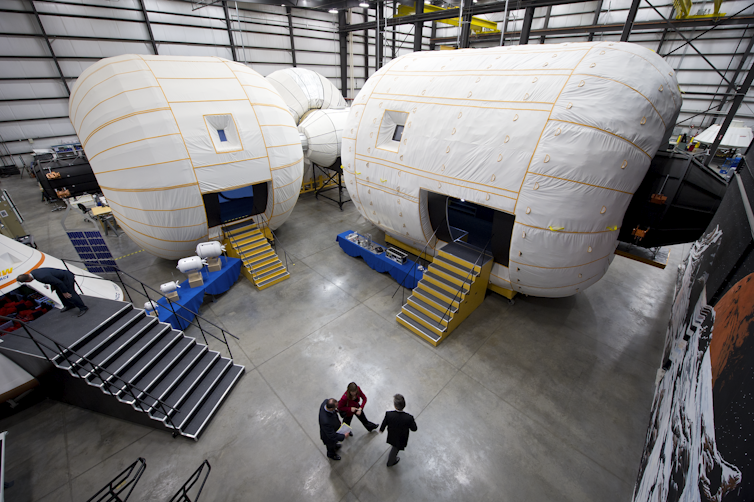
Expandable habitats could be deployed on the moon before more permanent structures. Image Credit: NASA / Bill Ingalls
Later, more permanent architectures may use microwaves or lasers to sinter or melt the lunar regolith into solid structures. This would create protective shells around base modules to protect them against micrometeorites and cosmic radiation.
The moon serves as a testbed for the life-support, power, and robotic systems required to support human missions on Mars and other destinations in deep space.
The fiscal implications of sustained operations on the lunar surface also require a more realistic assessment of funding. With NASA’s topline budget remaining largely flat, the higher cadence (frequency) of lunar missions outlined in NASA’s changes to Artemis would increase pressure on agency resources.
This may intensify competition with existing science and Earth observation priorities, but it also strengthens the case for greater commercial participation and international cost-sharing. If these financial pressures can be managed effectively, the long-term legacy of sustained lunar surface operations could be a more durable framework for funding space exploration.
The coming decade will test not only our ability to operate through the lunar night, but also our capacity to build the logistical, legal, and cooperative frameworks needed for a durable human presence beyond Earth.
This article is republished from The Conversation under a Creative Commons license. Read the original article.
