

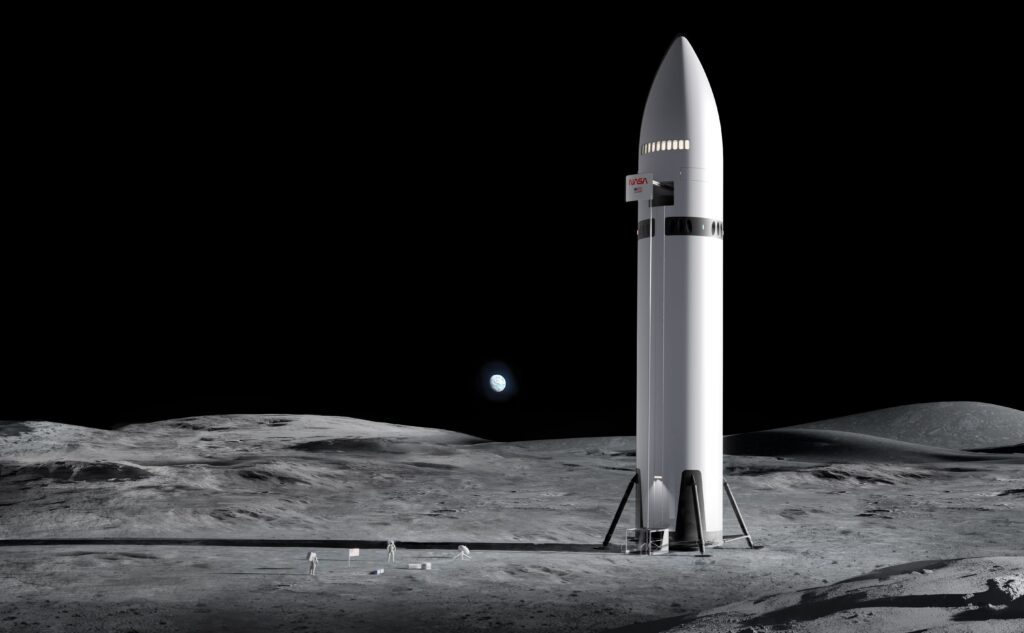

NASA is proposing SpaceX Starship now handles translunar injection (TLI) propulsion and the full landing role, while SLS/Orion is limited to LEO only.
This shrinks Boeing’s role and gives more to SpaceX Starship.
Artemis III (2027) — LEO Docking Test (Almost Unchanged, Now a Perfect Dress Rehearsal)
Before today’s proposal (Feb 27 baseline):
Orion (with 4 astronauts) launches on SLS into LEO. It practices rendezvous, docking, and joint operations with one or both commercial Human Landing Systems (HLS) — SpaceX’s Starship variant and/or Blue Origin’s Blue Moon. Full tests of life support, communications, propulsion, new xEVA suits, and docking procedures. No trip to the Moon. This was explicitly designed as a low-risk “Apollo 9-style” shakedown.
After today’s proposal, It is virtually identical, The LEO docking with Starship is exactly the first step of the new landing architecture. Artemis III becomes the ideal rehearsal for the Earth-orbit rendezvous + Starship TLI that Artemis IV will actually fly. No major hardware changes needed for this mission. It still launches in mid-2027 and remains the risk-reduction flight before any landing attempt.
Artemis IV (2028) — First Crewed Lunar Landing (Biggest Change) OLD PLAN
SLS launches Orion + crew on a direct path toward the Moon (using the Interim Cryogenic Propulsion Stage or similar for TLI to send Orion into a near-rectilinear halo orbit or lunar orbit). A pre-launched, refueled Starship HLS would meet Orion in lunar orbit, crew transfers, Starship descends to the surface (South Pole region), spends ~6–7 days on the Moon, ascends, redocks, and Orion returns the crew to Earth.
Artemis IV (2028 NEW)
Completely chagned.
SLS launches Orion + crew only into LEO (no TLI burn from SLS — that expensive upper-stage role is eliminated).
In LEO, Orion docks with a Starship (the HLS variant, already refueled via Starship tankers if needed).
Starship performs the entire TLI burn, propelling the docked Orion + Starship stack all the way to lunar orbit.
In lunar orbit (now likely a simpler low-lunar orbit instead of NRHO), crew transfers to Starship for landing, surface ops, ascent, redock with Orion, and Earth return.
This cuts costs fpr SLS upper stages, enables more propellant margin, and simplifies the mission.
First landing still targeted for 2028 (possibly early in the year).
Artemis V (Late 2028) — Second Landing (Same New Architecture)
OLD PLAN
Identical to the old Artemis IV profile SLS sends Orion most of the way to the Moon, lunar-orbit docking with a second Starship (or Blue Moon) HLS.
NEW PLAN
Exactly the same new flow as New Artemis IV: SLS → Orion to LEO only.
LEO docking with Starship.
Starship TLI + landing + ascent.
NASA is now aiming for two landings in 2028 (IV and V) and one per year thereafter. The new architecture makes that cadence far more realistic because Starship can be reused/refueled faster than redesigning SLS flights.
Risk reduction, Artemis III now tests the exact docking that IV/V will use.
The plan has been internally approved at NASA. Isaacman is holding a summit this Tuesday (March 25) with SpaceX, Blue Origin, Boeing, and Lockheed Martin to finalize implementation details and acceleration. Formal public confirmation is expected soon after. Starship still needs to demonstrate orbital refueling and human-rating, but the 2027 Artemis III test buys critical time.
Brian Wang is a Futurist Thought Leader and a popular Science blogger with 1 million readers per month. His blog Nextbigfuture.com is ranked #1 Science News Blog. It covers many disruptive technology and trends including Space, Robotics, Artificial Intelligence, Medicine, Anti-aging Biotechnology, and Nanotechnology.
Known for identifying cutting edge technologies, he is currently a Co-Founder of a startup and fundraiser for high potential early-stage companies. He is the Head of Research for Allocations for deep technology investments and an Angel Investor at Space Angels.
A frequent speaker at corporations, he has been a TEDx speaker, a Singularity University speaker and guest at numerous interviews for radio and podcasts. He is open to public speaking and advising engagements.
