

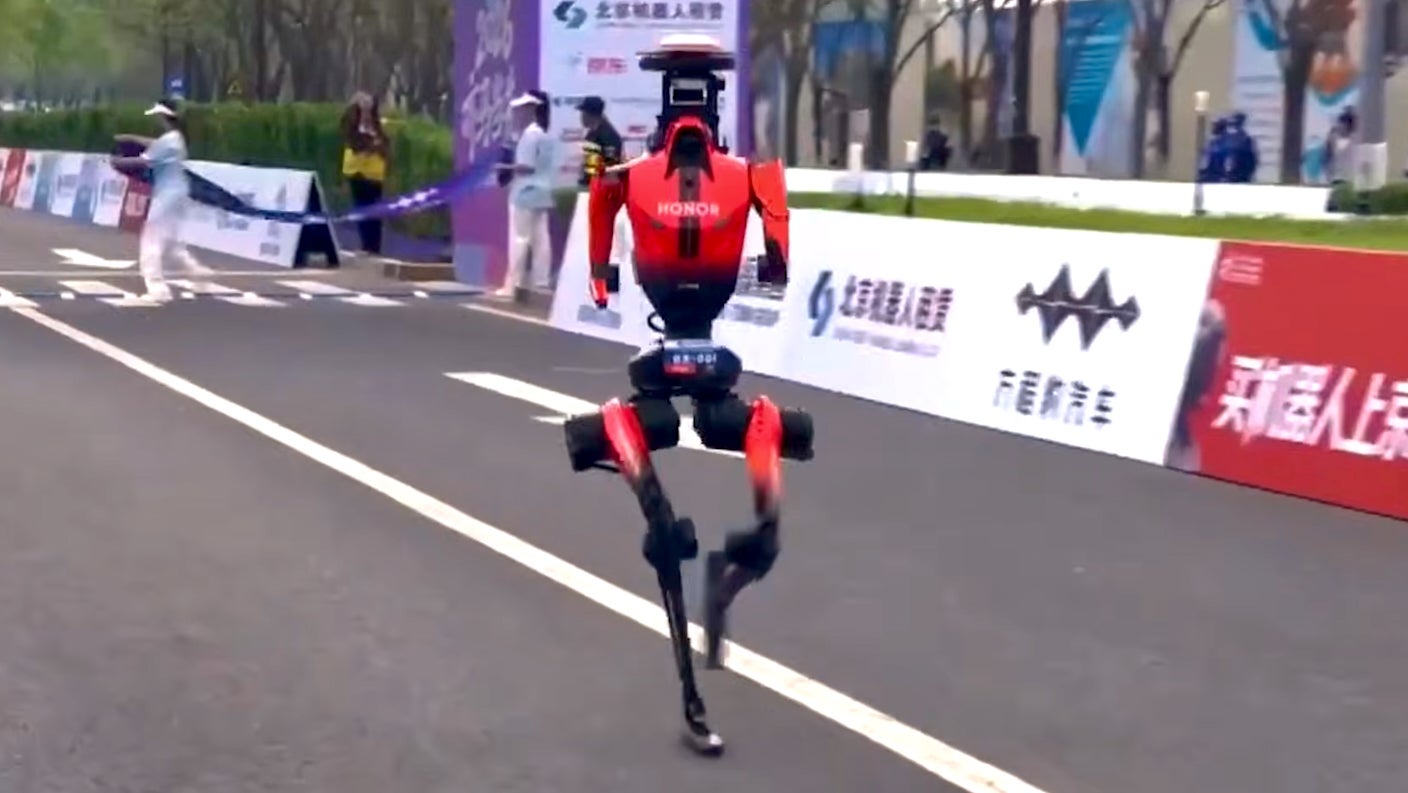

Humanoid robots are Silicon Valley’s latest obsession, but real-world performance has lagged the hype. That may be starting to change, however, after a robot beat the human record for a half marathon by nearly seven minutes in Beijing.
While tech companies around the world are piling into humanoid robots, China has made it a national priority. The government is pouring subsidies and infrastructure investment into the sector, and Chinese firms already account for around 80 percent of the humanoid machines shipped globally, according to the South China Morning Post.
Eager to show off its prowess, China has been staging sporting events for robots, most notably last year’s inaugural World Humanoid Robot Games. Another such event, the Beijing E-Town Half Marathon, pits humanoid robots against thousands of human runners over a 13-mile course. Last year, most of the non-human competitors failed to finish, and the fastest robots managed an unimpressive two hours and 40 minutes.
But this time around, four robots clocked times under an hour. And the winner, made by Chinese smartphone company Honor, registered a record-breaking 50 minutes, 26 seconds, eclipsing the benchmark set by Ugandan long-distance runner Jacob Kiplimo in Lisbon last month.
“Running faster may not seem meaningful at first, but it enables technology transfer, for example, into structural reliability and cooling, and eventually industrial applications,” Du Xiaodi, an engineer on the winning team, told Reuters.
More than 100 teams fielded 300 robots at this year’s event, up from just 21 entries at the inaugural event last year. But Honor, a spinoff from Chinese telecom giant Huawei, dominated the competition, with separate teams from the company taking all three podium spots.
The winning robot, Lightning, navigated the course entirely autonomously. The bot stands 5 feet 6 inches tall but features legs 37 inches long to mimic the physical attributes of elite runners. It also boasts liquid cooling technology used in the company’s smartphones.
The growing sophistication of the robots’ control software is perhaps one of the starkest shifts since last year, with roughly 40 percent of teams operating autonomously. This is particularly impressive given the challenging course, according to Bernstein Research analysts.
“The course included flat sections, slopes, narrow passages, and ~ 20 turns, demonstrating rapid improvement in robots’ intelligence to handle generalized environments in the real world,” they wrote, according to Bloomberg.
But the technology isn’t bulletproof yet. One robot ran into a barricade and had to be carried off on a stretcher. Another veered into a bush after crossing the finish line. And one continued racing with its torso held together by packing tape after a heavy fall.
Nonetheless, the race showcased the rapid progress China’s tech industry is making, particularly in the raw components used to build these machines, like motors, joints, and batteries. Liu Xiangquan, a robotics professor at Beijing Information Science and Technology University told The South China Morning Post that long-distance running is a great test of how well these components can stand up to the kind of repeated strain that will occur in industrial settings.
And that’s likely to cause some consternation in US policy circles, where many see robotics as a key battlefront in the growing technological rivalry between the two superpowers.
Behind Sunday’s spectacle is a higher-stakes contest between China and the US over who will dominate the next generation of humanoids. US robotics firms have been lobbying Washington to draft a national strategy to counter China, which could include tariffs or bans on Chinese robots to help protect domestic producers.
However, running fast in a straight line is a very different challenge than the fine motor control and perception demanded by commercial applications. Experts told Reuters that despite impressive hardware, robotics companies are still a long way from developing the sophisticated software required to put these humanoids to practical use.
Still, these machines struggled to get over the starting line just a year ago. The gap between humanoid robots and human athletes has closed faster than anyone expected, so betting against further rapid progress seems unwise.
