

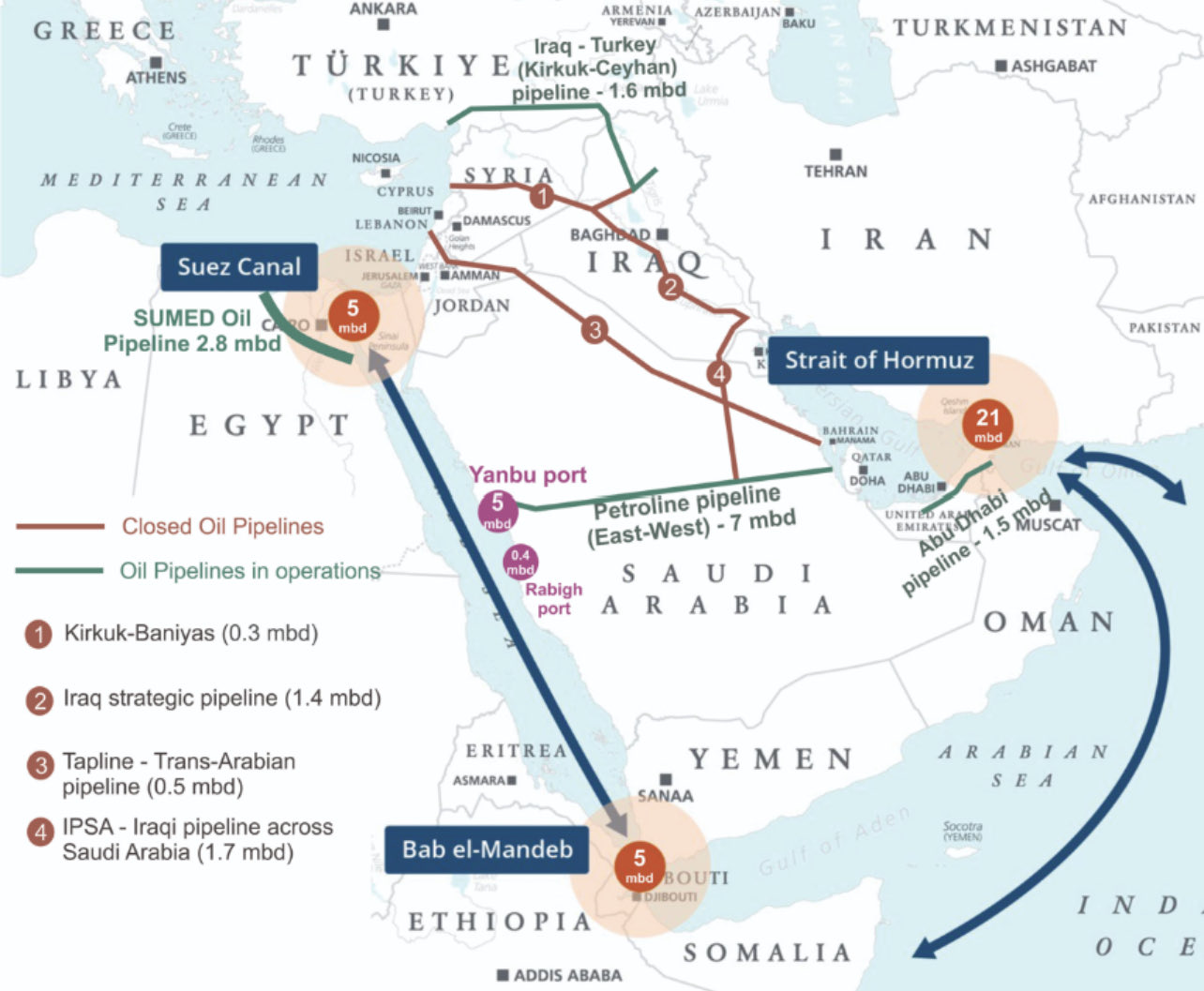

There are three pipelines operating now to take oil around the Hormuz blockage.
The East-West Crude Oil Pipeline (Petroline) in Saudi Arabia, and the UAE’s ADCOP pipeline and the Iraq Kirkuk–Ceyhan (Turkey) Pipeline.
The Iraq Turkey pipelin is at an initial ~250k bpd but could ramp over the next month or two to 400k-650k bpd.
Saudi Yanbu Terminal and Export Optimizations and Minor Petroline Tweaks. This could provide a +0.5–1 mb/d potential export uplift. Terminal and jetty constraints currently limit full pipeline use. This enhances Red Sea access without new builds. There could be continued Gulf field curtailments.
There is early Iraq Basra–Haditha Pipeline Work. Many of the pipelines have fragile politics like revenue sharing issues between Iraq and Kurds.
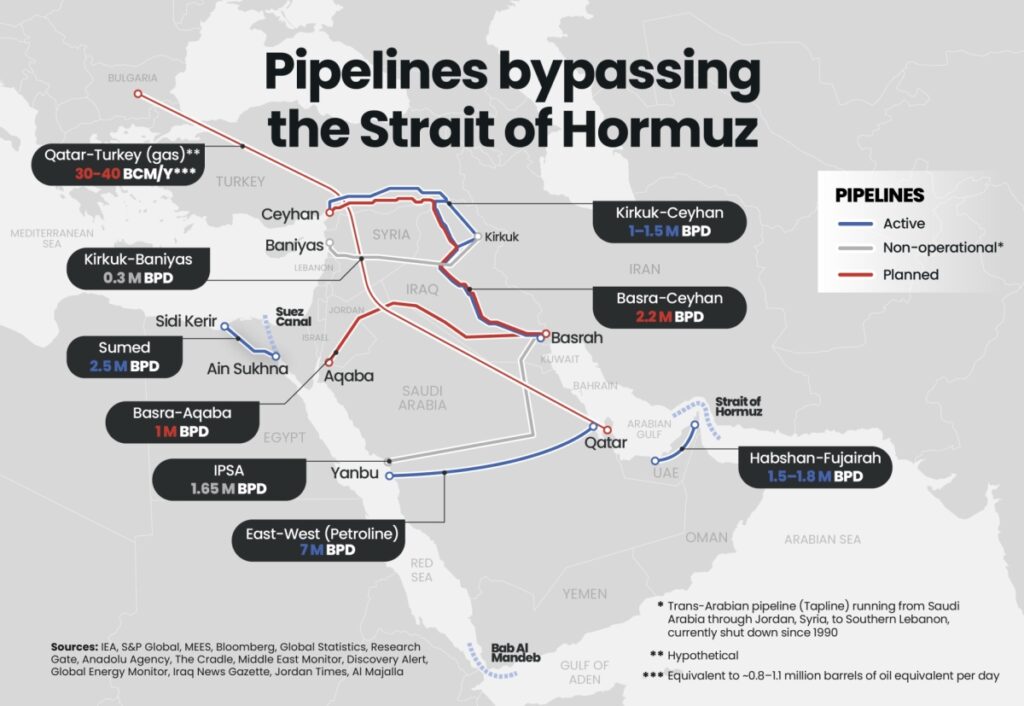
The Iraq Basra–Haditha is in the planning and early construction phase. There are no flows yet but could reach full 2.25–2.5 mb/d planned. There could be late 2026 or early 2027 with some early flows. It will take 1-2 years to get to full production if things go right.
It links southern (Hormuz-locked) Basra fields westward to multiple outlets (Ceyhan, Syria Baniyas, Jordan Aqaba/Red Sea). $1.5B allocated.
UAE ADCOP Expansion is likely happening. This would add +0.5–1+ mb/d (target ~3 mb/d total in combination with existing).
The Iraq Pipeline through Saudi Arabia, known as IPSA was built in the mid-1980s to give Iraq an export route outside the Arabian Gulf risk zone, it ran 1,650km from southern Iraqi oil fields to Yanbu, with a design capacity of 1.65 million bpd. It was closed in 1990 after Iraq’s invasion of Kuwait. There are political and other challenges to restarting.
Broader corridors
The search for alternatives has now widened beyond pipelines. Broader corridors, incorporating rail, road, pipelines, electricity, and data, are designed as systems capable of moving goods and energy without passing through a single maritime chokepoint. One of the more ambitious proposals is the India-Middle East-Europe Economic Corridor (IMEC).
Unloading goods in the Gulf and moving them by rail through Saudi Arabia, Jordan, and Israel to European markets could save 5-7 days compared with shipping routes. More importantly, the corridor offers an overland route for containerised trade that does not depend on either Hormuz or Bab al-Mandeb, the Red Sea chokepoint that became dangerous throughout 2024. The plan also includes electricity cables, a hydrogen pipeline, and high-speed fibre-optic links, making the corridor not just a trade route but an infrastructure spine.
IMEC builds on the long-delayed GCC Railway, a project conceived in 2008 to link all six Gulf Cooperation Council states through a network of national and transnational lines. Originally estimated at $250bn for 2,117km of track, it has missed multiple deadlines. It would likely take until 2030 to complete all lines.
Incremental expansions
In the near term, the most plausible path is likely to be incremental expansion of existing national bypass systems, including expansion of the East-West pipeline within Saudi territory, upgrades to Yanbu terminal capacity, a second ADCOP pipe within the UAE, and the construction of additional storage and bunkering at Fujairah, rather than rapid construction of ambitious new cross-border corridors.
These projects require only domestic decisions and could feasibly deliver results within 3-5 years. They would push the combined bypass ceiling toward 12-13 million bpd, a meaningful improvement on the current 8-8.5 million.
The more ambitious multimodal corridors require changes in politics but the crisis is motivating some of this. The Iraq options could add another 2-3 million bpd.
Brian Wang is a Futurist Thought Leader and a popular Science blogger with 1 million readers per month. His blog Nextbigfuture.com is ranked #1 Science News Blog. It covers many disruptive technology and trends including Space, Robotics, Artificial Intelligence, Medicine, Anti-aging Biotechnology, and Nanotechnology.
Known for identifying cutting edge technologies, he is currently a Co-Founder of a startup and fundraiser for high potential early-stage companies. He is the Head of Research for Allocations for deep technology investments and an Angel Investor at Space Angels.
A frequent speaker at corporations, he has been a TEDx speaker, a Singularity University speaker and guest at numerous interviews for radio and podcasts. He is open to public speaking and advising engagements.
