


Freda Duan estimates XAI Colossus 1 has ~$6B annual rent. Colossus 2 is leasing roughly one-third of its total compute capacity to $Anthropic. I am extending the analysis to renting out one third to one half of the new construction. This does not included distributed compute from Tesla cars, Tesla bots, new servers with Tesla Powerwalls and Tesla Superchargers and then the Space based AI.
That covers:
150,000 H100s
50,000 H200s
30,000 GB200s
Separately, $Anthropic’s total payment to $SpaceX is $15B per year, based on the SpaceX S-1 “$1.25B per month through May 2029, with capacity ramping in May and June 2026 at a reduced fee.”
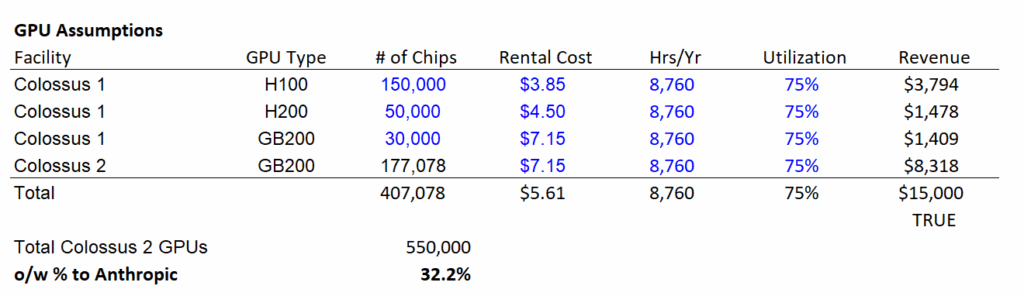
This implies the payment attributable to Colossus 2 would be roughly $9B per year.
Assuming a price of $6/hour, that would imply $Anthropic is renting approximately 150,000–200,000 GB200-equivalent.
For context, Colossus 2’s total target capacity is reportedly 550,000 GB200/GB300s and 1.5GW of power.
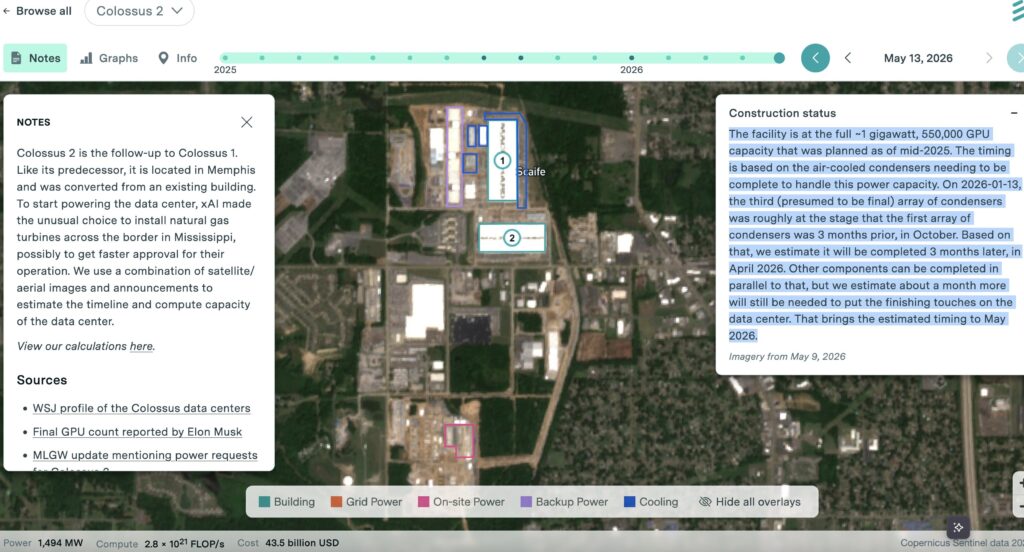
Colossus 2e facility is at the full ~1 gigawatt, 550,000 GPU capacity that was planned as of mid-2025. The timing is based on the air-cooled condensers needing to be complete to handle this power capacity. On 2026-01-13, the third (presumed to be final) array of condensers was roughly at the stage that the first array of condensers was 3 months prior, in October. Based on that, it is estimated it will be completed 3 months later, in April 2026. Other components can be completed in parallel to that, but we estimate about a month more will still be needed to put the finishing touches on the data center. That brings the estimated timing to May 2026.
It cost about $7 billion to build Colossus 1 and one third of Colossus 2 is $14.5 billion. The rent of $15 billion per year is about 17 month ROIC.
Rough guesstimates based on public information:
Using the numbers below, Colossus 1 = ~$6B annual rent.
That covers:
150,000 H100s
50,000 H200s
30,000 GB200sSeparately, $Anthropic’s total payment to $SpaceX is $15B per year, based on the SpaceX S-1 “$1.25B per month through… https://t.co/TC8zL4OJsC
— Freda Duan (@FredaDuan) May 21, 2026
xAI can scale additional data center capacity (to rent out half or one-third profitably) extremely quickly—likely adding full Colossus-scale clusters (hundreds of thousands of GB200/GB300-equivalent GPUs) every 4–12 months in parallel, with new rental revenue flowing within 6–9 months of starting construction on a new site. This is based on their proven execution speed, brownfield repurposing strategy, on-site gas turbine power, and the economics you outlined (17-month ROIC at full utilization, $6/hour rental pricing, and partial rental covering costs +
XAI already scaled this across sites. The third building (MACROHARDRR in Southaven, MS) is converting now for ~2 GW total campus capacity.
They could have another ~550k GPU (or equivalent) tranche online by late 2026–Q1 2027 (4–9 months from now). The third building is already in conversion; similar new sites could follow the same pattern.
Multiple in parallel- xAI is on track for 1M+ GPUs total by late 2026 (per their roadmap and independent projections). They could stand up 1–2 additional Colossus-scale facilities per year while renting half/one-third of the incremental capacity.

ROIC remains excellent even at partial rental. The 17-month full payback → ~4-year payback at ⅓ rental, but positive cash flow from day one on new tranches because opex is low and power is solved on-site.
Margins are 65–80% net after everything. Cheap gas-turbine power + massive scale keep costs down. Rentals cover capex for the next buildouts.
Risks upside. GPU supply is the only real constraint (xAI has strong NVIDIA ties). Demand for rental is proven (Anthropic deal) and growing. If they rent more than ½ of incremental, numbers go higher.
By renting just ⅓–½ of new capacity, xAI turns its compute scaling into a $30–80B+/year high-margin rental business by 2028 (on top of Grok’s own value).
Brian Wang is a Futurist Thought Leader and a popular Science blogger with 1 million readers per month. His blog Nextbigfuture.com is ranked #1 Science News Blog. It covers many disruptive technology and trends including Space, Robotics, Artificial Intelligence, Medicine, Anti-aging Biotechnology, and Nanotechnology.
Known for identifying cutting edge technologies, he is currently a Co-Founder of a startup and fundraiser for high potential early-stage companies. He is the Head of Research for Allocations for deep technology investments and an Angel Investor at Space Angels.
A frequent speaker at corporations, he has been a TEDx speaker, a Singularity University speaker and guest at numerous interviews for radio and podcasts. He is open to public speaking and advising engagements.
