


In order to understand the addressable market case for many of the AI and space markets you must understand replatforming. Replatforming is when a fundamentally better technology platform displaces or layers on top of the old infrastructure and business models. It wins because it offers lower costs, vastly better scalability, broader accessibility, and new capabilities that incumbents can’t match. The old guard either adapts slowly or gets marginalized while the new platform explodes the total market.
Historical Examples
PCs replatforming minicomputers and mainframes (1980s–2000s). Mainframes and minis were centralized, extremely expensive, and required specialized rooms/operators. PCs started as personal tools but, combined with networking and client-server architectures, decentralized computing. They handled most everyday workloads cheaper and faster. Mainframes didn’t disappear entirely but the primary computing platform shifted to distributed x86/PCs + servers. This created the PC/software ecosystem we still live in. Later internet and smartphones layered onto the PC paradigm.
Apple (iPhone) displacing Nokia and BlackBerry (2007+). Nokia dominated feature phones and early smartphones. BlackBerry owned enterprise email. The iPhone introduced the modern smartphone platform — full touchscreen internet, App Store, rich media, and app economy. It wasn’t just a better phone. It replatformed mobile from voice/SMS-centric devices to pocket computers. Nokia and BlackBerry’s market shares collapsed in ~5 years. The new platform created entirely new multi-trillion-dollar markets (apps, mobile advertising, cloud services, etc.).
Starlink Replatforming Global Connectivity
SpaceX/Starlink is already changing broadband and mobile infrastructure (fiber, cable, DSL, cell towers). Instead of building out expensive ground networks Starlink uses a massive low-Earth-orbit satellite constellation. It delivers high-speed, low-latency internet anywhere with far lower marginal cost once the sats are up. April 2026, Current scale Starlink broadband is already serving ~11 million paying customers.
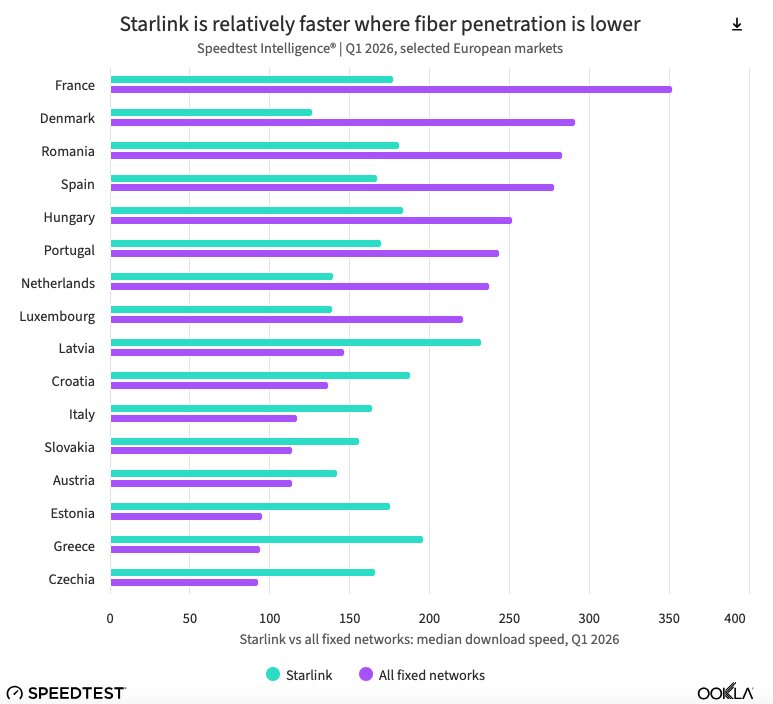
Speedtest data across 27 European markets shows where Starlink LEO broadband is gaining ground where fiber, cable, and fixed wireless still leave gaps. Starlink got faster in most European markets. Starlink’s median download speed across all 27 countries rose from 114.05 Mbps in Q1 2025 to 165.71 Mbps in Q1 2026, up 45%. Download speed improved in 26 of the 27 markets. Usage is most visible where fixed broadband leaves more gaps. Bulgaria had the highest Starlink Speedtest sample share at 8%, followed by Greece and Croatia at 6% each, Ireland and Latvia at 4% each. Starlink was faster than the average fixed network on median download speed in 11 of 27 markets, but fixed networks had lower latency in every market and stronger upload performance in 26.
Starlink is multiplying its satellite constellation and shifting to V3 satellites will increase the Terabit per second capacity from 700 Tbps now with 10,000 mostly V2 mini to 20,000 V3 satellites with 20,000 Tbps. The power flux density will increase another 4-8 times which will also increase capacity several times. More satellites will be reachable by each customer.
Greece is the clearest example of Starlink filling a gap while terrestrial upgrades continue. Starlink recorded a median download speed of 196.31 Mbps in Q1 2026, compared with the national median of 94.29 Mbps across all fixed networks. Greece also had the second-highest Starlink sample share at 6%.
Across the 27 measured markets combined, Starlink’s median speed in Q1 2026 was 165.71 Mbps on download, 24.10 Mbps on upload, and 49 ms on multi-server latency.
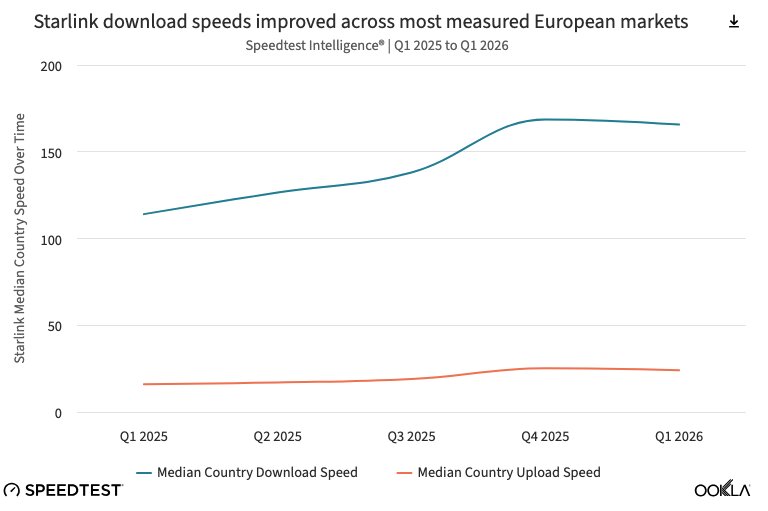
Tripling download speeds will get Starlink more market share.
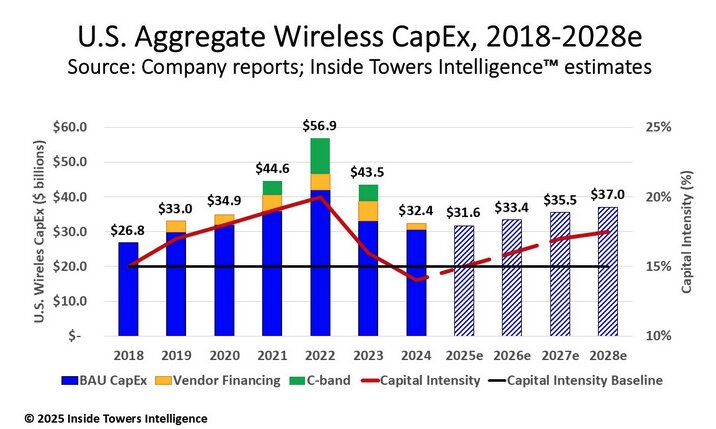
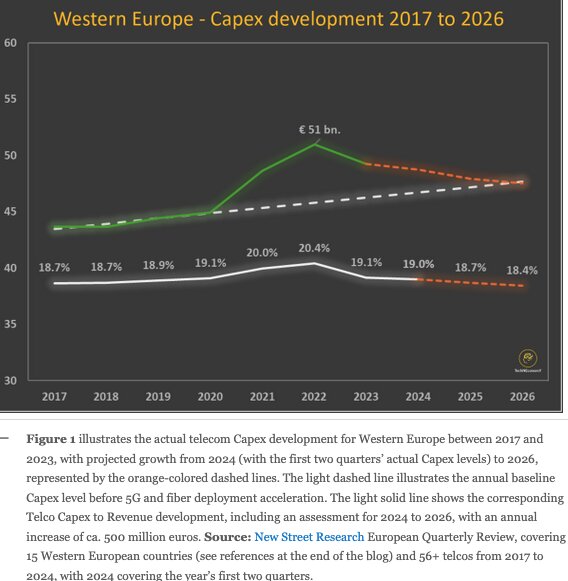
Starlink’s model front-loads CAPEX into satellites/launches but enables dynamic global coverage while cell towers require site-by-site builds. There is a global untapped rural broadband aand mobility market of at least ~$200 billion per year. North America (US) celltower costs is ~$275k–$333k per new rural site. Covering US unserved roads would need ~37,500 new towers at $12.5B total upfront. There is also the capex of fiber and cable deployments.
Less than 400 Starship launches would deploy 20,000 V3 satellites and another 250 or so would deploy 15,000 DTC V3 satellites. 600 launches at $10 million or less per launch is $6 billion. the V3 satellites will cost about $30 billion or less. Each V3 satellite has ~10× the capacity of V2-mini (roughly 1 Tbps downlink).
Total potential annual displaced Capex, Open across North america, Europe and Asia is $50-100B+ per year for fiber and other buildout. This will be conservative. Higher if penetration hits upper end and includes more suburban in-fill. Global mobile infrastructure (towers + related) exceeds $300B annual Capex+Opex. Rural and suburban share is the least efficient and most displaceable and replaceable. The replacement and replatforming has already started.
Starlink Mobile (direct-to-cell / DTC)
The existing ~650 V2-mini DTC satellites is already serving millions of unique devices.
Starship enables 2–3× more internet satellites deployed per launch window and ~20× more capacity per launch overall.
V3 DTC version will have ~20× more satellites and ~40× bandwidth versus current V2-mini DTC.
V3 will deliver true 5G-level performance directly to phones in rural and suburban areas. This removes the need for ~80% of traditional cell towers. (no more massive capex on ground infrastructure). Total potential annual displaced Capex, Open across North america, Europe and Asia is $50-100B+ per year. This will be conservative. Higher if penetration hits upper end and includes more suburban in-fill. Global mobile infrastructure exceeds $300B annual Capex+Opex.
Orbital constellation vs. ground-based towers/fiber
Starlink’s advantages (ubiquitous coverage, rapid global scaling via reusable Starship launches, lower long-term costs) let it serve the unserved/underserved while undercutting or replacing legacy telco economics in many places.The TAMs Cited by SpaceX (from their recent S-1 IPO filing)
Total addressable markets (TAMs)
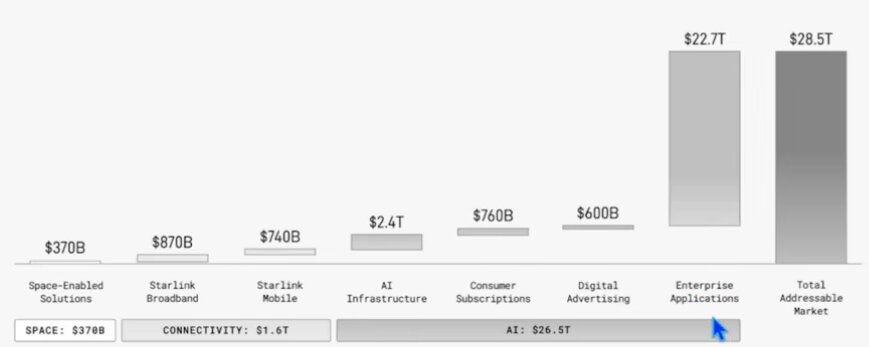
Starlink can go after Space-Enabled Solutions is $370B per year for launch. SpaceX already has 80% of launch payload and will go to 99% with Starship.
Connectivity (Starlink Broadband $870B + Starlink Mobile $740B) = $1.6T Getting to a large fraction up from 4-8% in many market now will go to 20-50% with increased V3 capacity.
There will be V4 and V5 satellites totaling 100,000+. This will enable another 10-50X in system capacity.
AI Infrastructure $2.4T per year is the total demand for AI data centers. This is being built and out and XAI has built two data centers so far. They are competing with Amazon also at $15 billion per year in AI data center run rate and Microsoft at $37 billion per year in AI data center runrate. XAI already has $15 billion per year of this market.
Consumer Subscriptions $760B + Digital Advertising $600B. Those market also already exist and XAI is already serving about $2 billion per year in ads and $1 billion in subscriptions. XAI will go to 5-10X as many customers when the Starlink internet and direct to cellphone businesses reach billions of customers. They will be able to head towards Meta levels of ad revenue.
Enterprise Applications $22.7T = $26.5T
Grand Total TAM: $28.5T
How Many Customers + What ARPU Are Needed to Hit Those Connectivity TAMs?
These are addressable market sizes (annual revenue potential), not what SpaceX will capture 100% of. What is needed to hit the TAMs?
Starlink Broadband — $870B TAM
At ~$70/month ARPU (≈ $840/year) → ~1.04 billion customers
At ~$100/month ARPU (premium/higher-speed plans) → ~725 million customers
At ~$50/month ARPU (international/emerging-market plans) → ~1.45 billion customers
Current global fixed broadband subscribers are heading toward ~1.4–1.5 billion by 2030 in major markets. Starlink’s V3 capacity explosion + rural/global reach makes capturing hundreds of millions to low billions realistic over time. Later V4 and V5 capacity expansion. Technology of the satellites keeps getting upgraded. New satellites each year. 20-30% of the capacity replaced, added or upgraded each year.
Starlink Mobile (DTC) — $740B TAM
Mobile ARPU is typically lower (often an add-on or lower-tier data plan)
At ~$20/month → ~3.08 billion users
At ~$40/month → ~1.54 billion users
At very low ~$8–10/month (emerging-market incremental data) → even larger user bases (global mobile users already >5 billion).
Current Starlink broadband ARPU has declined to the $66–81/month range as international and lower-priced plans scale. Replatforming volume drives prices down while total revenue explodes.
Enterprise Applications $22.7T is where digital Optimus and next generation Grok and Cursor comes in. Tesla’s humanoid robots (Optimus) + AI create physical/digital workers that expand enterprise software, automation, integration, and services markets far beyond today’s SaaS. Starlink connectivity + AI infra + Optimus = a new enterprise platform.

Brian Wang is a Futurist Thought Leader and a popular Science blogger with 1 million readers per month. His blog Nextbigfuture.com is ranked #1 Science News Blog. It covers many disruptive technology and trends including Space, Robotics, Artificial Intelligence, Medicine, Anti-aging Biotechnology, and Nanotechnology.
Known for identifying cutting edge technologies, he is currently a Co-Founder of a startup and fundraiser for high potential early-stage companies. He is the Head of Research for Allocations for deep technology investments and an Angel Investor at Space Angels.
A frequent speaker at corporations, he has been a TEDx speaker, a Singularity University speaker and guest at numerous interviews for radio and podcasts. He is open to public speaking and advising engagements.
