

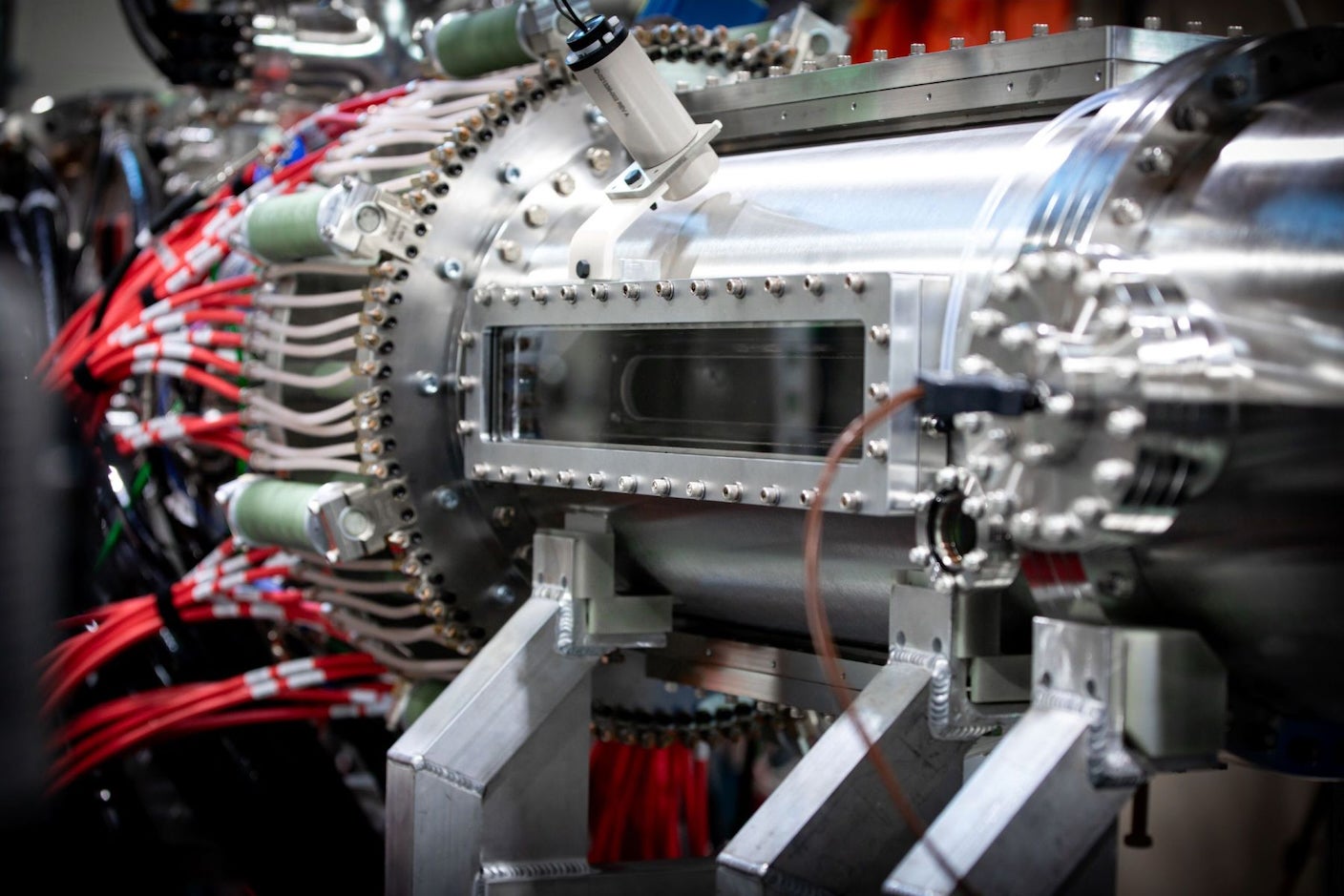

A host of startups are racing to achieve commercial fusion power. Zap Energy just drew a line in the sand after announcing its latest device recorded the highest-ever plasma pressures for its particular class of reactors.
Getting atoms to fuse typically requires you to subject an ionized gas, known as a plasma, to extreme heat and pressure. This normally involves massive rings of powerful magnets or enormous laser arrays. But Zap Energy is pursuing a novel approach known as a sheared-flow-stabilized Z-pinch configuration, which uses electrical currents to compress and heat the fuel.
The company says this should make its devices much smaller and cheaper than competitors, but the technology is considerably less mature than other leading fusion reactor designs. Now, though, the company has achieved plasma pressures of 1.6 gigapascals—roughly 10,000 times atmospheric pressure at sea level—in a machine only 12 feet long, a record for a sheared-flow Z-pinch system and a major step toward commercialization, according to the company.
“This was a major effort by the team that was successful because of a tightly coupled cycle of theoretical predictions, computational modeling, rapid build and test engineering, experimental validation, and measurement expertise,” Ben Levitt, vice president of research and development at Zap, said in a press release.
“With a smaller system we have the benefit of being able to move quickly, and achieving these results in systems that are a fraction of the size and cost of fusion devices of comparable performance is a big part of what makes this such a significant accomplishment.”
The idea behind Zap’s reactor design is surprisingly simple. Like most fusion systems, it uses special hydrogen isotopes as fuel. These are contained as gas in a thin tube at the reactor’s heart. The machine fires a massive electrical current through this gas, superheating and turning it into a plasma.
The electrical current also creates a powerful magnetic field that squeezes the plasma—a phenomenon known as a Z-pinch—and generates extremely high pressures in a small area. In theory, with careful design and high enough currents, this should generate the conditions for fusion.
The process is actually a little more complicated in reality. Zap’s reactor first uses electrical current to accelerate the plasma along the length of the tube, which helps stabilize it. When the plasma reaches the cone-shaped end of the tube, the magnetic field squeezes it into a Z-pinch.
Zap’s recent record-breaking pressure was thanks to a new design separating the processes of accelerating and compressing the plasma. Earlier devices used two electrodes to deliver current to the reactor. These achieved good levels of heating but didn’t allow the team to hit the high pressures they were targeting.
The new FuZE-3 system incorporates a third electrode, which makes it possible to deliver two power pulses rather than just one, spokesperson Andy Freeborn told TechCrunch. The company says this new setup allows them to independently control plasma acceleration and compression—key to achieving the latest record-breaking results.
Generating useful power from fusion reactions requires a careful balance between plasma density, temperature, and confinement time. Zap says their approach represents a middle-ground, aiming for relatively high pressures and reasonably long confinement times.
However, TechCrunch notes that Zap believes it will have to boost plasma pressures at least tenfold before it hits scientific breakeven—the point where energy created by the reaction outweighs the amount required to kickstart it.
Scientific breakeven doesn’t account for the energy use of supporting infrastructure or the ability to extract energy from the reaction, so even this is only a stepping stone towards commercial viability.
Nonetheless, Zap is powering ahead with work on a next-generation device, due to come online this winter even as FuZE-3 tests are ongoing. Given the huge uncertainties around the feasibility and timelines of different fusion approaches, the more people driving progress in this field the better.
