


Format wars have been going on since the beginning of the home theater industry. Most people are aware of the battle between VHS and Betamax, but there have been many, many similar rivalries over the years, all in the name of becoming the de facto product customers have to turn to, and other electronics firms have to license. There was even a brief time when you could buy an HD DVD player for your Xbox 360 — which, in retrospect, was a futile attempt to challenge Blu-ray when attempts at an industry-wide standard failed.
One of the newest challengers is Eclipsa Audio, a 3D surround sound format created in collaboration between Samsung and Google. But how does it differ from Dolby Atmos, which is the most prevalent 3D audio format? Should you consider investing in Eclipsa-ready hardware? Not yet, probably — but it may be too early to count Eclipsa out of the fight. You’ll see what I mean towards the end.
Dolby Atmos vs Eclipsa Audio: The similarities
Swimming in an ocean of sound

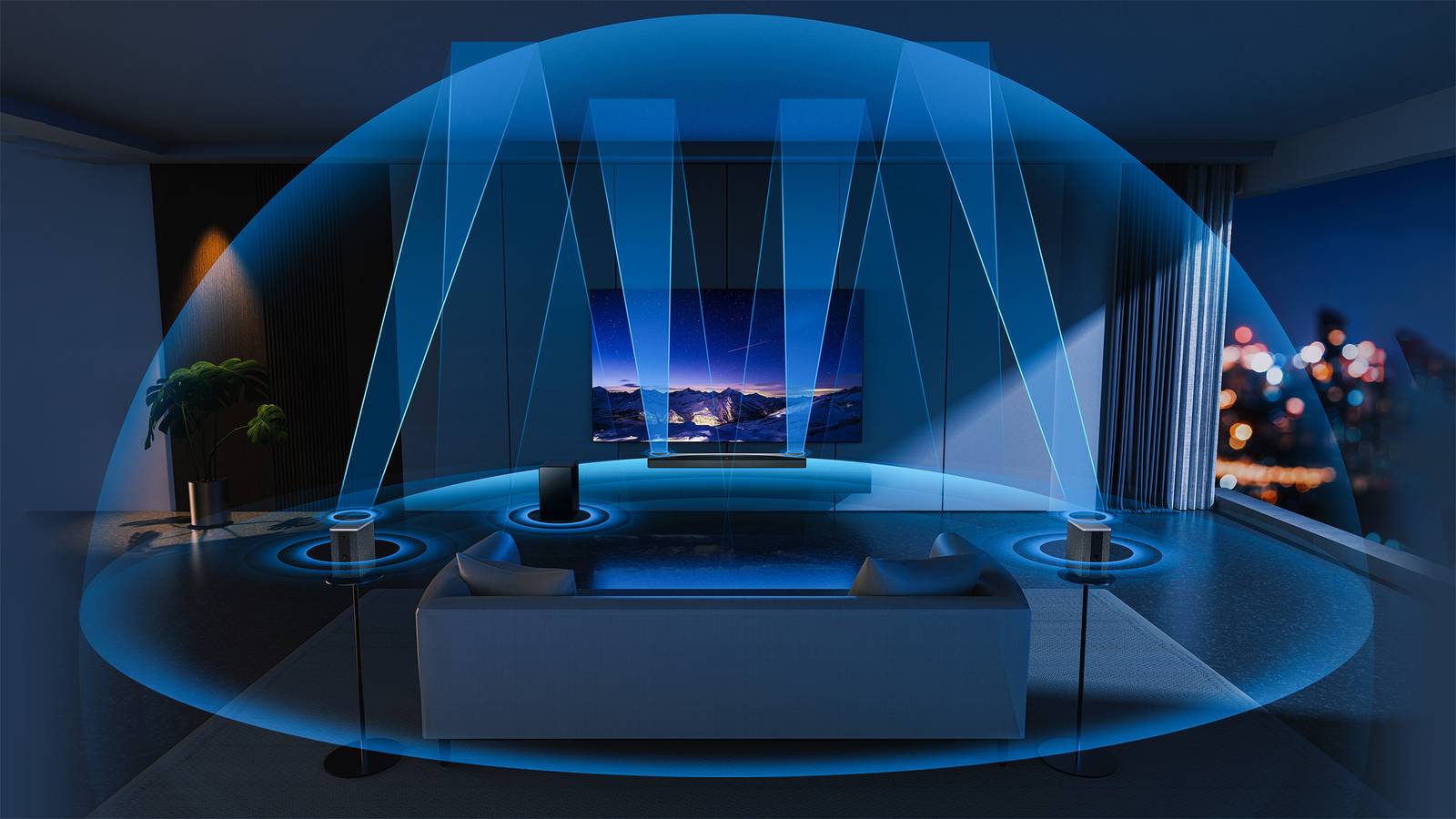
Both Atmos and Eclipsa simulate audio “objects” in fully 3D space, allowing them to not just rise or sink, but appear to come from very specific directions. That differs from older standards such as Dolby Surround, which are limited to the horizontal plane, and panning less defined sounds between channels. Either Atmos or Eclipsa can bounce sounds off your ceiling to simulate height if, like most people, you don’t have ceiling-mounted satellite speakers. Likewise, there are scaled-back versions if you’re wearing headphones and need to rely entirely on digital trickery.
Audio isn’t magically converted into 3D. Engineers have to mix sound specifically for the two formats, which can be processed only by compatible hardware and software. In other words, it hardly matters that you have an Atmos/Eclipsa-ready TV if your speakers don’t support it, and/or the creators behind a movie, album, or TV show mix it for other formats instead. Every part of the chain has to be enabled, or at least let it pass through.
Both Atmos and Eclipsa simulate audio “objects” in fully 3D space, allowing them to not just rise or sink, but appear to come from very specific directions.
In a home setting, Atmos can theoretically support as many as 34 channels and up to 128 sound objects. It’s not quite clear what the ceiling on Eclipsa is, but Samsung and Google did recently announced Eclipsa Audio 2.0, which removes an earlier 28-channel cap. This will, of course, be academic for most home theater owners, who are lucky to have a 7.1-channel configuration. Indeed, Atmos requires an AV receiver to reach any more than seven speakers at once.
Another parallel is that both formats require certification. Dolby handles all Atmos product certification, while Eclipsa is managed by HDR10+ LLC and the Telecommunications Technology Association.
So what are the differences between Dolby Atmos and Eclipsa Audio?
Nothing personal, strictly business

Really, the major difference is this: Eclipsa is open-source. While compatible products might need certification, there’s no need for anyone to pay licensing fees, which is obviously hugely attractive to companies already paying for the rights to other standards. Conversely, the bulk of Dolby’s revenue comes from licensing, covering not just audio formats but also Dolby Vision for video. If a device maker or service provider doesn’t pay up, they can’t use Dolby technology.
Presumably, Samsung and Google are hoping that Eclipsa will catch on to the extent that they (and other companies) will be less reliant on Dolby. It’s worth noting that Google doesn’t support Atmos on Pixel devices, preferring its own spatial audio technology instead. Samsung does support Atmos on many of its TVs and speakers, but intentionally excludes Dolby Vision from its TVs, opting for HDR10 and 10+.
You won’t really find Eclipsa on services other than YouTube, and hardware compatibility is extremely limited so far.
Another unique aspect is that while Atmos is a broad standard supported across many avenues of music, movies, games, and TV, Eclipsa is heavily geared towards independent video makers on YouTube. It is, naturally, a little cost prohibitive for most YouTube creators to pay for anything from Dolby, so Eclipsa should in theory give them the chance to deliver more impressive sound mixes that compete with what you might hear on Netflix or HBO Max.
Support is Eclipsa’s major obstacle at the moment, however. You won’t really find Eclipsa on services other than YouTube, and hardware compatibility is extremely limited so far, mostly on some Samsung TVs and Harman audio systems — Harman being a Samsung subsidiary. Recent improvements to the certification process should see this grow, but today, even Android phones and Google TVs don’t support Eclipsa, whereas it’s almost difficult to find examples of either without Atmos.
Atmos is so widely available that it’s essentially the default for 3D audio. Even DTS has struggled to gain much traction for its DTS:X format — the only major US streaming service to back it is Disney+, although some purchases on Amazon Prime Video may be compatible. If you want to sample DTS:X, your best bet is Disney’s IMAX Enhanced collection.
What are the prospects for Eclipsa Audio?
Off to a dead crawl

Honestly, were you to consider the situation purely as-is, Eclipsa’s odds might seem grim. YouTube is very popular, but it’s not enough to prop up an audio format on its own, much less with compatible hardware coming from a single entity. There isn’t even much Eclipsa content on YouTube, yet — none of my favorite channels are using it, and a quick search turns up scarce test material. I’m tempted to call it dead on arrival.
Things aren’t that simple, though. Samsung and Google are gigantic corporations that can afford to take their time and have every incentive to do so. While Dolby doesn’t publish the values of its licensing deals, its biggest clients are liable to be worth many millions of dollars every year. So even if Eclipsa takes five years to spread to other hardware and streaming platforms, it’ll be worth it for its backers in the long run, potentially saving them hundreds of millions they could put towards other interests. There’s less worry about intellectual control, too — they can introduce 3D surround to whatever product they like, whenever they like.
If you’re going to do 3D audio at all, focus on Dolby Atmos — it’s your best bet for the movies, shows, and albums you already enjoy.
Also, since the certification program for Eclipsa has only recently been streamlined, it’s possible that we’re on the verge of an explosion in compatibility. I’m skeptical, personally — yet with no licensing fees, the barrier to entry is pretty low. Samsung claims that it already has third parties expressing interest. Whether they’ll make that official is another matter.
As a consumer, I wouldn’t bother spending any money on Eclipsa until the situation changes. If you’re going to do 3D audio at all, focus on Dolby Atmos — it’s your best bet for the movies, shows, and albums you already enjoy. Keep tabs on Eclipsa only if you’re a fan of YouTube and open-source standards.
