


As prominent artificial intelligence researchers eye limits to the current phase of the technology, a different approach is gaining attention: using living human brain cells as computational hardware.
These “biocomputers” are still in their early days. They can play simple games such as Pong, and perform basic speech recognition.
But the excitement is fueled by three converging trends.
First, venture capital is flowing into anything adjacent to AI, making speculative ideas suddenly fundable. Second, techniques for growing brain tissue outside the body have matured with the pharmaceutical industry jumping on board. Third, rapid advances in brain–computer interfaces have seen growing acceptance of technologies that blur the line between biology and machines.
But plenty of questions remain. Are we witnessing genuine breakthroughs, or another round of tech-driven hype? And what ethical questions arise when human brain tissue becomes a computational component?
What the Technology Actually Is
For almost 50 years, neuroscientists have grown neurons on arrays of tiny electrodes to study how they fire under controlled conditions.

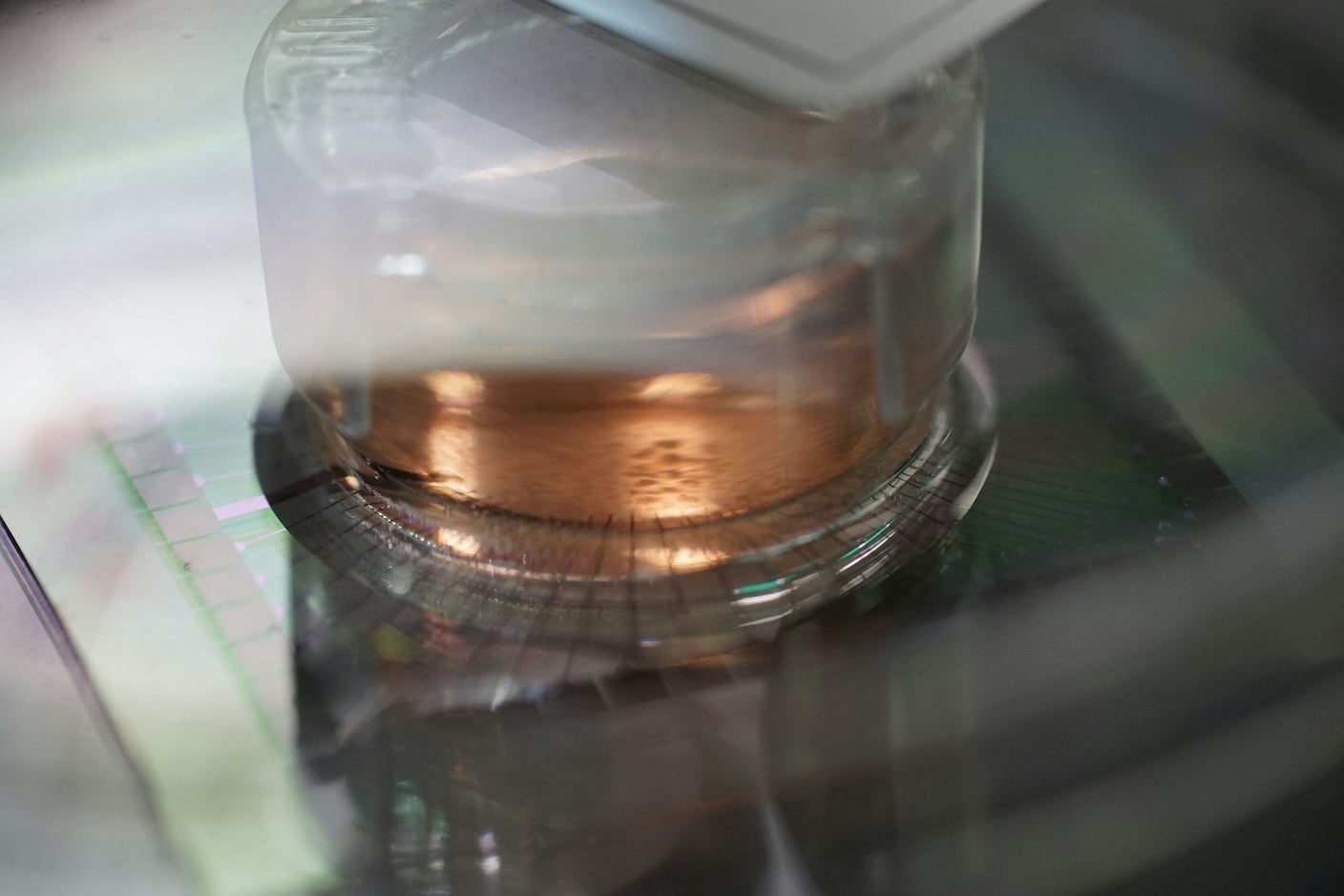
A newly fabricated microelectrode array. Bram Servais
By the early 2000s, researchers attempted rudimentary two-way communication between neurons and electrodes, planting the first seeds of a bio-hybrid computer. But progress stalled until another strand of research took off: brain organoids.
In 2013, scientists demonstrated that stem cells could self-organize into three-dimensional brain-like structures. These organoids spread rapidly through biomedical research, increasingly aided by “organ-on-a-chip” devices designed to mimic aspects of human physiology outside the body.
Today, using stem cell-derived neural tissue is commonplace—from drug testing to developmental research. Yet the neural activity in these models remains primitive, far from the organized firing patterns that underpin cognition or consciousness in a real brain.
While complex network behavior is beginning to emerge even without much external stimulation, experts generally agree that current organoids are not conscious, nor close to it.
‘Organoid Intelligence’
The field entered a new phase in 2022, when Melbourne-based Cortical Labs published a high-profile study showing cultured neurons learning to play Pong in a closed-loop system.
The paper drew intense media attention—less for the experiment itself than for its use of the phrase “embodied sentience.” Many neuroscientists said the language overstated the system’s capabilities, arguing it was misleading or ethically careless.
A year later, a consortium of researchers introduced the broader term “organoid intelligence.” This is catchy and media-friendly, but it risks implying parity with artificial intelligence systems, despite the vast gap between them.
Ethical debates have also lagged behind the technology. Most bioethics frameworks focus on brain organoids as biomedical tools—not as components of biohybrid computing systems.
Leading organoid researchers have called for urgent updates to ethics guidelines, noting that rapid research development, and even commercialization, is outpacing governance.
Meanwhile, despite front-page news in Nature, many people remain unclear about what a “living computer” actually is.
A Fast-Moving Research and Commercial Landscape
Companies and academic groups in the United States, Switzerland, China, and Australia are racing to build biohybrid computing platforms.
Swiss company FinalSpark already offers remote access to its neural organoids. Cortical Labs is preparing to ship a desktop biocomputer called CL1. Both expect customers well beyond the pharmaceutical industry—including AI researchers looking for new kinds of computing systems.
Academic aspirations are rising too. A team at UC San Diego has ambitiously proposed using organoid-based systems to predict oil spill trajectories in the Amazon by 2028.
The coming years will determine whether organoid intelligence transforms computing or becomes a short-lived curiosity. At present, claims of intelligence or consciousness are unsupported. Today’s systems display only simple capacity to respond and adapt, not anything resembling higher cognition.
More immediate work focuses on consistently reproducing prototype systems, scaling them up, and finding practical uses for the technology.
Several teams are exploring organoids as an alternative to animal models in neuroscience and toxicology.
One group has proposed a framework for testing how chemicals affect early brain development. Other studies show improved prediction of epilepsy-related brain activity using neurons and electronic systems. These applications are incremental, but plausible.
Small Systems, Big Questions
Much of what makes the field compelling—and unsettling—is the broader context.
As billionaires such as Elon Musk pursue neural implants and transhumanist visions, organoid intelligence prompts deep questions.
What counts as intelligence? When, if ever, might a network of human cells deserve moral consideration? And how should society regulate biological systems that behave, in limited ways, like tiny computers?
The technology is still in its infancy. But its trajectory suggests that conversations about consciousness, personhood, and the ethics of mixing living tissue with machines may become pressing far sooner than expected.
Disclosure statement: Bram Servais formerly worked for Cortical Labs but holds no shared patents or stock and has severed all financial ties.
This article is republished from The Conversation under a Creative Commons license. Read the original article.
