


Nicole Kagan, Head of Research at Kalshi, with hosts Nick and Sam) sees Kalshi’s CFTC-regulated prediction markets as emerging financial instruments that can revolutionize risk hedging across finance, insurance, and beyond. Event contracts (binary Yes/No payouts on real-world outcomes) are tools to financialize uncertainty and turn discrete risks like macroeconomic data releases, policy changes, cultural events, or industry-specific triggers into tradable, hedgeable assets.
Key Takeaways Relevant to Future Financial Instruments & Risk Hedging
Fed Study Spotlight. Finance and Economics Discussion Series
Federal Reserve Board, Kalshi and the Rise of Macro Markets Anthony M. Diercks, Jared Dean Katz, and Jonathan H. Wright.
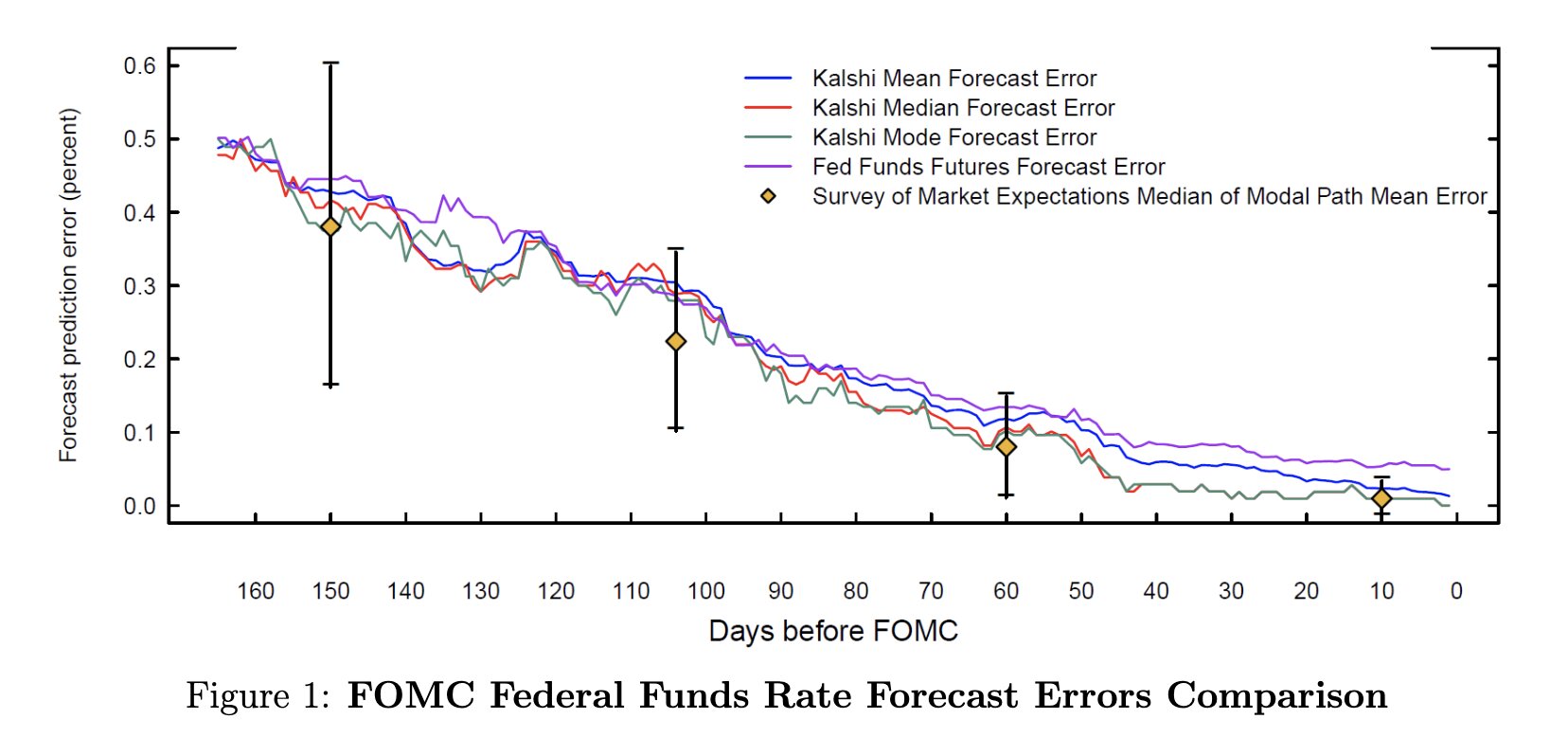
Kalshi’s macro prediction markets (on CPI inflation, unemployment, payrolls, GDP, Fed rate decisions) outperform or match traditional consensus forecasts (Bloomberg surveys, Blue Chip, Fed funds futures) in accuracy, with advantages in high-frequency, real-time updates and full probability distributions. This is highlighted as Kalshi Beats Consensus.
Massive TAM via Event Hedging: Prediction markets unlock new hedging opportunities for risks not easily covered by traditional derivatives or insurance (e.g., regulatory shifts, weather extremes, corporate events, or macro surprises). This creates a vast total addressable market for entrepreneurs, investors, corporations, governments, and insurers.
Scale Drivers: Institutional participation (liquidity providers like Citadel, Susquehanna, Two Sigma), margin requirements, and access via brokerages (Robinhood, Webull) drive liquidity and professional adoption. Zero-fee structures and rebates further boost trading volume.
Regulatory Legitimacy: Fully CFTC-regulated as a Designated Contract Market (same category as major futures exchanges), with strict rules users must follow—positioning these as legitimate risk-management tools, not gambling.
Tech Integration: AI is discussed for enhanced reasoning, trial forecasting, and better market design.
Finance & Insurance Applications: Contracts act as synthetic event insurance or supplements to traditional hedges (e.g., hedging interest-rate or inflation shocks alongside bonds/futures; insurers or sportsbooks laying off discrete-event risks). They provide forward-looking signals for portfolio positioning, scenario analysis, and probabilistic risk pricing.
The episode argues that as liquidity grows, these markets evolve from retail speculation into professional-grade infrastructure for hedging policy, macro, and event risks—potentially becoming a new layer of derivatives/insurance.
Links to Key Papers, Research & Related WorkHere are direct links to the Federal Reserve analysis, Kalshi’s own research, and other relevant academic/practical work on prediction markets as hedging/financial instruments (focused on Kalshi where possible):Federal Reserve Analysis (the one referenced in the video):
“Kalshi and the Rise of Macro Markets” by Anthony M. Diercks, Jared Dean Katz, and Jonathan H. Wright (FEDS paper, February 2026).
Evaluates Kalshi’s accuracy vs. surveys/futures, news response, and policy-signal interpretation. Concludes these markets offer a high-frequency, distributionally rich benchmark valuable for researchers, policymakers, and risk managers.
→ Main page: https://www.federalreserve.gov/econres/feds/kalshi-and-the-rise-of-macro-markets.htm
→ PDF: https://www.federalreserve.gov/econres/feds/files/2026010pap.pdf
Kalshi Research (official studies from Kalshi’s team):
“Prediction Markets and the Forecasting of Inflation Shocks” (compares Kalshi implied probabilities to consensus estimates for CPI and inflation forecasting).
→ https://research.kalshi.com/articles/crisis-alpha
Academic Paper on Kalshi’s Economics:
“Makers or Takers: The Economics of the Kalshi Prediction Market” by Christoph Bürgi et al. (George Washington University, 2026). Analyzes market mechanics, accuracy, and biases.
→ PDF: https://www2.gwu.edu/~forcpgm/2026-001.pdf
CEPR/VoxEU Column (based on the above paper):
“The economics of the Kalshi prediction market” (February 2026) – discusses accuracy, design, and real-money incentives.
→ https://cepr.org/voxeu/columns/economics-kalshi-prediction-market
Additional Practical/Industry Work on Hedging & Insurance:Kalshi’s expansion into sports insurance/hedging (e.g., partnerships for performance-risk layoff).
Broader analyses: “How Prediction Markets Are Becoming Financial Infrastructure” (Forbes, Dec 2025) and “The Multibillion-dollar shift turning prediction markets into a professional hedging tool” (CoinDesk, Mar 2026) – discuss use as derivatives/insurance layers for policy and event risk.
For the latest, check Kalshi’s institutional page (https://institutional.kalshi.com) or research hub (https://research.kalshi.com). These markets are still maturing but are increasingly viewed as complementary tools for finance/insurance risk hedging—especially where traditional instruments fall short on discrete or hard-to-model events. The video and Fed paper together provide strong evidence of their growing credibility.
Brian Wang is a Futurist Thought Leader and a popular Science blogger with 1 million readers per month. His blog Nextbigfuture.com is ranked #1 Science News Blog. It covers many disruptive technology and trends including Space, Robotics, Artificial Intelligence, Medicine, Anti-aging Biotechnology, and Nanotechnology.
Known for identifying cutting edge technologies, he is currently a Co-Founder of a startup and fundraiser for high potential early-stage companies. He is the Head of Research for Allocations for deep technology investments and an Angel Investor at Space Angels.
A frequent speaker at corporations, he has been a TEDx speaker, a Singularity University speaker and guest at numerous interviews for radio and podcasts. He is open to public speaking and advising engagements.
