


Protecting drones from high-power lasers with reflective or thermic coatings is fails to protect. It is a known countermeasure that’s been researched since the Cold War, but modern 100 kW and 300 kW lasers defeat it quickly and reliably for typical small/medium drones (Group 1-3 UAVs like FPVs or commercial quadcopters). Dusty days can reduce effective range, but sufficiently dusty days are rare.
Why Reflective Coatings Fail Against 100 kW / 300 kW Lasers
Reflective coatings (mirrors, aluminum foil, dielectric/Bragg multilayer films) aim to bounce away 99.9–99.99% of the laser energy. Thermic/ablative/insulating coatings try to absorb or delay heat transfer without melting the drone underneath.
Even tiny absorption destroys the coating. A perfect chrome mirror reflects ~99.9%. On a 100 kW laser, that means 100 watts of energy still gets absorbed—equivalent to a powerful industrial cutting laser focused on one spot. The coating heats, melts, vaporizes, or flays off in fractions of a second, exposing the plastic/composite skin, motors, or electronics underneath.
Dielectric mirrors (up to 99.99% reflective) only work perfectly for one narrow wavelength. Military lasers (fiber or solid-state, usually ~1.06 μm) can tune wavelength slightly or use multiple beams, and any imperfection (edges, cracks, dust on the coating, angle changes) creates hot spots.
Real-world tests: show reflective coatings add less than 1 second to burn-through time. Spinning/rotating the drone or adding cheap thermal shields helps a bit by spreading heat, but doesn’t stop it.
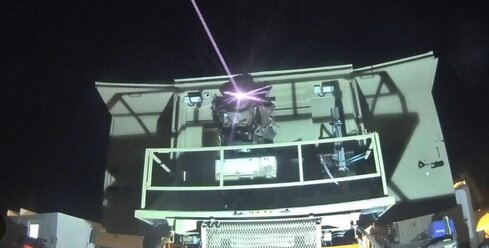
100 kW systems (Israel’s operational Iron Beam, Australia’s EOS Apollo, Japan’s ship-mounted laser, Raytheon/MBDA equivalents) defeat coated/maneuvering small drones in 1.3–4.4 seconds dwell time. EOS Apollo explicitly advertises it defeats UAS even when they use countermeasures like reflective coatings or thermal isolation—up to over 20 drones per minute.
Iron Beam has done it in real combat tests against rockets/UAVs.
300 kW class (U.S. Army in development, some Lockheed HELIOS upgrades) even faster—seconds or less on target—because irradiance (power per cm²) is tripled. It cuts through metal and defeats larger threats.
Lasers win because they focus energy into a tiny spot (dime-sized or smaller) at the speed of light, with adaptive optics keeping the beam locked despite drone jinking.
What Dusty Days (or Fog, Haze, Smoke) Do
This is where lasers struggle—dusty conditions are one of their biggest weaknesses.Dust, aerosols, sand, smoke scatter and absorb the beam (Mie scattering + absorption). In dense fog/dust, transmission can drop over 9/0%, slashing effective range from several km down to hundreds of meters or less.
Thermal blooming: The beam heats the air, creating a lens that defocuses it.
Iron Beam and similar systems explicitly note reduced performance in fog, dust, or clouds (though radar + thermal cameras still help cue the target).
Adaptive optics and wavelength tweaks help somewhat (some systems penetrate better than others), but not magically—lasers are line-of-sight weapons sensitive to weather, unlike missiles or microwaves.
Required Dusty or Foggy threshold
Clear air (visibility over 10 km has Negligible loss (~0.1–0.3 dB/km). Full range (several km) for 100–300 kW lasers.
Light haze/dust (visibility 5–10 km) Minor degradation. range reduced 10–30%.
Moderate dust/fog (visibility 1–2 km, attenuation ~10–20 dB/km) Significant drop — effective range often cut to 1–2 km or less. Beam still works at shorter distances but dwell time increases.
Heavy/dense dust storm or fog (visibility less 1 km, attenuation over 20–30+ dB/km). Lasers become marginal or ineffective beyond a few hundred meters. Most energy scatters or absorbs in the first 500–1,000 m due to Mie scattering (particles ~same size as laser wavelength) and absorption. Thermal blooming (beam heating the air and defocusing itself) worsens it.
Weather and conditions have impacted battles forever.
In Iran and most Middle East combat zones, lasers face noticeable-to-severe degradation on 30–100+ days per year (mainly spring/summer dust), with fully laser-unfriendly heavy storms on 5–30 days. That’s why hybrid systems (lasers + missiles + microwaves) are standard — lasers dominate on clear days (most of the year), but dust/fog forces fallback to kinetics. Real-world ops in CENTCOM have already highlighted dust storms as a key limiter. Conditions are predictable by season, so forces plan around forecasts.
Militaries are fielding 100 kW+ lasers precisely because they work against current drone threats, including basic countermeasures. Swarms + bad weather remain the real challenges, which is why hybrid systems (lasers + missiles + microwaves) are the future.

Brian Wang is a Futurist Thought Leader and a popular Science blogger with 1 million readers per month. His blog Nextbigfuture.com is ranked #1 Science News Blog. It covers many disruptive technology and trends including Space, Robotics, Artificial Intelligence, Medicine, Anti-aging Biotechnology, and Nanotechnology.
Known for identifying cutting edge technologies, he is currently a Co-Founder of a startup and fundraiser for high potential early-stage companies. He is the Head of Research for Allocations for deep technology investments and an Angel Investor at Space Angels.
A frequent speaker at corporations, he has been a TEDx speaker, a Singularity University speaker and guest at numerous interviews for radio and podcasts. He is open to public speaking and advising engagements.
