

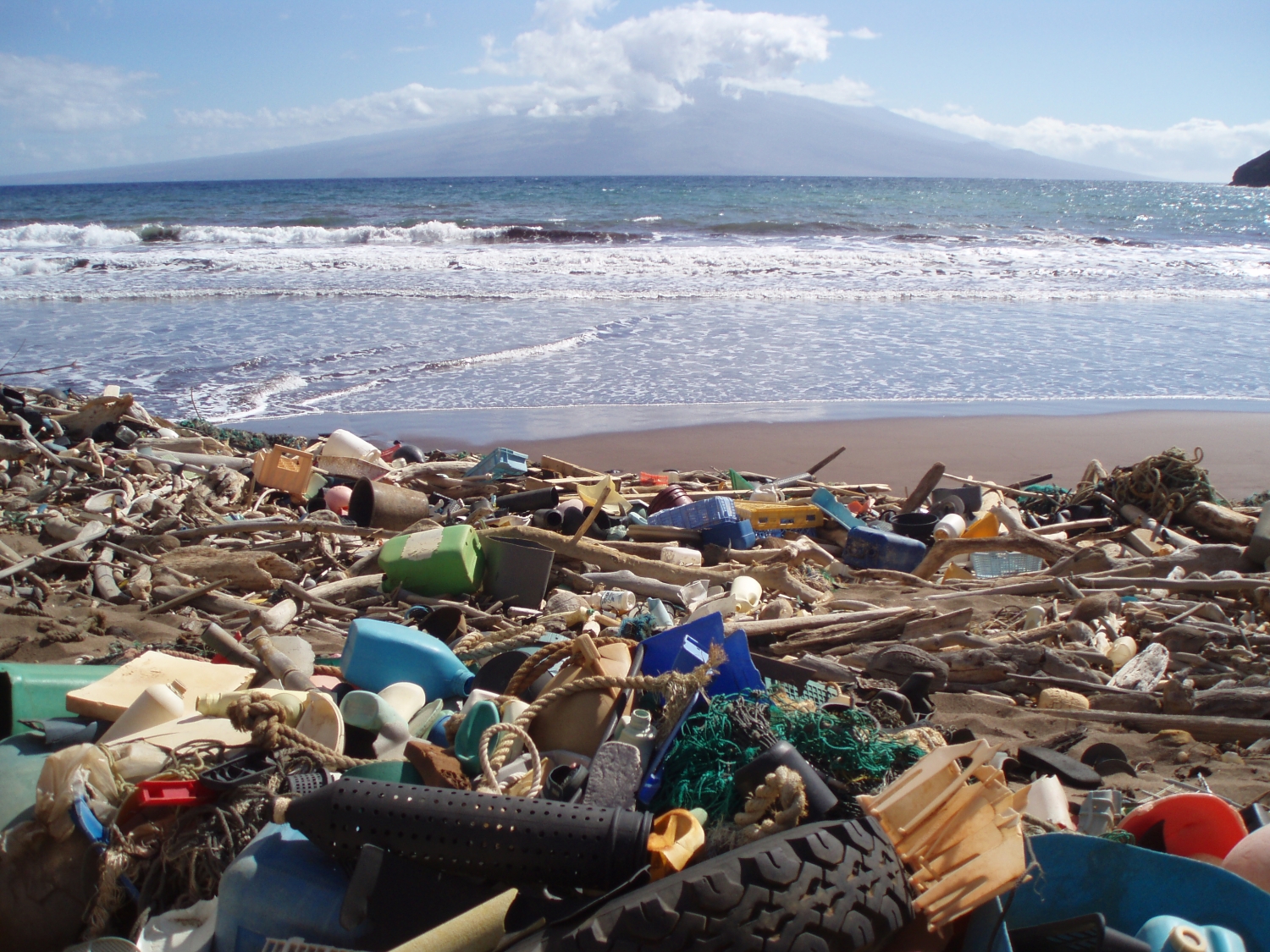

Space-based technology could help track plastic and other flotsam by its ‘fingerprints.’
In late 2025, scientists reported that, for the first time, they were able to detect concentrations of plastic pollution on land using NASA’s Earth Surface Mineral Dust Source Investigation (EMIT) sensor aboard the International Space Station. The technology has inspired marine researchers to see whether it could also help track debris in our waters.
Before future generations of sensors like EMIT can be called upon to detect ocean litter, scientists need to know what to look for. Working with collaborators, NASA intern Ashley Ohall has built a newly published reference library containing nearly 25,000 molecular “fingerprints” from all manner of flotsam and jetsam, including rope, tires, metal, bubble wrap, buoys, and bottle caps. Given the overwhelming presence of plastic in marine debris, the library includes some 19 types of polymer.
Most of the estimated 8 million tons or more of plastic that enter the ocean every year comes from land, so mapping pollution hot spots near coastlines could be a first step toward reducing what ends up on beaches and washed out to sea. That’s exactly what NASA’s sensor showed it could do, though detecting plastic wasn’t its first mission. Launched in 2022, EMIT maps minerals across desert regions to help determine how the dust can heat or cool the atmosphere.
But the instrument has proved itself incredibly nimble. From its perch on the space station, it can identify hundreds of compounds on Earth via the unique spectral patterns they make in reflected sunlight. The technology behind EMIT, called imaging spectroscopy, was pioneered at NASA’s Jet Propulsion Laboratory in Southern California and is used on missions throughout the solar system. One of EMIT’s cousins discovered lunar water in 2009, and another is set to return to the Moon to help future astronauts identify scientifically valuable areas to sample.
The same technology has now shown that it can find plastic compounds in landfills and large-scale structures like greenhouses, said JPL’s David Thompson, who coauthored the 2025 study. However, detecting plastic once it enters the ocean is more challenging: Seawater absorbs infrared light, masking many of plastic’s prominent spectral features.
That’s where the work of Ohall and her collaborators comes in. Their open-source library compiles the work of many researchers over the years who’ve analyzed marine debris using handheld instruments in laboratories. Standardizing the various datasets into one searchable repository is crucial because different kinds of debris have slightly different spectra based on material, color, and condition. Weathered water bottles, for example, “look” different than washed-up hurricane detritus. Once the patterns are known, detection algorithms can be developed.
Carried by ocean currents, debris can travel thousands of miles from the source, so a better understanding of where it is and where it’s headed could be a boon for public health and coastal tourism, said Ohall, a Florida native who recently graduated from the University of Georgia.
“My biggest hope is that people see remote sensing as an important and useful tool for marine debris monitoring,” Ohall said. “Just because it hasn’t been done yet doesn’t mean it can’t be done.”
Conventional methods for quantifying plastic in the ocean — including dragging nets through garbage patches — can’t sample the millions of tons that flow in. With NASA’s support, scientists are learning more about the ability of existing sensors as well as what’s still needed to spot marine debris. Teams are also training AI tools to sift through satellite imagery.
It remains a planet-scale endeavor, said Kelsey Bisson, a program manager at NASA Headquarters in Washington. The groundwork being done by Ohall and other scientists brings us a step closer to leveraging a powerful technology flying in air and space today.
“Humans have a visceral connection to the ocean and its health,” Bisson said. “Detecting marine debris is the kind of incredible challenge that NASA can help solve.”
To learn more about EMIT, visit:
https://earth.jpl.nasa.gov/emit/
Andrew Wang / Andrew Good
Jet Propulsion Laboratory, Pasadena, Calif.
626-379-6874 / 818-393-2433
andrew.wang@jpl.nasa.gov / andrew.c.good@jpl.nasa.gov
Written by Sally Younger
2026-003
