

Close Menu

    Subscribe to Updates

    Get the latest Tech news from SynapseFlow

    What's Hot

    Elon Musk Orders Sweeping Layoffs as xAI Fails to Catch Up

    March 14, 2026

    Your ROG Xbox Ally X is about to get a free performance upgrade soon

    March 14, 2026

    Laptop performance and FPS drop after BIOS update

    March 14, 2026
    Facebook X (Twitter) Instagram
    • Homepage
    • About Us
    • Contact Us
    • Privacy Policy
    Facebook X (Twitter) Instagram YouTube
    synapseflow.co.uksynapseflow.co.uk
    • AI News & Updates
    • Cybersecurity
    • Future Tech
    • Reviews
    • Software & Apps
    • Tech Gadgets
    synapseflow.co.uksynapseflow.co.uk
    Home»Future Tech»Hubble Snaps Stellar Baby Pictures
    Hubble Snaps Stellar Baby Pictures
    Future Tech

    Hubble Snaps Stellar Baby Pictures

    The Tech GuyBy The Tech GuyJanuary 17, 2026No Comments3 Mins Read0 Views
    Share
    Facebook Twitter LinkedIn Pinterest Email
    Advertisement


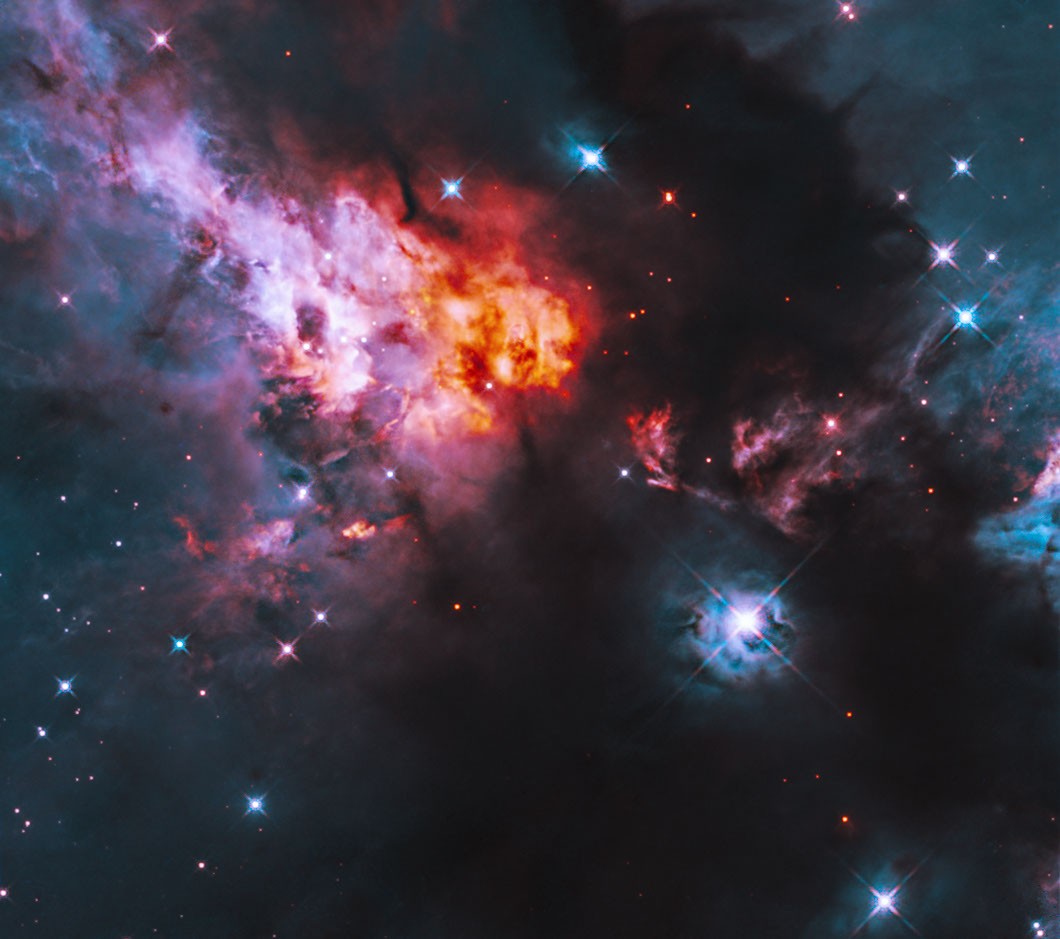
    Newly developing stars shrouded in thick dust get their first baby pictures in these images from NASA’s Hubble Space Telescope. Hubble took these infant star snapshots in an effort to learn how massive stars form.

    Advertisement

    Protostars are shrouded in thick dust that blocks light, but Hubble can detect the near-infrared emission that shines through holes formed by the protostar’s jets of gas and dust. The radiating energy can provide information about these “outflow cavities,” like their structure, radiation fields, and dust content. Researchers look for connections between the properties of these young stars – like outflows, environment, mass, brightness – and their evolutionary stage to test massive star formation theories.

    These images were taken as part of the SOFIA Massive (SOMA) Star Formation Survey, which investigates how stars form, especially massive stars with more than eight times the mass of our Sun.

    The high-mass star-forming region Cepheus A hosts a collection of baby stars, including one large and luminous protostar, which accounts for about half of the region’s brightness. While much of the region is shrouded in opaque dust, light from hidden stars breaks through outflow cavities to illuminate and energize areas of gas and dust, creating pink and white nebulae. The pink area is an HII region, where the intense ultraviolet radiation of the nearby stars has converted the surrounding clouds of gas into glowing, ionized hydrogen.
    Cepheus A lies about 2,400 light-years away in the constellation Cepheus.

    Glittering much closer to home, this Hubble image depicts the star-forming region G033.91+0.11 in our Milky Way galaxy. The light patch in the center of the image is a reflection nebula, in which light from a hidden protostar bounces off gas and dust.

    This Hubble image showcases the star-forming region GAL-305.20+00.21. The bright spot in the center-right of the image is an emission nebula, glowing gas that is ionized by a protostar buried within the larger complex of gas and dust clouds.

    Shrouded in gas and dust, the massive protostar IRAS 20126+4104 lies within a high-mass star-forming region about 5,300 light-years away in the constellation Cygnus. This actively forming star is a B-type protostar, characterized by its high luminosity, bluish-white color, and very high temperature. The bright region of ionized hydrogen at the center of the image is energized by jets emerging from the poles of the protostar, which ground-based observatories previously observed.

    New images added every day between January 12-17, 2026! Follow @NASAHubble on social media for the latest Hubble images and news and see Hubble’s Stellar Construction Zones for more images of young stellar objects.

    Explore More

    Media Contact:

    Claire Andreoli
    NASA’s Goddard Space Flight Center, Greenbelt, MD
    claire.andreoli@nasa.gov

    Advertisement
    Share. Facebook Twitter Pinterest LinkedIn Tumblr Email
    The Tech Guy
    • Website

    Related Posts

    Elon Musk Orders Sweeping Layoffs as xAI Fails to Catch Up

    March 14, 2026

    US Destroys All Military Targets on Kharg Island Which Is Iran’s Oil Export Hub

    March 14, 2026

    NASA Selects Finalists in Student Aircraft Maintenance Competition – NASA

    March 13, 2026

    The US Plans to Break Ground on a Permanent Moon Base by 2030. Here’s What It Will Take.

    March 13, 2026

    Robot Escorted Away By Cops After Terrorizing Old Woman

    March 13, 2026

    SpaceX Space AI Ramp | NextBigFuture.com

    March 13, 2026
    Leave A Reply Cancel Reply

    Advertisement
    Top Posts

    The iPad Air brand makes no sense – it needs a rethink

    October 12, 202516 Views

    ChatGPT Group Chats are here … but not for everyone (yet)

    November 14, 20258 Views

    Facebook updates its algorithm to give users more control over which videos they see

    October 8, 20258 Views
    Stay In Touch
    • Facebook
    • YouTube
    • TikTok
    • WhatsApp
    • Twitter
    • Instagram
    Advertisement
    About Us
    About Us

    SynapseFlow brings you the latest updates in Technology, AI, and Gadgets from innovations and reviews to future trends. Stay smart, stay updated with the tech world every day!

    Our Picks

    Elon Musk Orders Sweeping Layoffs as xAI Fails to Catch Up

    March 14, 2026

    Your ROG Xbox Ally X is about to get a free performance upgrade soon

    March 14, 2026

    Laptop performance and FPS drop after BIOS update

    March 14, 2026
    categories
    • AI News & Updates
    • Cybersecurity
    • Future Tech
    • Reviews
    • Software & Apps
    • Tech Gadgets
    Facebook X (Twitter) Instagram Pinterest YouTube Dribbble
    • Homepage
    • About Us
    • Contact Us
    • Privacy Policy
    © 2026 SynapseFlow All Rights Reserved.

    Type above and press Enter to search. Press Esc to cancel.

    Ad Blocker Enabled!
    Ad Blocker Enabled!
    Our website is made possible by displaying online advertisements to our visitors. Please support us by disabling your Ad Blocker.