

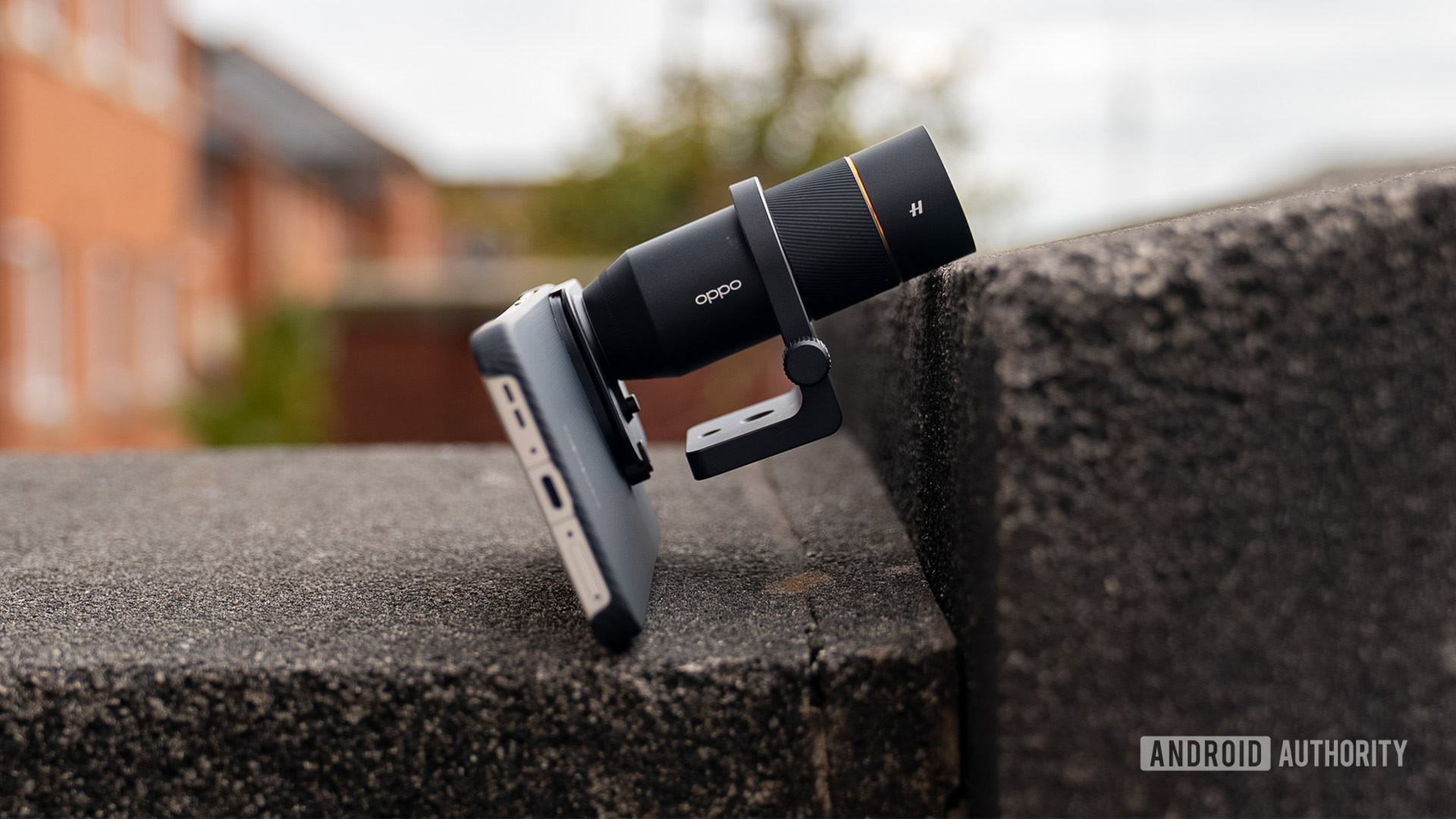

We took some impressive pictures with the OPPO Find X9 Pro’s Hasselblad lens kit, and the rather impressive 230 mm lens offers significant distance, which can be extended up to 40x digital zoom, roughly equivalent to 920 mm. That’s pretty long range, and as a very, very, very amateur astronomer, I wondered whether OPPO’s lens kit would be a gateway to some even more amateur astrophotography. Given the rise of brilliant camera phones, computational photography, and dedicated astrophotography modes, I set out to answer whether smartphones are finally catching up to entry-level telescopes for casual sky-watching.
Before I braced myself for the cold, I did some quick math to set my expectations. “My Newtonian telescope has a 750 mm focal length, just bright enough to make out nebulae and galaxies on a dark night, such as Andromeda, with a 28mm lens (27x magnification).
OPPO’s lens kit certainly doesn’t have the same capabilities as a telescope — unless we throw some software zoom on top. The 230 mm telephoto lens translates to roughly a 10x zoom compared to the phone’s primary 23 mm lens, or approximately 6.6× relative to 35 mm, which is close to the field of view of the human eye. Digital zoom can push this even further, up to around 40x, but software zoom doesn’t aid in all-important light capture.
Do you use your camera app’s astrophotography mode?
10 votes
Furthermore, the X9 Pro’s small 1/1.56-inch periscope camera sensor is around 0.4x smaller than an APS-C sensor and even smaller than the full-frame cameras usually used for amateur astrophotography. Not to mention, placing glass and mirrors in front of glass and mirrors is a recipe for reducing light capture and introducing artifacts like chromatic aberration and vignetting.
In a nutshell, I’m not expecting the Hasselblad lens and Find X9 Pro combo to perform miracles. But paired with my go-to equatorial mount, I would at least have the benefit of stable long-term exposures (much more sturdy than software-based astrophotography modes). But what, if anything, can you see in the night’s sky with this setup? Well, moon craters are visible even through a pair of binoculars, so I started there.
The exposure is spot on, but the field of view is relatively wide, even at 40x, which doesn’t come close to filling the field of view with the moon. So we have to crop in, and the combination of optical and digital zoom leaves much to be desired in terms of detail. The craters are there, but there’s hardly any detail to speak of. Disappointing, especially given how clear the night was. I probably would have been better off trying to take a picture through my telescope viewfinder, which doesn’t bode well.
After seeing how underwhelming the moon shots were with the telephoto extender, I shifted my focus to star clusters: Pleiades and the stars in the region of the Orion Nebula (I think. It wasn’t easy to see exactly what the camera was pointed at, even with my tracking mount, because the screen was essentially black).
While I’m pretty impressed at just how much zoom the setup can offer, I find the results underwhelming — even though I wasn’t attempting anything approaching the bright, colorful pictures you’ll see taken with top-tier gear. You can clearly make out the clusters, which is certainly a win, and you can make out quite a lot of stars, thanks to a bit of RAW editing. However, even my cleanest shots are unfocused; stars appear as round, processed blobs rather than twinkling points of light, and there isn’t much in the way of red or blue colors.
Unfortunately, OPPO’s camera app setup isn’t well-suited for this type of photography. While you can use manual control for longer exposures, distant focus, RAW, and high ISO settings, the results came out unfocused, and the picture is mirrored due to the extender. You’re forced to switch to OPPO’s Tele Lens Extender camera mode to improve the focus, but then you lose manual controls. The best I could achieve was a 10-second shutter time, which just wasn’t good enough to pick out many stars.
I was tempted to experiment with other camera apps and RAW stacking to see if I could achieve better results, but my gut feeling was that I’d be wasting my time. What you really need for even basic-level astrophotography is a nice, bright camera sensor and lens, solid long-range optics, and software options to aid capture and shot stacking. After a little experimentation, it’s clear that a telephoto extender on a smartphone won’t get me there.
I was far more impressed just shooting larger portions of the night’s sky with the camera’s larger primary sensor with the widest aperture — no telephoto extender attached. The results were far more comparable to the Pixel’s astrophotography mode and previous snaps I’ve grabbed with the aid of Samsung’s Expert RAW. I also grabbed another moon shot simply holding my phone up to my telescope’s eyepiece, which again really wasn’t brilliant but looks far better than the shot using the lens extender.
Smartphone telephoto extenders won’t replace a proper telescope or large sensor for serious astrophotography. For casual shots, a stable tripod and primary camera lens — or mounting the phone to a telescope — will give far better results. The Hasselblad lens is fun, but the stars remain mostly out of reach. Live and learn.
Don’t want to miss the best from Android Authority?


Thank you for being part of our community. Read our Comment Policy before posting.
