

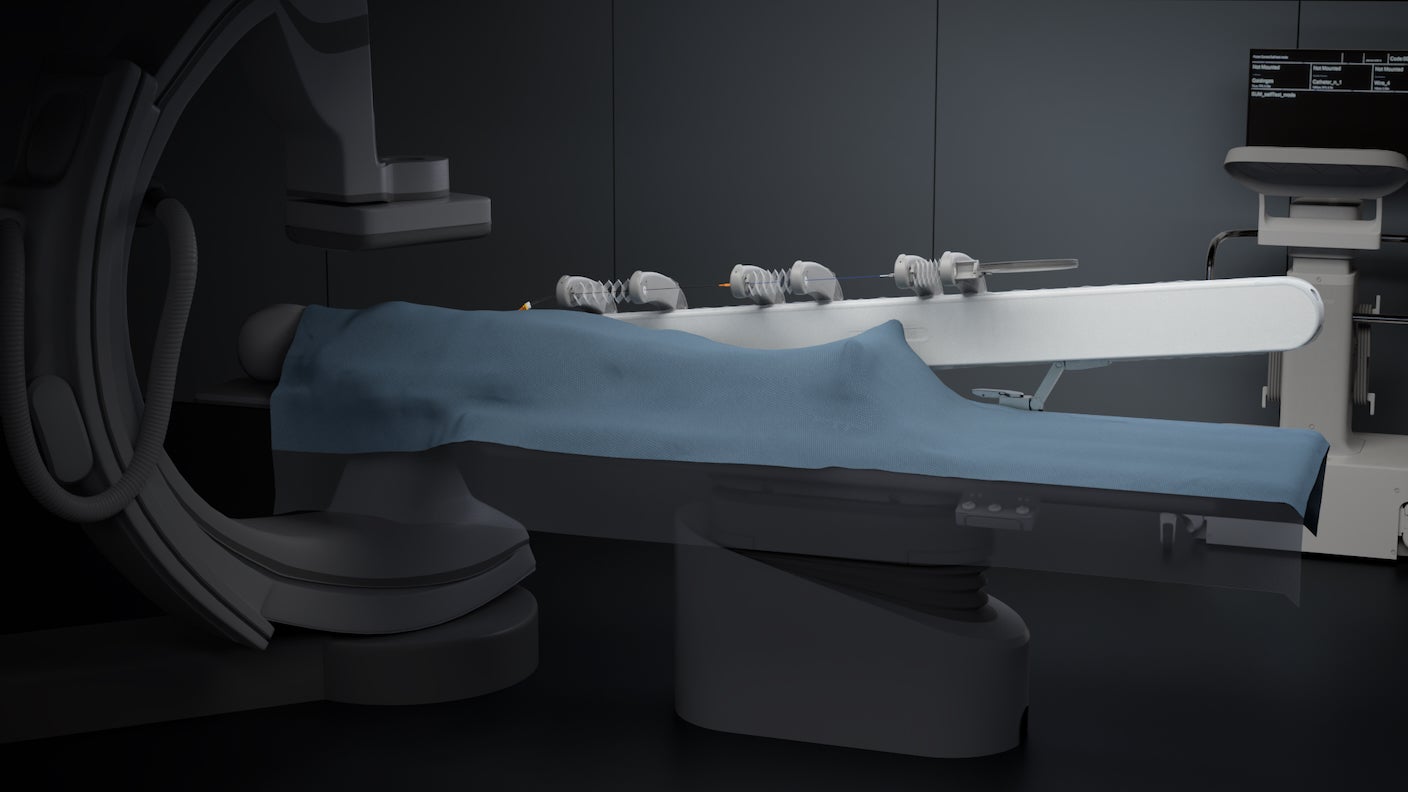

Robotic surgery has dramatically improved surgical precision, but it could also help surgeons treat people on the other side of the world. A surgeon in Florida has now used a robot to remove a simulated brain clot from a cadaver in Scotland, with near-instant feedback across 4,000 miles.
In the US, someone has a stroke roughly every 40 seconds, totally more than 795,000 cases each year and costing the health system more than $56 billion annually, according to the Centers for Disease Control and Prevention.
Ischemic strokes block blood flow to the brain and account for 87 percent of cases. These strokes often require an emergency surgery called a thrombectomy to remove the offending blood clot. However, the procedure requires highly skilled specialists and advanced imaging setups, which means they’re only available to a fraction of stroke patients.
That could soon change thanks to a breakthrough experiment carried out by doctors on either side of the Atlantic. Ricardo Hanel, a neurosurgeon at the Baptist Medical Center in Jacksonville, Florida used a surgical robot to carry out a thrombectomy on a human cadaver at the University of Dundee in Scotland.
“To operate from the US to Scotland with a 120 millisecond (blink of an eye) lag is truly remarkable,” Hanel said in a press release.
“Tele neurointervention [robotic surgery at a distance] will allow us to decrease the gap and further our reach to provide one of the most impactful procedures in humankind.”
The robotic system used in the experiment was developed by Lithuanian company Sentante. The system translates a surgeon’s hand movements into fine robotic control of the standard tools used in the procedure. It also provides haptic feedback, giving the surgeon the same sensations they would feel if doing the procedure by hand.
This feedback makes it possible for the operators to recognize subtle but crucial cues—such as the softness of clot material or the transition into more delicate vessels in the brain. Study leader Iris Grunwald at the University of Dundee also used the robot to carry out a thrombectomy on a cadaver from a remote site within the same hospital, as a precursor to the transatlantic experiment.
“It is remarkable to feel the same fine control and resistance through a robotic interface as during a live procedure,” she said in the press release. “Sentante’s robotic platform redefines what is possible in endovascular treatment today.”
The technology could greatly expand access to this life saving procedure, as it only requires a medical professional trained to gain access to the patient’s arteries before a neurosurgical specialist can take over remotely. The robotic system can also be wheeled to a patient’s bedside within minutes—a critical capability given that every minute counts when it comes to strokes.
“For an ischemic stroke, the difference between walking out of hospital and a lifetime of disability can be just two to three hours,” Edvardas Satkauskas, co-founder and CEO of Sentante, said in the press release.
“Today, patients are often transported long distances to reach one of a limited number of thrombectomy centers. With Sentante, the specialist comes to the patient over a secure network and performs the entire procedure remotely—with the same tactile feel and control they have at the bedside.”
Of course, the experiments took place on cadavers rather than living patients, and bridging the gap could still be tricky. Also, a reliable internet connection—plus good backup plans should it fail—will be as crucial as a smoothly operating robot.
But these experiments suggest that your chances of surviving a stroke may soon no longer be reliant on how close you are to the nearest specialist hospital.
