

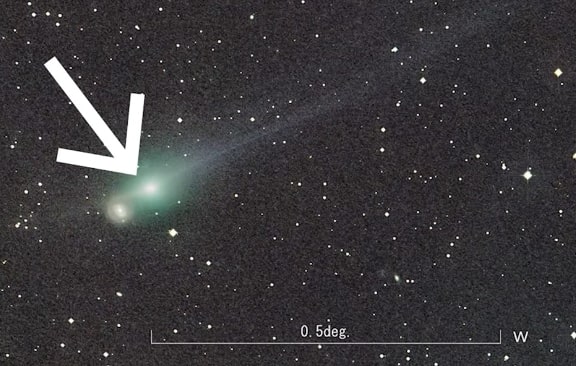

Comet 3I Atlas is currently ~186 million miles from Earth, which is twice the distance from the Earth to the sun. It is moving away from the Sun now but getting closer to Earth until December 19, 2025.
There are more major observed anomalies that cannot be explained and break known standard comet physics. It has unusually collimated (Laser-Like) tails. It has two distinct, extremely narrow tails. The tail going towards the Sun is tough to explain. It is about ~600,000 miles long. This is almost three times the distance from the Earth to the moon. There is a normal tail (away from Sun that is ~3 million miles long (5× longer than the sunward tail).
Tails remain tightly focused over millions of miles instead of diffusing (spreading out) like typical comets.
Multiple independent amateur and professional observations confirm these are real features.
Impossible Anti-Solar Tail
Material in the toward-Sun tail must fight directly against solar wind and radiation pressure. Harvard astrophysicist Avi Loeb calculated the density in the anti-tail would need to be ~1 million time denser than the solar wind itself. This is far beyond normal comet outgassing.
Stable Asymmetric Jet Structure Has Remained Constant for Weeks
The 5:1 tail length ratio has remained constant for weeks.
No wild fluctuations typical of rotating comets exposing different ice pockets.
Mechanism producing jets is remarkably steady over hundreds of millions of miles.
Mass Loss Far Too High for Distance and Surface Area
At 1.8–2 AU, solar energy is only ~300 W/m².
To explain observed mass loss via normal CO₂ ice sublimation would require ~620 square miles of actively sublimating surface at maximum efficiency.
Actual nucleus is only a few miles across → total surface area ~30–40 square miles max.
Recent images (including MRO image from Mars) show one intact nucleus, no fragmentation or debris cloud that could increase surface area.
Brightness Not Fading Post-Perihelion
The comet should be cooling and rapidly dimming as it moves away from the Sun.
Instead, coma and tails remain intensely bright and well-defined.
Avi Loeb calculates ~200 tons of material lost per second to sustain current brightness.
The huge extent of the anti-tail towards the Sun implies that it carries a large enough momentum flux to penetrate through the solar wind. The anti-tail’s ram-pressure exceeds that of the solar wind out to that distance. The solar wind is flowing at a speed of about 400 kilometers per second, which is at least a thousand times faster than the thermal speed of outflowing gas from a natural comet at the location of 3I/ATLAS. Since ram-pressure scales as the gas speed squared, this means that the outermost mass density in the anti-tail is a million times bigger than the solar wind density of a few proton masses per cubic centimeters. For a natural comet, the outermost mass density of the anti-tail implies a mass flux of 200 tons per second per square area of size 0.3-million kilometer on a side. Counting also the tail, this yields a total mass loss rate of about a few billion tons over the past two months.
Momentum conservation at the maximum thermal gas speed of 400 meters per second implies that the measured level of non-gravitational acceleration requires more than 10% of the mass of 3I/ATLAS to be lost if it is a natural comet, as I showed here. Jets from technological thrusters could be more effective in accelerating 3I/ATLAS with less mass loss, as they produce higher exhaust speeds. The required mass loss to penetrate through the solar wind is scaled down by the square of the increased outflow speed. This corresponds to 2 or 4 orders of magnitude reduction in mass loss for chemical thrusters or ion thrusters, respectively. Future spectroscopic measurements could assess the speed of the jets and distinguish between the natural sublimation of pockets of ice by sunlight and technological alternatives.
We are all awaiting better images from the largest telescopes on Earth, as well as from the Hubble and Webb Space Telescopes, near 3I/ATLAS’s closest approach to Earth on December 19, 2025 at a minimum distance of 269 million kilometers.
The best is yet to come. The data collected in December 2025 will set the verdict on the nature of 3I/ATLAS. In addition, we will be able to assess whether 3I/ATLAS is forecasted to reach the Hill radius of Jupiter on March 16, 2025 — as discussed here, to better than four significant digits.
Since perihelion (late September/early October), this rate implies billions of tons lost — roughly 10% of the entire estimated 33-billion-ton mass in just ~2 months.
No visible shrinking, sputtering, or structural failure expected from such extreme mass loss.
Conclusion from the VideoMultiple independent lines of evidence (tail structure, density, mass-loss rate, surface-area mismatch, sustained brightness) cannot be explained by standard heat-driven sublimation physics.
The object is behaving in ways no natural comet has before at this distance.

Brian Wang is a Futurist Thought Leader and a popular Science blogger with 1 million readers per month. His blog Nextbigfuture.com is ranked #1 Science News Blog. It covers many disruptive technology and trends including Space, Robotics, Artificial Intelligence, Medicine, Anti-aging Biotechnology, and Nanotechnology.
Known for identifying cutting edge technologies, he is currently a Co-Founder of a startup and fundraiser for high potential early-stage companies. He is the Head of Research for Allocations for deep technology investments and an Angel Investor at Space Angels.
A frequent speaker at corporations, he has been a TEDx speaker, a Singularity University speaker and guest at numerous interviews for radio and podcasts. He is open to public speaking and advising engagements.
