


Millionaires have become far more common over time, driven by global economic growth, inflation, and wealth creation. In the early 20th century, being a millionaire was extremely rare.
Historical Number of Millionaires
There were estimated to be only about 20 millionaires in 1840 in the USA and around 4,000-5,000 by 1900. Globally, the figure was likely in the low tens of thousands at most, as Europe (e.g., Britain had about 4,500 millionaires by 1914) and other regions lagged behind.
This scarcity reflects a smaller global economy and fewer opportunities for wealth accumulation beyond inheritance or early industrial fortunes (Rockefellers, Carnegies).
Early 20th Century (1900-1950), the numbers grew slowly.
By 1916, U.S. tax records show about 7,000 millionaires. Post-WWII, global figures remained low due to wars and depressions.
Late 20th Century, explosive growth began. In 2000, there were 14.7-20 million millionaires worldwide.
By 2022-2024, the global number of millionaires hit 58-60 million, representing about 1.5% of the world’s adult population.
Projections for 2025 suggest over 80 million, per UBS estimates. The U.S. dominates with ~22-24 million (38-41% of the global total).
The global GDP was ~$200-300 billion (in 2011 intl. dollars) around 1900 and is over $100 trillion today.
When Millionaire Counts Were Comparable to Today’s Count of Billionaires
Today’s global billionaire count is around 2,900-3,028 (as of 2025, per Forbes and UBS).
The number of millionaires around 1900-1910 were in the low thousands to perhaps as much as 10,000-20,000 (mostly in the U.S. and Europe).
A $1 million fortune in 1900 equates to about $38.6 million today (using U.S. CPI data) in 2013dollars.com
However, this understates the relative exclusivity because the global economy was much smaller (~100x smaller than today).
Adjusted for both inflation and economic growth (e.g., via per capita GDP multipliers), a 1900 millionaire’s wealth might feel like $500 million to $1 billion+ today in purchasing power and societal status. For instance, global per capita GDP was ~$1,100-2,200 (in 2011 intl. dollars) in 1900 vs. ~$14,000 today—a 7-13x increase.
Millionaires were about as common around 1900 as billionaires are now (~3,000 globally), but their wealth (inflation- and growth-adjusted) represented even greater relative power due to a smaller economy.
Countering the Gini Coefficient and History of Rising and Falling Inequality
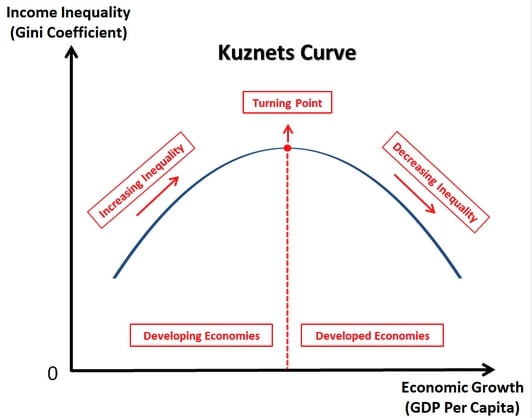
The Gini coefficient (a 0-1 measure of inequality, where 0 is perfect equality) has indeed gone up and down. It rises during rapid growth phases before stabilizing or falling to less inequality.
Global Gini Trends
Pre-IR (1820) inequality was quite high ~0.43-0.60. This reflects agrarian inequalities like feudal systems.
The early IR (1820-1910) saw a sharp rise in inequality to 0.61-0.72. Industrialization concentrated wealth in factory owners, colonial powers, and early capitalists while workers faced low wages and exploitation.
Interwar and Post-WWII (1910-1980) inequality peaked at 0.64-0.72 around 1950-1980, then slight dips in some metrics. Post-war booms (U.S./Europe) saw temporary declines due to progressive taxes, unions, and welfare states, but globally, Cold War divides and decolonization kept inequality high.
US Specific
Pre-IR/Early 20th Century was at 0.41 in 1918, peaking at 0.49 in 1928 amid Gilded Age.
Post-War Boom (1940s-1970s) dropped to 0.35-0.40 due to New Deal policies, strong unions, and high taxes on the rich (top marginal rates >70%).
1980s-Present saw a steady rise to 0.48-0.49 by 2016-2024, driven by deregulation, tax cuts, and tech/finance concentration. Today, it’s 0.42 after taxes/transfers.
Future AI Abundance
For a future with space-based AI data centers and superintelligence: This could mirror the IR but on steroids—potentially surging the economy a million-fold via abundant compute/energy, automating routine tasks (white-collar included), and enabling post-scarcity
If distributed (via policies like UBI or wealth taxes), it could lower Gini, as IR eventually did in developed countries. But without intervention, inequality might spike at first.

Brian Wang is a Futurist Thought Leader and a popular Science blogger with 1 million readers per month. His blog Nextbigfuture.com is ranked #1 Science News Blog. It covers many disruptive technology and trends including Space, Robotics, Artificial Intelligence, Medicine, Anti-aging Biotechnology, and Nanotechnology.
Known for identifying cutting edge technologies, he is currently a Co-Founder of a startup and fundraiser for high potential early-stage companies. He is the Head of Research for Allocations for deep technology investments and an Angel Investor at Space Angels.
A frequent speaker at corporations, he has been a TEDx speaker, a Singularity University speaker and guest at numerous interviews for radio and podcasts. He is open to public speaking and advising engagements.
