

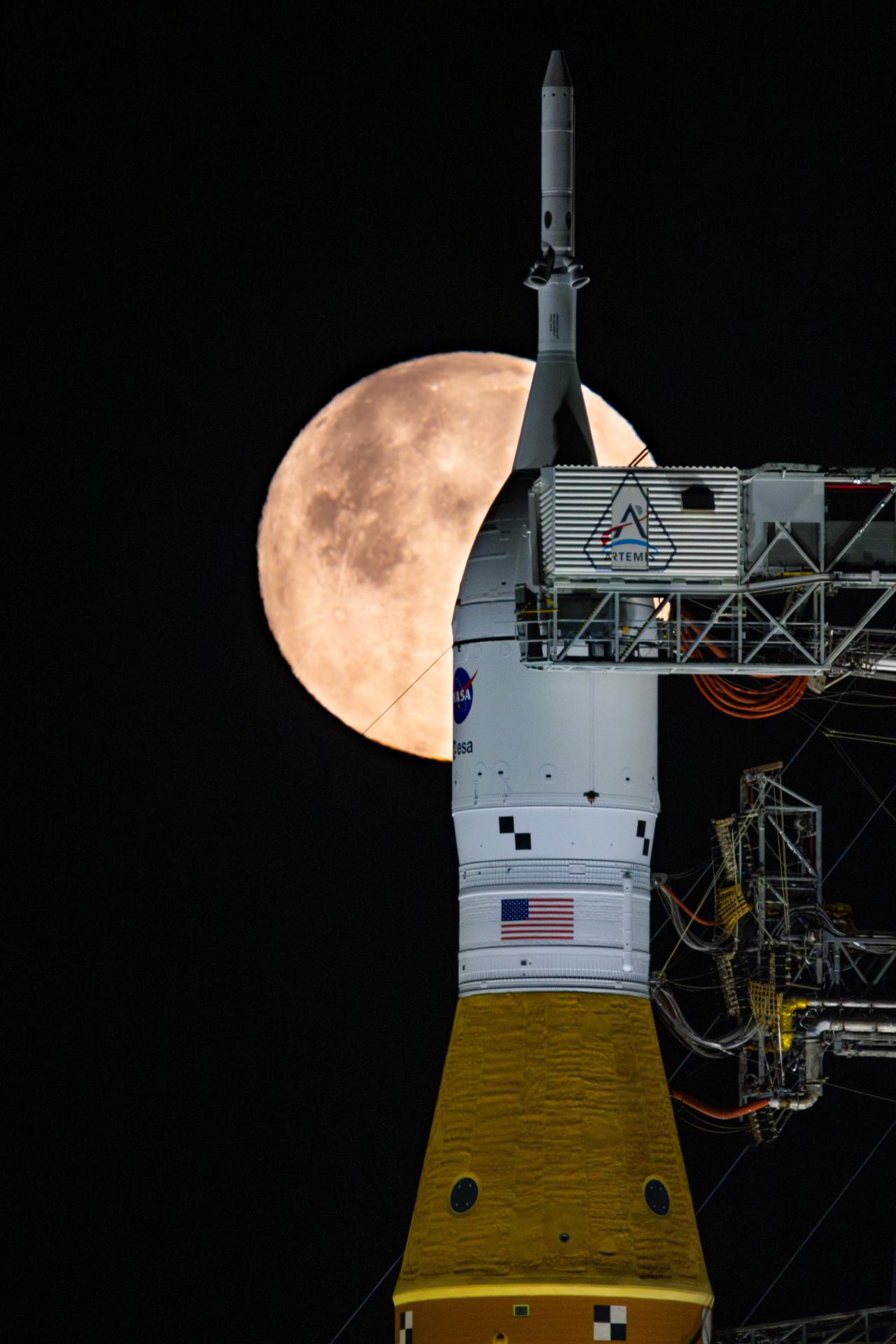

NASA Artemis 2 mission after encountering hydrogen leaks during a fueling test of the Space Launch System. The Space Launch System (SLS) and Orion spacecraft have been central to NASA’s Artemis program, aimed at returning humans to the Moon. Development began in earnest around 2011, following the cancellation of the Constellation program in 2010. SLS evolved from shuttle-derived technologies, using RS-25 engines from the shuttle era and solid rocket boosters similar to those on the shuttle. Orion, originally conceived as the Crew Exploration Vehicle in 2004 under the Vision for Space Exploration, was designed as a deep-space capsule capable of carrying crews beyond low Earth orbit.
SLS and Orion have faced chronic delays, cost overruns, and technical challenges. Initially targeted for a 2016-2018 debut as mandated by Congress, SLS’s first flight (Artemis 1) slipped repeatedly due to issues like welding problems on the core stage tanks, immature design requirements, and contractor performance issues with Boeing. Artemis 1 finally launched in November 2022 after multiple scrubs from hydrogen leaks at the tail service mast umbilical (TSMU) interface—issues that required several wet dress rehearsals (WDRs) to resolve.
NASA concluded a wet dress rehearsal for the agency’s Artemis II test flight early Tuesday morning, successfully loading cryogenic propellant into the SLS (Space Launch System) tanks, sending a team out to the launch pad to closeout Orion, and safely draining the rocket. The wet dress rehearsal was a prelaunch test to fuel the rocket, designed to identify any issues and resolve them before attempting a launch.
Engineers pushed through several challenges during the two-day test and met many of the planned objectives. To allow teams to review data and conduct a second wet dress rehearsal, NASA now will target March as the earliest possible launch opportunity for the flight test.
Artemis I also had a hydrogen fuel leak in about the same spot. The LH2 leaks that plagued Artemis 1 centered on an interface with the tail service mast umbilical (TSMU), a line that carries propellant from the mobile launch tower to the rocket. The two leaks observed during today’s wet dress also occurred at a TSMU interface.
Artemis 1 required four WDR attempts and multiple launch scrubs before succeeding, with LH2 leaks at the same TSMU spot causing months of slippage.
If the second WDR reveals persistent issues, NASA could push into April or later. IF they have to fix root causes like seal reseating or interface redesigns then it would be a substantial delay.
NASA has concluded the Orion heat shield is safe for Artemis 2 astronauts, but with caveats and ongoing debate. Post-Artemis 1, investigations found the Avcoat material wasn’t porous enough, trapping gases that built pressure and caused cracking/chunk loss in over 100 spots during reentry.
Rather than redesign for Artemis 2 (which would cause major delays and costs), NASA opted to alter the reentry trajectory to a shallower, slower path to reduce heat buildup and manage ablation. They decided the worst case scenario is still safe. They can lose chunks of heat shield and still be safe. Nextbigfuture thinks it is like the Pinto car of human capsules. The Pinto was known for catching fire easily in accidents.
Artemis 2
During tanking, engineers spent several hours troubleshooting a liquid hydrogen leak in an interface used to route the cryogenic propellant into the rocket’s core stage, putting them behind in the countdown. Attempts to resolve the issue involved stopping the flow of liquid hydrogen into the core stage, allowing the interface to warm up for the seals to reseat, and adjusting the flow of the propellant.
Teams successfully filled all tanks in both the core stage and interim cryogenic propulsion stage before a team of five was sent to the launch pad to finish Orion closeout operations. Engineers conducted a first run at terminal countdown operations during the test, counting down to approximately 5 minutes left in the countdown, before the ground launch sequencer automatically stopped the countdown due to a spike in the liquid hydrogen leak rate.
In addition to the liquid hydrogen leak, a valve associated with Orion crew module hatch pressurization, which recently was replaced, required retorquing, and closeout operations took longer than planned. Cold weather that affected several cameras and other equipment didn’t impede wet dress rehearsal activities, but would have required additional attention on launch day. Finally, engineers have been troubleshooting dropouts of audio communication channels across ground teams in the past few weeks leading up to the test. Several dropouts reoccurred during the wet dress rehearsal.
The team carried out updated procedures to purge the Orion service module’s cavities with breathing air during closeout crew operations rather than gaseous nitrogen to ensure the team assisting the crew into their seats and closing Orion’s hatches can safely operate in the White Room.

Brian Wang is a Futurist Thought Leader and a popular Science blogger with 1 million readers per month. His blog Nextbigfuture.com is ranked #1 Science News Blog. It covers many disruptive technology and trends including Space, Robotics, Artificial Intelligence, Medicine, Anti-aging Biotechnology, and Nanotechnology.
Known for identifying cutting edge technologies, he is currently a Co-Founder of a startup and fundraiser for high potential early-stage companies. He is the Head of Research for Allocations for deep technology investments and an Angel Investor at Space Angels.
A frequent speaker at corporations, he has been a TEDx speaker, a Singularity University speaker and guest at numerous interviews for radio and podcasts. He is open to public speaking and advising engagements.
