

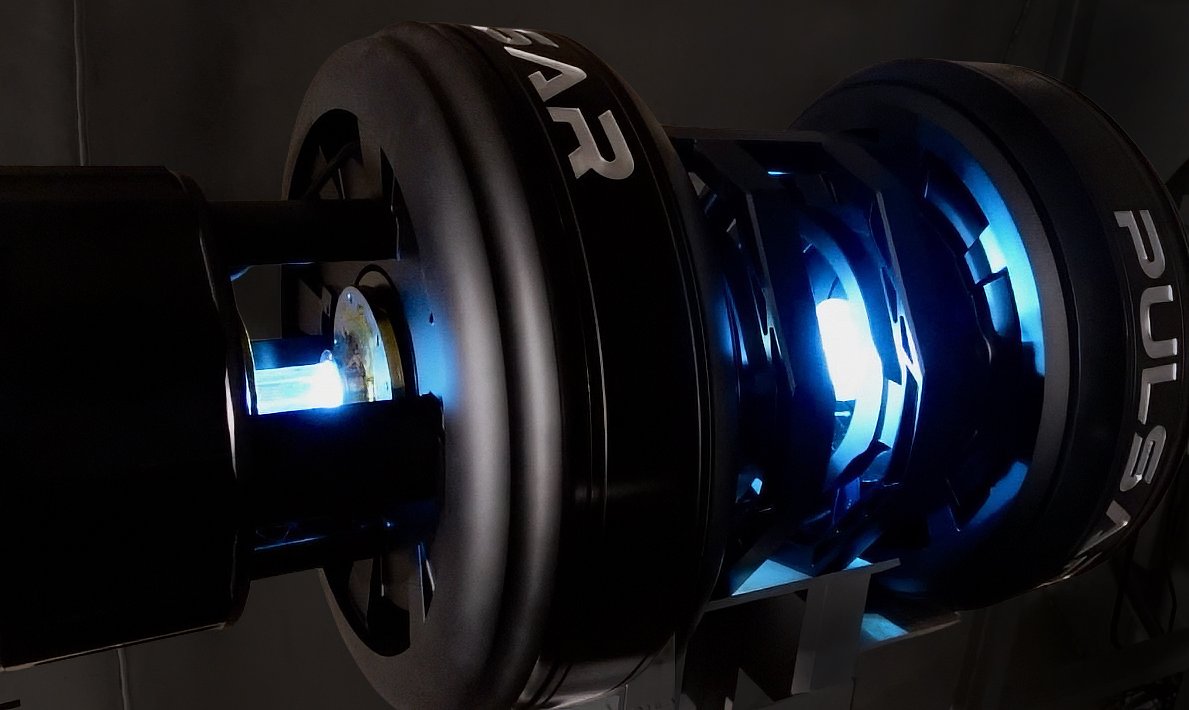

UK-based Pulsar Fusion announced it has successfully achieved first plasma in its Sunbird nuclear fusion rocket exhaust system. The demonstration, a world’s first for a rocket of this type, was showcased live during a technical session at Jeff Bezos’s exclusive MARS Conference in California, offering a tantalizing glimpse into a future of dramatically faster interplanetary travel. Pulsar Fusion’s state-of-the-art Dual Direct Fusion Drive (DDFD) has high specific impulse (10,000–15,000 s) and a planned 2 MW of power.
The achievement represents a critical, foundational step in harnessing the power of a star for propulsion. By successfully generating and confining a superheated plasma—an ionized gas hotter than the sun’s core—within the rocket’s exhaust architecture, the company has cleared a major initial hurdle in one of the most ambitious engineering projects in the space industry.
Scientists in Bletchley used krypton gas, chosen for its efficiency in becoming a plasma at the required mass flow rates. The test was live-streamed to the MARS conference, where Pulsar Fusion CEO Richard Dinan presented the breakthrough to an audience of Nobel laureates, astronauts, and leaders in robotics and AI.
This is not the same as the fusion being pursued for terrestrial energy. While power plants aim for a net energy gain to supply electricity grids, fusion propulsion has a different primary objective: generating immense thrust and exhaust velocity. The goal is to channel the energetic particles from a fusion reaction directly out of a nozzle, creating a propulsion system that combines the high thrust of chemical rockets with the extreme efficiency of electric propulsion.
The Sunbird’s design, known as a Dual Direct Fusion Drive (DDFD), relies on superconducting magnets to form a magnetic bottle that contains the reaction and directs the exhaust, which could theoretically reach speeds over 500,000 miles per hour.
NASA and DARPA are actively working on a Nuclear Thermal Propulsion (NTP) rocket called Draco. It uses a fission reactor to heat hydrogen propellant. NTP is considered a more near-term technology, with a prototype flight planned for as early as 2027.
Nuclear Electric Propulsion (NEP), uses a reactor to power efficient ion thrusters, but most designs are low thrust relative to fusion drives.
2023 Nexgtbigfuture Coverage
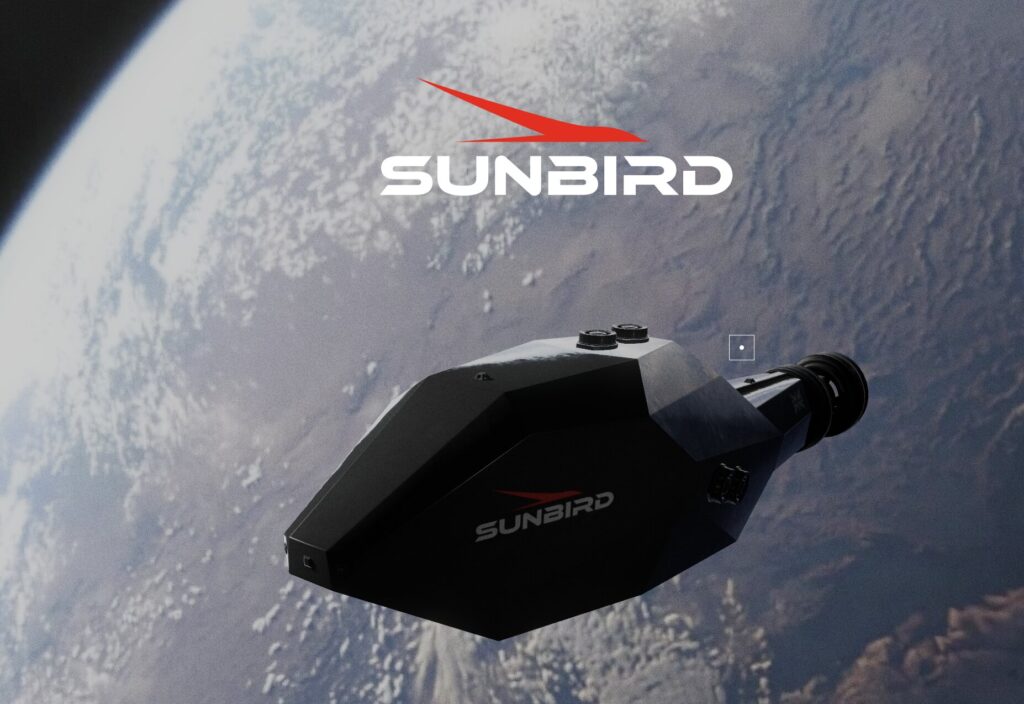
In 2023, Pulsar Fusion (UK) reported they were working on a Direct Fusion Drive (DFD). It is a compact nuclear fusion engine which could provide both thrust and electrical power for spaceships. This technology opens unprecedented possibilities to explore the solar system in a limited amount of time and with a very high payload to propellant masses ratio.
This engine is attractive for long missions where a lower thrust version of the engine, having a propellant mass ratio near unity, provides efficiencies that other engines cannot achieve.
Static tests are to begin in 2023 2025 followed by an In Orbit Demonstration (IOD) of the technology in 2027.

The direct drive fusion is designed to produce both thrust and electric power for interplanetary spacecraft. It will be a long-term source of acceleration with self-sustaining fuel supply. Modeling shows that this technology can potentially propel a spacecraft with a mass of about 1,000 kg (2,200 lb) to Pluto in 4 years.
Since DFD provides power as well as propulsion in one integrated device, it would also provide as much as 2 MW of power to the payloads upon arrival. Designers think that this technology can radically expand the science capability of planetary missions.


Brian Wang is a Futurist Thought Leader and a popular Science blogger with 1 million readers per month. His blog Nextbigfuture.com is ranked #1 Science News Blog. It covers many disruptive technology and trends including Space, Robotics, Artificial Intelligence, Medicine, Anti-aging Biotechnology, and Nanotechnology.
Known for identifying cutting edge technologies, he is currently a Co-Founder of a startup and fundraiser for high potential early-stage companies. He is the Head of Research for Allocations for deep technology investments and an Angel Investor at Space Angels.
A frequent speaker at corporations, he has been a TEDx speaker, a Singularity University speaker and guest at numerous interviews for radio and podcasts. He is open to public speaking and advising engagements.
