


Why you can trust TechRadar
We spend hours testing every product or service we review, so you can be sure you’re buying the best. Find out more about how we test.
Sigma 17-40mm f/1.8 DC | Art: One-minute review
Cast your mind back to 2013 and Sigma had just brought out its 18-35mm f/1.8 DC HSM | Art lens – the world’s first zoom with a fast, constant f/1.8 aperture – and was set to revolutionize the photography industry.
The lens is specifically designed for mirrorless cameras with an APS-C sensor and is available in L-mount, Sony E, Fujifilm X, and Canon RF versions. I’ve spent a month testing an E-mount version of the lens mounted on a Sony A6700, to see if this optic really can do the job at least three primes.
The TLDR is that it absolutely can, and I thoroughly enjoyed hitting the streets to use it for all sorts of photography, from city shots to portraits, shallow-depth-of-field still-life shots, and even low-light scenes like traffic trails and stars.

While the 17-40mm f/1.8 DC | Art builds on its predecessor in pretty much every way, it’s not free from faults. It’s an APS-C lens with a smaller imaging circle, so it’s less future-proof if you upgrade to a full-frame camera later down the road. It’s also very expensive, and costs significantly more than its predecessor did back in 2013.
If money is no limit, and you love to shoot at a range of wide-angle focal lengths while also having the versatility of a fast f/1.8 aperture, this is the lens for you, providing you shoot on an APS-C mirrorless body. However, if you’re on a stricter budget, and prefer smaller lenses and don’t mind switching between them, then you may be better off with one or two cheaper prime lenses instead – provided you’re not shooting weddings and other events where you may have less time to swap your optics over.
Sigma 17-40mm f/1.8 DC | Art: Price and availability
- Priced at $919 / £779 / AU$1,650
- Lens hood included
- Announced in July 2025
The Sigma 17-40mm f/1.8 DC Art costs $919 / £779 / AU$1,650. That’s more than Sigma’s original 18-35mm f/1.8 DC HSM Art, which retailed for $799 / £699 (around AU$1,150) at launch. However, this higher price is to be expected given more than a decade of inflation since then, and tariff increases have likely impacted US pricing too. Regardless, I think the extra money is justified in the US and UK by the suite of upgrades that come with the new and improved version.
It’s difficult to say exactly who this lens is for, as I personally found it a bit frustrating with it either being not wide enough or not telephoto enough for my shooting style, though as someone who regularly likes to shoot with 35mm prime lenses, there were times when the extra versatility from its small zoom range was welcome. It is a bit like a souped-up kit lens, but one that costs significantly more.
If you’re on a tighter budget, and not fussed about that wide f/1.8 aperture, or you’re looking for something a bit more portable for your everyday carry lens, then the Sigma 18-50mm f/2.8 DC DN Contemporary would be a better choice. Similarly, if you don’t want a zoom and simply want a smaller prime lens there are options like the Canon RF 35mm f/1.8 IS Macro STM that are lighter, smaller and a little bit cheaper, too. So it really comes down to what you want to use the lens for.
However, for events and wedding photographers shooting with APS-C bodies I can see this lens being a game changer, giving those photographers extra focal length options and a fast f/1.8 aperture when they may not have the time to change lenses.
Sigma 17-40mm f/1.8 DC | Art: Specs
|
Type: |
Wide-angle zoom |
|
Mount: |
L-mount, Sony E, Fujifilm X, Canon RF |
|
Sensor: |
APS-C |
|
Focal length: |
17-40mm (25.5-60mm effective on Fujifilm, Sony & L-mount, 27.2-64mm on Canon RF) |
|
Max aperture: |
f/1.8 |
|
Minimum focus: |
0.28m |
|
Filter size: |
67mm |
|
Dimensions: |
72.9 x 115.9mm |
|
Weight: |
18.8oz / 535g |
Sigma 17-40mm f/1.8 DC | Art: Design
- Some degree of weather-sealing, usually saved for more premium Art lenses
- Combines a versatile zoom range with a fast f/1.8 maximum aperture
- Switches on the lens barrel to control AF/MF and iris ring functions
- Much longer than most prime lenses with a length of 115.9mm
The Sigma 17-40mm f/1.8 DC Art lens improves on its predecessor in virtually every way. Not only is it 34% lighter, tipping the scales at 18.8oz / 535g, it’s also 6.5% leaner in diameter and 4.2% shorter in length. Despite being a skinnier and lighter model it manages to pack in a 2.35x optical zoom, with a more expansive focal range of 17-40mm, whereas the original 18-35mm fell just shy of 2x optical zoom, so the overall zoom range has been expanded by roughly 18%.
As in the 18-35mm f/1.8 the optical design comprises 17 elements, but there’s one fewer aspherical and one fewer SLD (Special Low Dispersion) elements this time around, meaning there’s a total of three aspherical and four SLD elements inside the barrel.
The aperture has been upgraded however, and instead of the old nine-bladed design, we now have a more premium 11-bladed design, which should deliver better-rounded bokeh.

The rear mount is brass and also weather sealed, confirming the dust and splash-proof credentials of the optic. The lens is available to fit L-mount, Sony E, Fujifilm X and Canon RF, and factoring in the 1.5x crop factor of APS-C sensors the lens will behave much more like a 25.5-60mm, with the exception of Canon cameras, which have a 1.6x sensor crop and with which the lens will be have a slightly tighter perspective at 27.2-64mm.
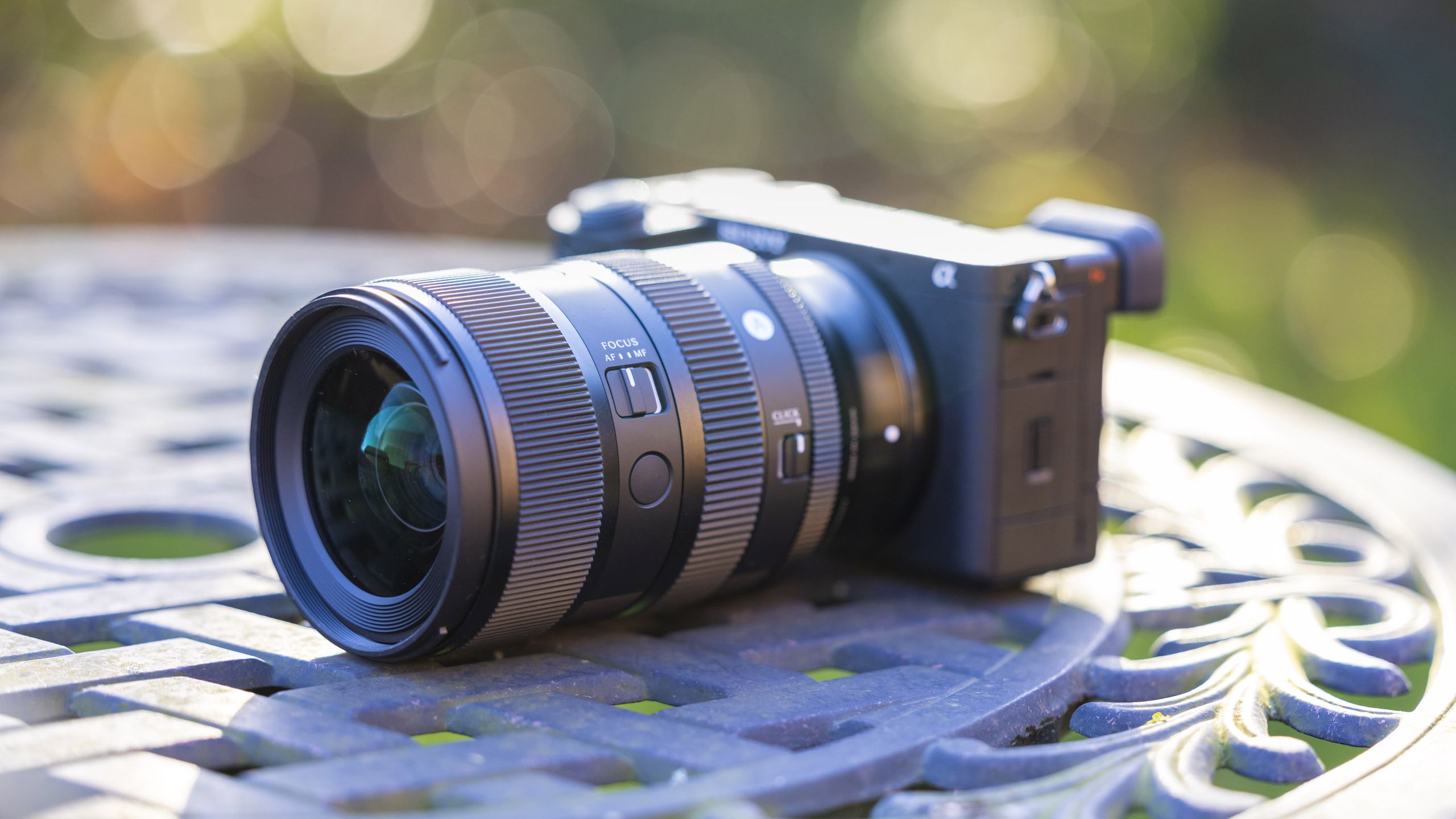
On the outside of the lens barrel are the zoom and focus rings, which are a decent size and have a knurled rubber finish, making them very grippy and comfortable to use. Because this new lens is designed for modern mirrorless cameras it has an electronic fly-by-wire focus ring rather than a mechanical one, and this also means we’ve lost the focus distance window on the top. Both rings turn smoothly and are easy to operate.

A third ‘iris’ ring sits closest to the lens mount and is for controlling the aperture. This also has a lock to keep it securely in the ‘A’ position if you prefer not to use it, and there’s also a switch to enable or disengage the click – videographers will likely prefer the smoother declicked option when recording footage. It’s also worth noting that on the Canon RF version this is instead a Control ring which can be assigned custom functions for all sorts of settings, including but not limited to aperture.
The zoom is internal, so the lens remains compact and doesn’t rack out when zooming in or out. The throw from 17mm to 40mm on the zoom ring is also quite short, and certainly less than 90 degrees, so you can zoom fully in or out very quickly.
Also on the barrel is a switch to control AF/MF, and there are two AF-L buttons for holding focus, though these can be assigned different functions via the menu.

Heading to the front of the lens we see the front element, which isn’t overly large considering it has a wide f/1.8 max aperture, and this is also where you’ll attach the 67mm screw-in front filters. The front element also has a water- and oil-repellent coating to make it more durable in harsh outdoor environments.
Also in the box is a LH728-02 petal-shaped lens hood, which is part plastic and part rubber for a premium feel, and also has a nice chunky button to lock it in place and release it. This fits on the lens backwards to take up less space when not in use.
Sigma 17-40mm f/1.8 DC | Art: Performance
- Chromatic aberration and flare handled well
- Bright f/1.8 aperture makes it great for low light and blurry backgrounds
- Corner details a little soft and vignetting at f/1.8 but cleared up by f/2.8
- Autofocus is fast, quiet and accurate
When it comes to assessing performance, we first need to consider who the Sigma 17-40mm f/1.8 DC lens is for. It clearly excels in low light with its fast maximum aperture of f/1.8, though its wider focal range of 17-40mm makes it a bit too wide for portraits, so it’s likely to be better suited to indoor events, astrophotography, and perhaps as a wide option for wedding photographers who don’t have time to switch lenses and need its versatility.
It is designed for use with APS-C cameras, which means its imaging circle is too small for full-frame cameras, with which you would see a pronounced vignette. That said, you can still pair the lens with a full-frame camera using the camera’s APS-C crop mode. The downside to this approach is that you won’t be making the complete use of the sensor – effectively throwing away pixels.
I took the lens out around London for several days, using it as my main lens for street photography. In this setup I found it to be a little on the large side, not in terms of width, but in overall length – it’s easily twice the length of, say, my Canon RF 35mm f/1.8 Macro IS STM. This made it more difficult to keep a low profile and take candid shots of people going about their lives without me being noticed, though this is the cost of having a more versatile zoom range.
Image 1 of 5


With its focal length of 17-40mm it’s fair to compare the lens to an 18-55mm kit lens, but with a little less telephoto power – it falls frustratingly short of that magical 50mm focal length which works wonderfully well with a wide aperture of f/1.8 for wider mid-length and head-and-shoulders portraits.
With all that being said, it is a big step up from the old 18-35mm f/1.8 DC HSM Art lens – the new version is 34% lighter, 6.5% shorter and 4.2% thinner, all while boasting two more aperture blades and being able to focus 2cm closer. While these may sound like minor updates, when combined they make the lens feel like a big upgrade overall.
Image 1 of 10


On to image quality, and I have to say that considering its broad zoom range and constant f/1.8 maximum aperture I was quietly impressed. Corners were a little soft and showed some vignetting when shooting wide open at f/1.8, though this was pretty much cleared up by f/2.8 and was easy to fix in software. Impressively, there was very little sign of chromatic aberration, and flare was handled well when shooting towards the sun.
There is a little barrel distortion around the edges when shooting at the wider focal lengths, which as expected starts to disappear as you zoom in – at 40mm the distortion has completely vanished. What distortion there is is very minor and testimony to the new lens element construction, and the in-camera lens corrections do a good job at ironing this out, though further correction can be applied in post-production to straighten out vertical lines more.
Autofocusing was a joy thanks to the High-response Linear Actuator motor, with the lens being very speedy, silent and reliable in achieving focus even in low light.
Image 1 of 4


Should you buy the Sigma 17-40mm f/1.8 DC | Art?
Buy it if…
Don’t buy it if…
How I tested the Sigma 17-40mm f/1.8 DC | Art
- I used the Sigma 17-40mm f/1.8 DC | Art extensively for a whole month and regularly took it out on day trips around busy cities in both day and night
- I paired it with the Sony a6700 APS-C body as well as a Sony a7R IV full-frame body in crop mode – both of which delivered 26MP stills
- I took shots at all focal lengths and apertures of cities, sunsets, low light scenes, stars and more
I got hold of the Sigma 17-40mm f/1.8 DC | Art and Sony A7R IV and A6700 bodies for a month to give the lens a thorough testing over an extended period.
Due to its small size and portability the lens quickly became my go-to option when I needed to bring a camera with me for days out around cities such as London, where I shot everything from landscapes to cityscapes, sunsets, astro and still life shots.
I took a range of pictures with in-camera lens corrections enabled and also turned off to see the comparison. I also shot in RAW and JPEG formats and shot at all of the various apertures to gauge how things like corner sharpness and vignetting changed throughout the aperture range.
- First reviewed January 2026
