

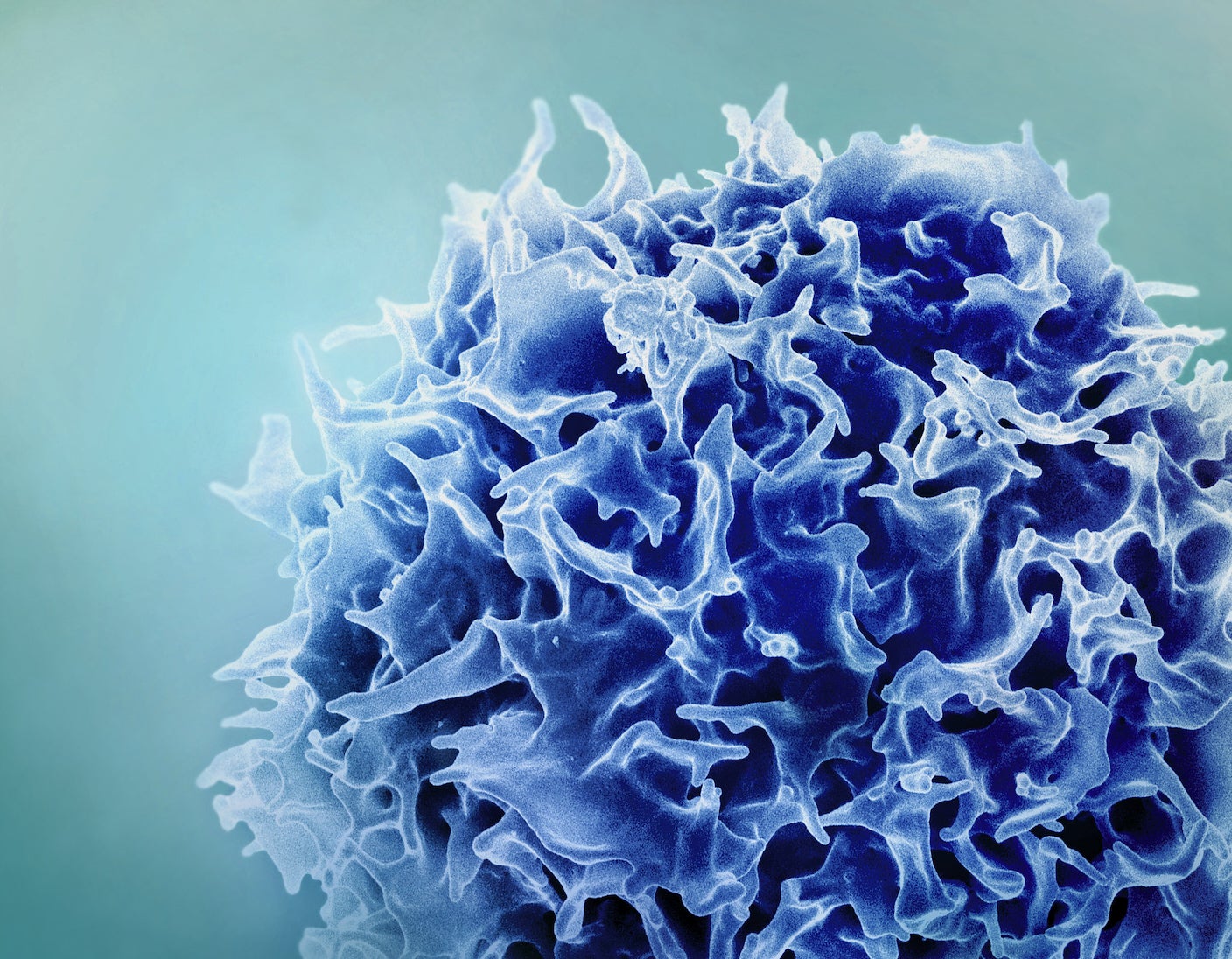

With just a single injection, a new treatment transforms immune cells in cancer patients into efficient tumor-killing machines. Now equipped with homing beacons, the cells rapidly track down and destroy their cancerous foes.
The shot is based on CAR T cell therapy, a breakthrough that uses genetic engineering to supercharge cancer-fighting T cells. Since its first FDA approval in 2017, CAR T has vanquished some deadly cancer cases with a one-and-done treatment.
But the technology is costly—for both body and wallet. CAR T cells are usually made outside the body in a lab. Patients undergo chemotherapy and other harsh treatments to make room for the enhanced immune cells, taxing an already ailing body with side effects. Making CAR T cells also takes precious time, and unfortunately, the clock often runs out.
At this year’s American Society of Hematology Annual Meeting & Exposition, an Australian team presented a different approach: Transforming normal T cells into super soldiers inside the body. Four people treated for stubborn multiple myeloma—a blood cancer that destroys bones and kidneys—went into remission for up to five months.
Led by Phoebe Joy Ho at the University of Sydney in collaboration with Kelonia Therapeutics, the trial, although small and still preliminary, marks a step towards the next revolution in CAR T therapy. Reported in The American Journal of Managed Care, an audience member from the conference said the findings “take your breath away.”
Silver Bullet
CAR T therapy has transformed cancer care. Six formulations are approved in the United States for a variety of blood cancers. Hundreds of clinical trials that expand the life-saving technology to solid cancers—including breast and brain tumors—are underway.
Beyond cancer, the therapy is also being used to treat life-long autoimmune diseases, such as lupus and multiple sclerosis, where the body’s immune system destroys its own organs. A small trial found a single infusion of CAR T cells reduced symptoms in patients with lupus. Other efforts are using these custom living drugs to tamp down infections, restore heart health after an attack, and remove the “zombie cells” that accumulate during aging.
The procedure usually goes like this: A patient’s own T cells are extracted from their blood. Using gene editing tools, like CRISPR, the cells are supplied with extra protein “hooks.” These hooks let them better grab onto their targets—cancer cells or otherwise.
After a short course of chemotherapy or radiation to deplete existing immune cells and make room for new ones, the engineered CAR T cells are infused back into the body. Once there, the genetically engineered cells repopulate the immune system and hunt down their prey. The process, while undeniably efficient for some cancers, is costly and takes months—time that some patients don’t have.
“Off-the-shelf” CAR T is one solution. Instead of editing a patient’s own cells, scientists could transform a healthy population of donor T cells. But attempts have faced immune rejection. Even with more genetic tinkering, the cells struggle to survive and expand in the body.
One Shot Wonder
An alternative method directly converts a person’s T cells inside their own body.
In 2022, a team designed a shot to reprogram T cells using RNA. This avoids tinkering with a patient’s DNA. In mice with heart scarring, the injection revived the organ.
Other successes soon followed. Another shot converted T cells into CAR T cells within hours in mice and monkeys. The therapy targeted a type of blood cancer deriving from an overgrowth of B cells (another immune cell type). The shot boosted the immune system’s ability to destroy cancers in mice and slashed B cell numbers in monkeys. The effects lasted at least a month.
Both these treatments used fatty nanoparticles to deliver their payloads. They were also heavily modified to get around the so-called liver “sink.” Treatments often end up in the organ after injection. Careful design of surface proteins helped the therapies home in on T cells.
Gene-editors can also hitch a ride on a benevolent virus, stripped of disease-causing genes but highly efficient at tunneling into cells. Kelonia’s new technology used a virus to target T cells and avoid other cell types. One tweak, for example, added a small, engineered protein fragment that precisely targets T cells. Once inside, the payload synthesizes a gene that kills cancers.
The trick paid off. In a small trial, researchers gave the shot to four patients with previously uncontrollable multiple myeloma. The patients showed no signs of cancer in their bone marrow after a month. For one, the effect lasted at least five months. The side effects were also relatively minor, although some experienced mild cytokine release syndrome—an immune reaction that causes fever, chills, and other symptoms, which were easily managed.
The results come on the heels of a separate trial with similarly positive results. In July, four patients with multiple myeloma received an infusion of a virus carrying genes targeting T cells. Crafted by EsoBiotec in Belgium and Shenzhen Pregene Biopharma in China, the shot vanquished abnormal cells in the bone marrow of two patients after three months. The patients had previously undergone multiple cancer-related therapies to no avail.
The treatment did come with side effects. Blood pressure plunged, and two patients required supplemental oxygen. One showed confusion and temporary “brain fog.” These mental troubles aren’t common with traditional CAR T therapy, motivating researchers to find out why.
Despite risks, results from both trials highlight the promise of one-and-done CAR T therapy for deadly blood cancers. But it’s still early days. Scientists need to carefully follow patients over years to understand how long upgraded T cells remain in the body and their effect on cancers.
And not all viral carriers are made the same. Lentiviruses, used in both studies, can tunnel into the human genome, causing DNA typos that potentially trigger secondary cancers. The durability of the therapy, its longevity, and immune side effects also need to be studied.
Kelonia is adding more patients to their trial, amid an increasingly competitive landscape. AstraZeneca has acquired EsoBiotec to bring its technology to market. AbbVie, a drug company in Illinois, is testing the delivery of gene-editing tools to T cells via fatty nanoparticles in clinical trials. And Kelonia is planning a second clinical trial with an initial 20 patients and 20 more in an expansion phase, none of whom responded to at least three previous treatments.
“I think it gives us a glimpse into the future,” Ho told Science. “In vivo CAR T for multiple myeloma is here and hopefully it will stay.”
