

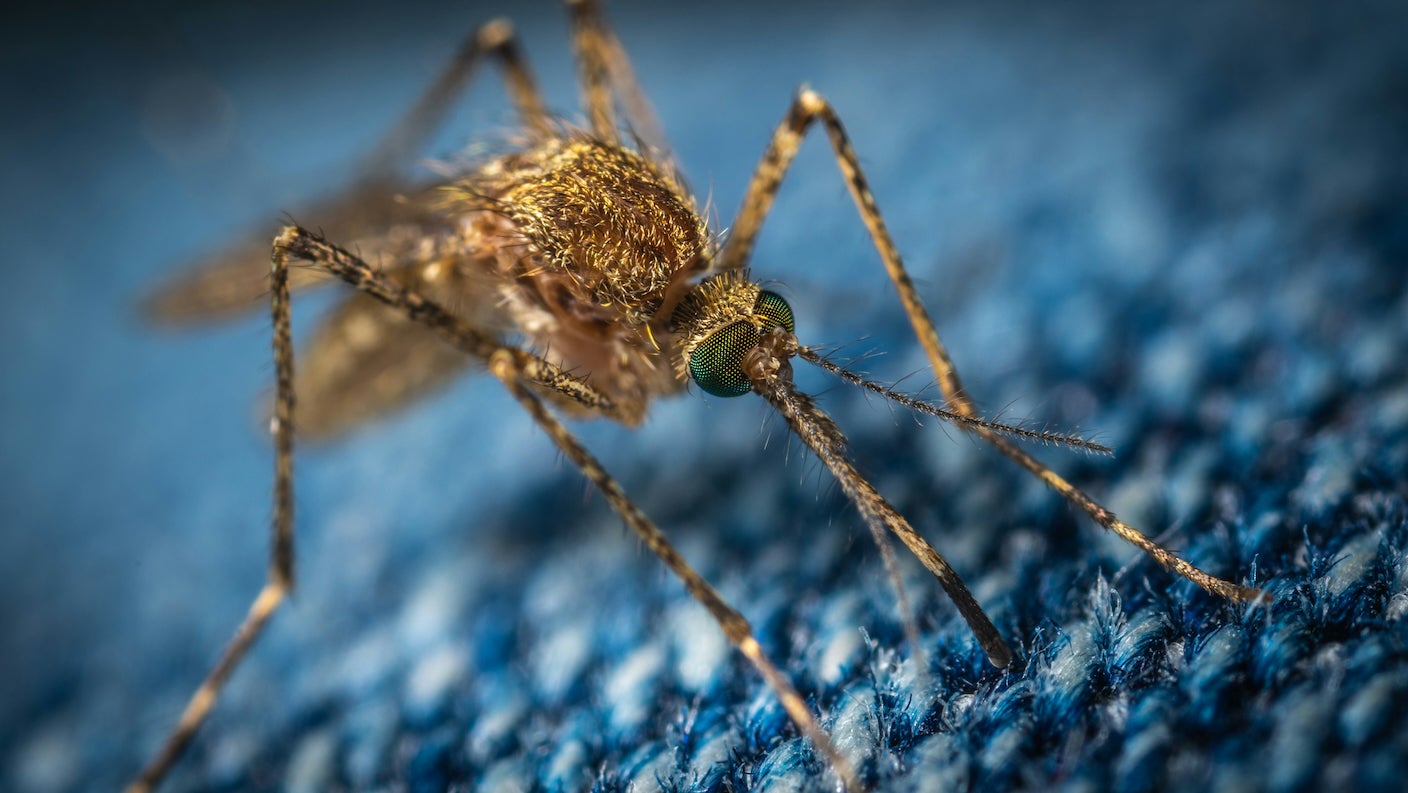

Mosquitos are perhaps one of the most universally loathed creatures. Not only are their bites itchy and annoying, they carry diseases that kill nearly 600,000 people worldwide—making them the deadliest animal.
Yet they’ve thrived for millions of years, partly due to the female’s efficient “stinger.” Called a proboscis, the organ’s stiffness allows it to penetrate the skin and into the bloodstream with high precision, but its tiny size and structure don’t tip off the host until it’s too late.
These advantages caught Changhong Cao’s eye at McGill University. Inspired by mosquitos, the bioengineer and his team developed a high-resolution 3D printer using a mosquito proboscis as the nozzle. Called necroprinting, the system prints lines half the width of commercially available printers. In tests, it reliably completed multiple complex 3D structures in bioink, including honeycombs, a maple leaf, and a waffle-like housing encapsulating cancer and red blood cells.
“Repurposing dispensing structures from uninfected, laboratory grown, deceased organisms represents a new avenue for engineering applications, which not only reduces the cost of high-resolution dispense tip production but also minimizes environmental impact,” wrote the authors.
Tips From Evolution
Engineers have long tapped Mother Nature for inspiration.
Early successes relied on mimicry, including self-cleaning surfaces inspired by lotus leaves or Velcro’s famous hook-and-loop structure derived from burdock burrs. More recent innovations combine soft, flexible biomaterials and living cells with plastics to form biohybrid robots capable of sensing, healing, and adapting to environments.
Another trend, perhaps more macabre, takes advantage of the complexity of animal anatomy. Mud eels, Madagascar hissing cockroaches, and beetle legs have been used to create biohybrid devices to monitor medical conditions and the environment. Necrobots repurpose spider legs into microgrippers that allow the legs to expand when activated and reverse to their natural state in a claw-like motion. The grippers can grasp randomly shaped objects up to 130 percent of their own weight, offering a low-cost, efficient, and biodegradable alternative to conventional grippers.
While biohybrid systems have mainly focused on robotics and sensing, Cao’s team had a different idea: Using animal materials in the manufacturing process, rather than the final product.
Nozzles were a favorable choice. For one, they’re widely used in 3D printing and in labs. Similar liquid-dispensing tips are currently made of nonbiodegradable materials—such as metals and plastics—with the US alone churning through over four billion annually.
They’re also costly, especially for high-resolution tips. The finest commercially available metal printer tips have an inner diameter of around 35 micrometers—roughly the size of a single human skin cell. A hefty price tag of over $80 per tip limits the technology’s use.
Natural Selection
Cao’s team started their search for a natural printer head with a vast survey of animal appendages.
Among these were scorpion stingers, snake fangs, harpoons from cone snails, and claws from a variety of deadly bugs. Each had a unique shape, length, and inner diameter optimized for the animal—but not necessarily for a printer nozzle.
An ideal nozzle should be straight like a needle, with relatively high stiffness to keep its shape as fluid flows. A small inner diameter is also crucial for high printing resolution, with a length that’s easy to manipulate but not too long, as this leads to pressure buildup and failure.
In their search, the female mosquito proboscis stood out. Its biopolymer core helps maintain a straight structure, similar to a microneedle, as liquids flow through. The organ also boasts a tiny diameter of just 20 micrometers. It’s smaller than commercially available tips and has a stiffness similar to common plastics.
The mosquito proboscis previously inspired microneedles used in biopsies to diagnose cancer with minimal trauma to nearby tissues. Those needles use human-made materials. The new study used the actual organ itself from lab-farmed mosquitos into their 3D printing setup.
A Sustainable Printer
To harvest each proboscis, the team bathed frozen, lab-raised female mosquitoes in alcohol to sterilize them before removing the organ. They then designed a custom adapter to connect the proboscis to a metal tip attached to a mechanical extruder, which regulates the flow of fluids.
Resin seals the gap between the commercial and biological dispense tips to prevent leakage. The custom 3D bioprinter has a vertical arm that lifts the nozzle up and down and a horizontally moving “stage” at the bottom that acts as the printing canvas.
In tests, the team found the necroprinter could generally handle commercial inks used for bioprinting, although the proboscis tore if the liquid ran through too quickly. Similar to a tiny straw, the system also failed if the ink clogged at the bottom and ruptured that end. Balancing the speed of ink released from the nozzle and the speed of nozzle movement took calibration.
Imbalance of those forces generated a pressure buildup, “ultimately leading to either gushing of ink or catastrophic rupture of the mosquito proboscis,” the team wrote.
But once the parameters were dialed in, the necroprinter performed accurately and predictably. It readily printed lines roughly 20 micrometers in width, outperforming state-of-the-art nozzles. It also managed to precisely print more complex shapes such as honeycombs and maple leaves.
The microscopic structures surpassed the resolution capabilities of standard metal and plastic dispense tips, wrote the authors.
A third demo used a bioink containing cancer or red blood cells. The necroprinter generated structures laden with cells, which remained alive and healthy. Finally, the printhead showed promise for high-resolution drug delivery. Loaded with hydrogel, it deposited the material into pig skin at extremely low volumes that mimicked therapeutic delivery.
Compared to engineered 3D printheads, a mosquito proboscis is highly consistent in inner diameter and wall thickness. It’s also very affordable. According to the team, it costs just two cents to raise a single mosquito, and assembling a necroprinting dispense tip is less than a dollar.
However, because the tips contain biological tissue they may not be as long-lasting as plastic components. Initial tests found they last for about nine days on the counter and at least a year stored in a freezer. The nozzles also operate in temperatures comfortable for mosquitoes (roughly 20 to 30 degrees Celsius or 70 to 85 degrees Fahrenheit), but extreme shifts can cause catastrophic failure. The team is now mapping temperature boundaries.
Despite potential roadblocks, the system shows the promise of integrating biological material into advanced manufacturing.
