


Why you can trust TechRadar
We spend hours testing every product or service we review, so you can be sure you’re buying the best. Find out more about how we test.
It’s often said that if at first you don’t succeed, you should try again. With Nintendo’s Virtual Boy rerelease for the Nintendo Switch and Nintendo Switch 2, I wonder if it maybe should have ignored that advice.
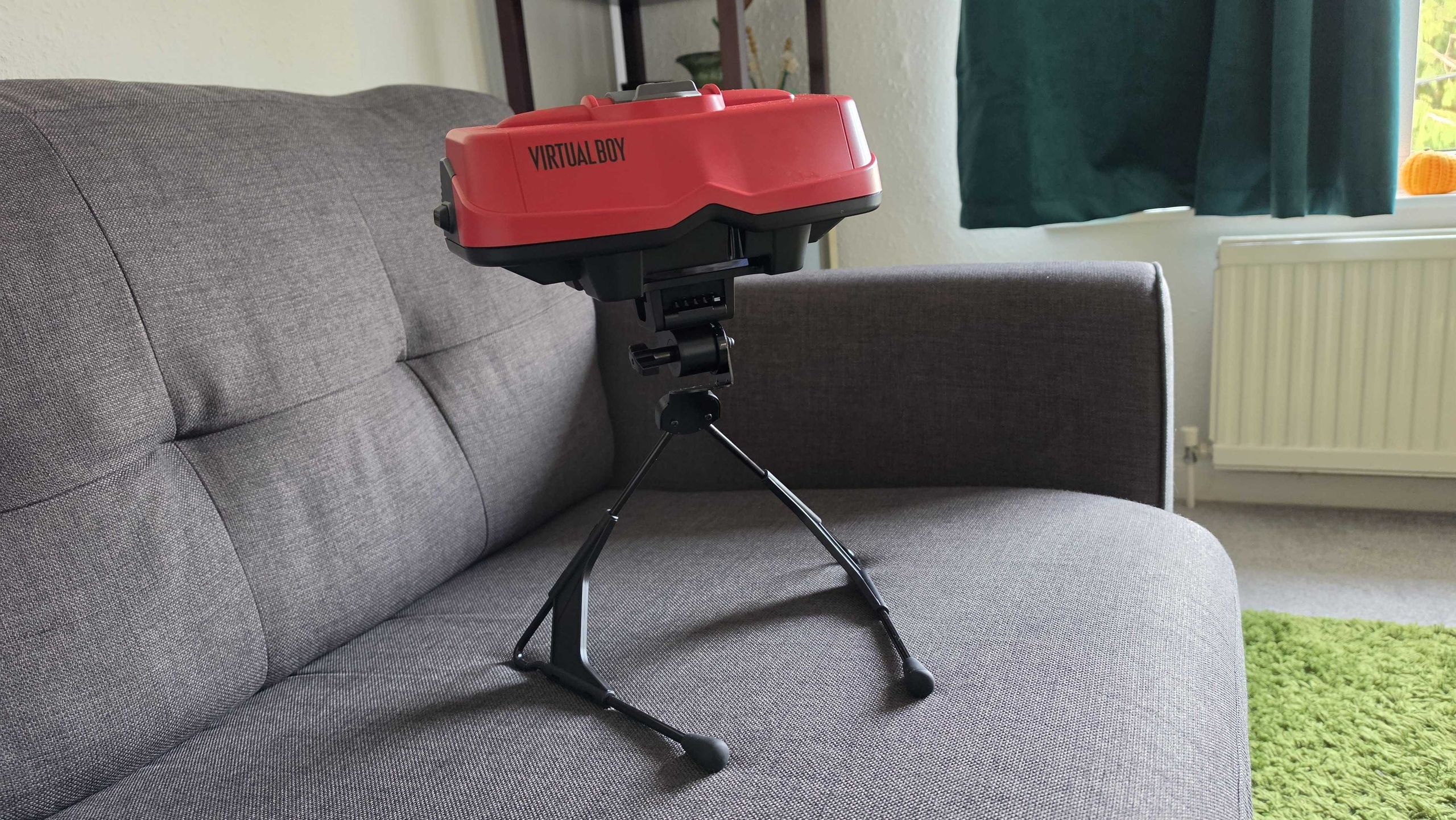
On the one hand, the Virtual Boy accessory for the Switch and Switch 2 is the ultimate novelty. The plastic recreation oozes an iconic 90s energy that somehow infected even me — someone born years after the Virtual Boy was discontinued — with a synthetic nostalgia that had me falling in love with its outer design. And as a VR fanatic, it’s a delight to experience one of VR’s earliest consumer interpretations.
On the other hand, Nintendo’s dedication to its history means it has left the headset and its games practically unchanged — which isn’t a good thing here. The Virtual Boy’s game library is as small and terrible as ever, and comfort very much feels like an afterthought.
So the question you have to ask yourself is this: do you want to spend $99.99 / £66.99 / AU$139.95 on a 10-minute novelty that will spend a lot more time on your shelf as a sculpture than on your face?
Nintendo Virtual Boy: Price
The proper Virtual Boy accessory will cost you $99.99 / £66.99 / AU$139.95, though if you simply want to experience the Nintendo Classics collection and don’t want to waste too much money, there’s also a cardboard version that costs $24.99 / £16.99 / AU$29.95. You can pick up either from Nintendo’s online store.
While this review isn’t generally positive about the Nintendo headset, if you are going to get one of the accessories, I believe you should at least get the proper non-cardboard version. I don’t believe you should get either for what it’s worth, but the properly recreated model looks rad and could be repurposed as shelf decoration when you’ve finished playing with it after a few short sessions.

Nintendo Virtual Boy: Design
When Nintendo debuted this VR headset back in 1995, it promised the Virtual Boy would “totally immerse players into their own private universe.” It certainly achieved this, though I do prefer my universes with a lot less red and a lot less nauseating.
It turns out plenty of other folks didn’t like what the Virtual Boy was delivering either. Despite predicting millions of global sales by the end of 1995, Nintendo shipped a mere 350,000 units in the US that year, and only around 770,000 globally by the time it was discontinued in 1996.
One of the big issues with the headset was, and still is with this Switch recreation, its design.
Too bulky to even attempt to wear on your head like a Meta Quest 3 — especially if you’re a kid, Nintendo’s typical target audience — Nintendo opted to have the original Virtual Boy rest on a stand. Despite being a lot lighter, the Switch accessory version can also only be perched on a roughly foot-tall stand at its max height. A design decision that created its own comfort conundrum.

After you’ve struggled to search for an appropriately tall table and/or a stack of books to place the headset on top of, you then have to hunch over to press your face into the console so you can peer into its stereoscopic worlds. This is not a comfortable way to sit for very long, and there’s no other alternative.
Here’s where you brush up against the next poor design decision: the red displays.
To act as a cost-cutting and processing power-saving method, the Virtual Boy’s screens were entirely red, and to mimic this, the Switch accessory uses two planes of red plastic — one for each eye. Opening up the headset, you slot your Switch or Switch 2 with the Virtual Boy software open to play games through this red filter to mimic the classic’s ruby hue.
If you think VR is nauseating at the best of times, just imagine what it would be like if your entire vision were merely shades of red.
Let’s just say my play sessions maxed out at 10 minutes before I needed a lie down — and I can usually stomach hours-long VR gaming if using other headsets.

Though I will say the Switch’s Virtual Boy add-on isn’t a total design flop.
As I mentioned in the intro, the classic Nintendo headset feels definitively like a gadget of the 90s, and half of that is how it looks — something this model recreates perfectly. Unboxing it in our office, even as someone who grew up in the 00s, I did feel like I was living out one of those grainy home videos of a kid ripping open their Christmas gifts.
There’s something magical about the Virtual Boy’s appearance, even if it’s not the most practically useful, though that’s where my praise ends.
Virtual Boy: Software
The original saw 22 games released before it was canned entirely, but for now, the Nintendo Switch version only has seven: 3D Tetris, Galactic Pinball, Golf, Red Alarm, Teleroboxer, The Mansion of Innsmouth, and Virtual Boy Wario Land. With the March catalogue update for Mario Day, they’ll be joined by two more: Mario Tennis and Mario Clash.
All of these titles are accessed via the Nintendo Classics software included with your Switch Online + Expansion Pass membership, which will cost you $49.99 / £34.99 / AU$59.95 for 12 months.
The smallish collection size isn’t ideal, but it could be overlooked if there were a definite must-play or two amongst the selection. Unfortunately, there isn’t anything exciting enough to make me want to push through the discomfort of using the system.

Wario Land is fun if you’re a fan of Mario’s doppelganger, and I liked Galactic Pinball well enough, but titles I had hopes would be fun — Tetris and Red Alarm — lacked not only entertainment but made me want to hurl. It turns out a spinning red teris board just isn’t the best way to play the game if you like keeping your lunch in your stomach.
You can extract maybe 5 to 10 minutes of novelty from each title, and you might return to a handful when you want to subject your friends to this hardware, but none of them sell this accessory as a bona fide gaming machine.
Nintendo Virtual Boy: scorecard
|
Attribute |
Comment |
Score |
|---|---|---|
|
Design |
From a usability perspective the Virtual Boy gets a very low score for its discomfort and red plastic displays, but the design does at least look wonderfully 90s so It gets some marks back. |
2/5 |
|
Software |
The Virtual Boy’s library is small and none of its titles are all that enjoyable, especially given the nausea they can induce. |
1/5 |
|
Value |
The Virtual Boy is a complete novelty, and when there are so many other better things for you to spend your money on this terrible Switch accessory isn’t worth it. |
1/5 |
Should you buy the Nintendo Virtual Boy?
Buy it if…
Don’t buy it if…

How I tested the Nintendo Virtual Boy
I used the Virtual Boy for two weeks for this review, though my sessions admittedly didn’t last too long, as it kept making me feel ill. I relied on my Nintendo Switch 2 and its base Joy-Cons to experience this add-on’s VR experiences and used it in our office, at home, and even took it on a flight — it’s even more awful in the air, terrible VR and turbulence don’t mix.
First reviewed March 2026
