

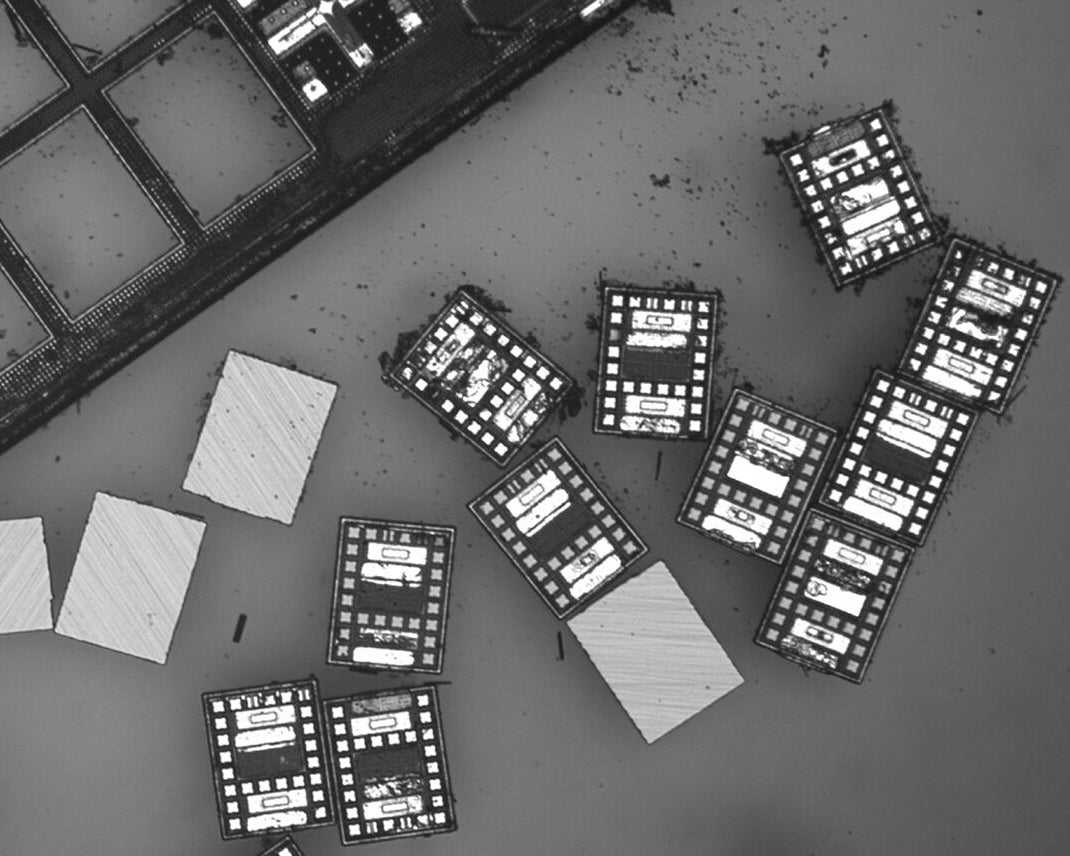

The robots, each the size of a single cell, casually turn circles in a bath of water. Suddenly, their sensors detect a change: Parts of the bath are heating up. The microrobots halt their twirls and head for warmer waters, where they once again settle into lounge-mode—all without human interference.
For 40 years, scientists have tried to engineer ‘smart’ microrobots. But building microscopic machines that sense, learn, and act based on their programming has eluded researchers. Today’s most sophisticated robots, such as Boston Dynamics’ Atlas, already embody these functions using computer chips, algorithms, and actuators. The seemingly simple solution would be to simply shrink down larger systems, and voila, mission accomplished.
It’s not so easy. The physical laws governing semiconductors and other aspects of robotics go sideways at the microscopic scale. “Fundamentally different approaches are required for truly microscopic robots,” wrote Marc Miskin and team at the University of Pennsylvania.
Their study, published last week in Science Robotics, packed the autonomous abilities of full-sized robots into microrobots 10,000 times smaller—each one roughly the size of a single-celled paramecium. Costing just a penny per unit to manufacture, the bots are loaded with sensors, processors, communications modules, and actuators to propel them.
In tests, the microrobots responded to a variety of instructions transmitted from a computer workstation helmed by a person. After receiving the code, however, the bots functioned autonomously with energy consumption near that of single cells.
While just prototypes, similar designs could one day roam the body to deposit medications, monitor the environment, or make nanomanufacturing more adjustable.
Spooky Physics
Intelligent living “microrobots” surround us. Despite their miniature size and lack of a central brain, single-celled creatures are quick to sense, learn, and adapt to shifting surroundings. If evolution can craft these resilient microorganisms, why can’t we?
So far, the smallest robots that can sense, be reprogrammed, and move on command are at least bigger than a millimeter, or roughly the size of a grain of sand. Further shrinking runs into roadblocks based on fundamental physical principles.
Just as quantum computing departs from everyday physics—with one computational quirk famously called “spooky action at a distance” by Albert Einstein—the rules that guide computer chip and robotic performance also begin to behave differently at the microscopic scale.
For example, forces on a robot’s surface become disproportionately large, so the devices stick to everything, including themselves. This means motors have to ramp up their power, which swiftly exhausts scarce energy resources. Drag also limits mobility, like trying to move with a parachute in strong winds. Processors suffer too—shrinking down computer chips causes noise to skyrocket—while sensors rapidly lose sensitivity.
You can get around all this by controlling a bot’s movement externally with light or magnets, which offloads multiple hardware components. But this sacrifices “programmability, sensing, and/or autonomy in the process,” wrote the team. Such microrobots struggle in changing environments and can only switch between a limited number of coded behaviors.
Alternatively, you can weave functions directly into the materials so microrobots change their properties as the environment shifts. This also switches their computation. Most examples are soft and biocompatible, but they’re harder to manufacture at scale and often require expensive hardware to control, crippling real-world practicality.
Honey, I Shrank the Chips
Many of the essential, miniaturized components needed for “smart” microbots already exist. These include tiny sensors, information processing systems, and actuators to convert electrical signals into motion. The trick is wiring them all together. For example, given a “limited power budget,” it’s difficult to accommodate both propulsion and computation, wrote the team.
The team optimized each component for efficiency, and the design relied on tradeoffs. Increasing the microbot’s memory took more energy, for example, but could support complex behaviors. In the end, they were limited to just a few hundred bits of onboard data. But this was sufficient to store the microbot’s current state, or the memory of its actions and past commands. The team wrote a library of simple instructions—like “sense the environment”—which could be sent to the bots.
The final design has mini solar panels to soak up beams of light for power, temperature sensors, and a processing unit. A communications module, also using light, receives new commands and translates sensor readings into specific movements.
The team made the bots in bulk using a standard chipmaking process.
In one test, they asked the microbots to measure nearby temperature, digitize the number, and transmit it to the base station for evaluation. Instead of infrared beams or other wireless technologies, the system relied on specific movements to encode temperature measurements in bits. To save energy, the entire process used only two programming commands, one for sensing and another to encode and transmit data.
The microrobots beat state-of-the-art digital thermometers, capturing temperature differences of 0.3 degrees Celsius in a tiny space. The technology could be used to probe temperature changes in microfluidic chambers or tiny blood vessels, wrote the team.
The bots can also move along heat gradients like living organisms. At rest, they stay in place and turn in circles. But when they detect a temperature change, they automatically move toward more heated areas until the temperature is steady. They then switch back into relaxed mode. Beaming a different set of commands asking them to move to colder regions reverses their trajectory. The microrobots faithfully adapt to the new instructions and settle in cooler waters.
The team also built in passcodes. These pulses of light activate the microrobots and allow the researchers to send commands to the entire fleet or only to select groups. They could potentially use this to program more sophisticated robotic swarm behaviors.
Although still prototypes, the microrobots have a reprogrammable digital brain that senses, remembers, and acts. This means the scientists can assign them a wide range of tasks on demand. Up next, they aim to add communication between the microrobots for coordination and upgrade their motors for faster, more agile movement.
