


I genuinely pity people coming into the home theater space in 2026. While the technology is better than ever, there’s such a baffling number of terms and standards — and products associated with them — that it can be hard to know where to begin. Perhaps it’s no wonder that some people might just wander into a store and walk out with the largest TV they can afford.
When it comes to speaker connections, there are several predominant connection types available: ARC, eARC, optical, 3.5mm, Wi-Fi, and Bluetooth. I’m going to explain why in the majority of situations, you should stick with ARC or eARC. There are cases to be made for some of the other formats, however, which may have their place depending on your TV and your budget.
What are ARC and eARC, and why are they usually the best?
Built for your TV

ARC stands for Audio Return Channel. It’s a standard tethered to HDMI, the same cable type you use to direct video to your TV. It was first introduced alongside the HDMI 1.4 spec in 2009. eARC, meanwhile, is an upgrade that arrived with HDMI 2.1 in 2017. If you’re lucky enough to have a TV with HDMI 2.2, you’re still using eARC.
The first advantage of ARC and eARC is simplicity. Because audio can be delivered alongside video, there’s no need for a dedicated audio cable of any kind. In fact when a compatible speaker is hooked up, it can receive audio from any other HDMI source connected to your TV, such as a media streamer or game console. Perhaps the simplest external audio setup for a TV is an ARC-based soundbar.
Another perk is support for CEC. The meaning of that acronym is unimportant — what does matter is that when you hit the power button on your TV remote, your speaker(s) will turn on too, and you’ll be able to adjust or mute volume without a second control, or else “training” your primary one. With some ARC/eARC alternatives, you may need to manually disable your TV’s internal speakers to avoid an echo effect.
When you hit the power button on your TV remote, your speaker(s) will turn on too, and you’ll be able to adjust or mute volume without a second control.
For many of you, the biggest benefit will be increased bandwidth. ARC can handle about 1Mbps, which is enough for the compressed versions of the two big spatial (3D) audio formats: Dolby Atmos and DTS:X. Compressed means that it’s not in full fidelity — it may be good enough for most circumstances, but it won’t exploit the most expensive speaker systems. It’s usually compressed audio that you’re listening to when you stream from a service like Netflix or Disney+.
eARC ups the available bandwidth to 37Mbps. Such a dramatic leap means that it supports the uncompressed (i.e. lossless) versions of every format, Atmos and DTS:X included. You’re unlikely to need this most of the time, but you can get a taste of it with a Blu-ray disc that mentions Dolby TrueHD or DTS-HD Master Audio.
An important point here is that when you’re connecting a speaker system to your TV, it needs to be plugged into an HDMI port expressly labeled for ARC or eARC. Note also that while eARC speakers are backwards-compatible with ARC-only ports, you’ll be limited to ARC-level features. An ARC speaker can likewise be plugged into an eARC port.
There’s one last benefit to ARC and eARC, and that’s automatic lip sync. While other connections won’t necessarily fall out of sync with visuals, lip sync is integral to eARC, and supported by ARC.
Optical and 3.5mm
Holdouts from an earlier age

Your next best option after ARC or eARC is optical, also known as S/PDIF or TOSLINK. It’s a much older standard, originally created by Toshiba in 1983. Most people refer to it simply as optical, since it’s used well beyond Toshiba products, and the term describes exactly how it works — light signals bounced through a plastic, glass, or silica fiber cable. Glass and silica are preferable for range purposes.
For a while, optical was a gold standard in home theater tech. Its 384Kbps of bandwidth may not be enough for lossless, Atmos, or DTS:X, but it’s still sufficient for 5.1-channel surround sound, whether through Dolby Digital or DTS Digital Surround. Stereo should also sound pretty great courtesy of digital tech.
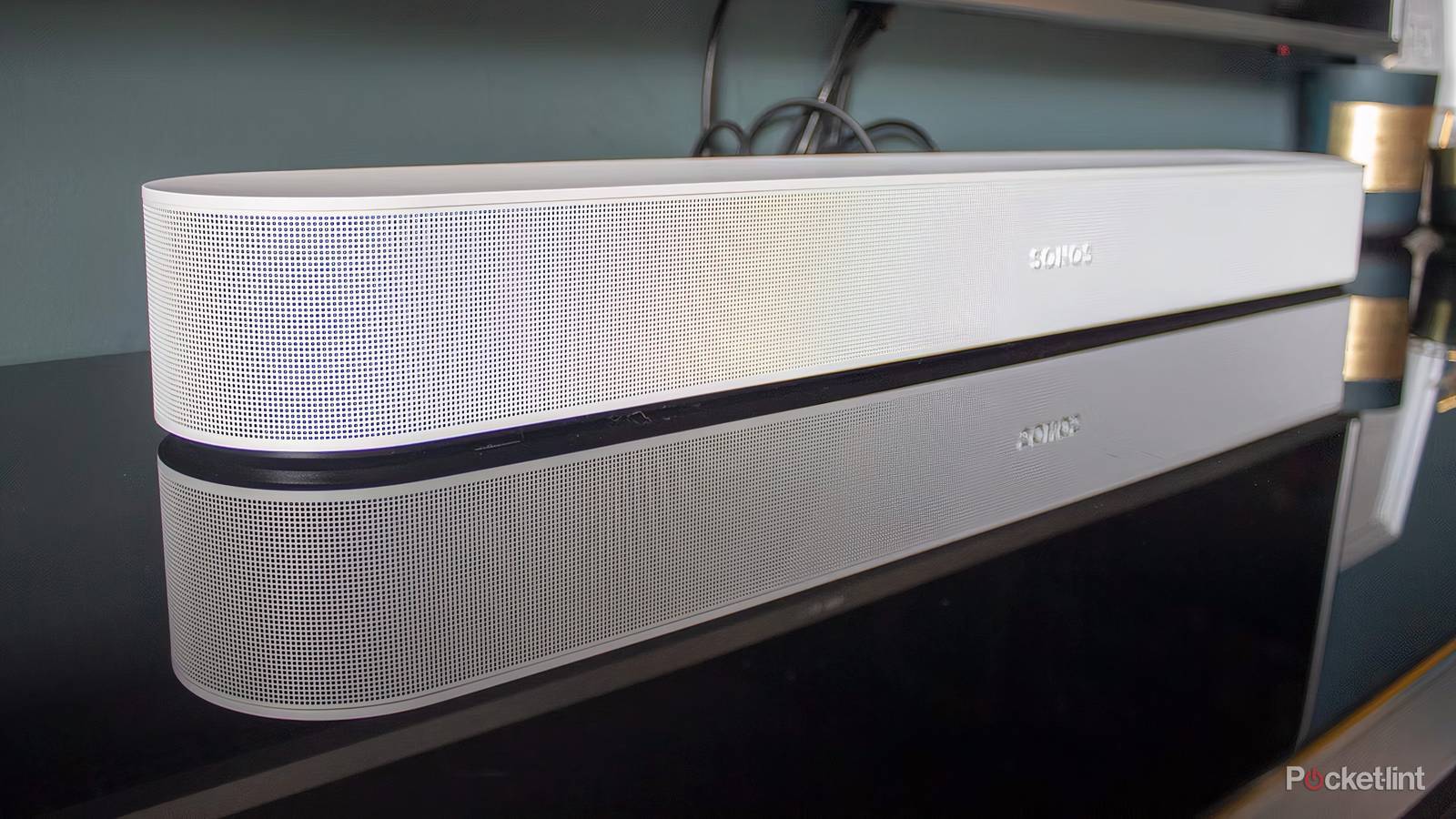
At this point, there’s only one real reason to choose an optical speaker: price. The Sonos Ray, for example, is over $200 cheaper than the eARC-equipped Sonos Beam. If you don’t care about lossless, Atmos, DTS:X, or CEC control, spending on ARC or eARC hardware may be pointless.
Hypothetically, you might also choose optical if your HDMI ports are full, but that’s a little ridiculous. If you can afford an ARC or eARC speaker, chances are you can spring another $30 for an HDMI 2.1 switch.
Avoid using 3.5mm if you can. You’ll most likely be limited to analog stereo, which is functional — digital formats can be downmixed — but robs you of the clarity of digital standards. Analog is also vulnerable to line interference, whereas a digital signal will be perfect as long as it makes it through.
What about Wi-Fi and Bluetooth?
The true alternatives to ARC and eARC

Bluetooth should also be avoided unless you’re pairing a set of headphones. While it’s convenient, Bluetooth is an intentionally low-bandwidth technology, which means it can’t handle lossless or true spatial audio. If Atmos or DTS:X is supported on your headphones, what you’re really hearing is a simulation rather than multiple channels in each ear.
There’s also a greater risk of audio falling out of sync. Your TV or media streamer can potentially compensate for this, but it’s just not an issue with ARC, eARC, or often optical or 3.5mm.
When it’s available, Wi-Fi is often just as good as ARC or eARC, if not better for the wireless factor.
Some TVs and devices can pair over Wi-Fi. This tends to be tied to a single platform, however. If you want a Wi-Fi setup for your Fire TV, for instance, you can only link select Amazon Echo speakers by way of Alexa. If you want to pair speakers with an Apple TV 4K, they have to support Apple’s AirPlay. Sonos speakers can only connect to each other over Wi-Fi.
When it is available, Wi-Fi is often just as good as ARC or eARC, if not better for the wireless factor. The bandwidth ceiling is actually far higher than eARC, measured in the hundreds or even thousands of megabits. It does have potential problems in the form of signal interference, and the chance of individual speakers dropping offline in a multi-channel setup — yet when it’s working as intended, it’s a thing of beauty. Indeed the only major reasons to skip Wi-Fi audio are compatibility, the lack of lossless or spatial audio in some products, and the cost. Simply buying an Apple TV 4K and a pair of second-generation HomePods will set you back about $730 — a fully decked-out Sonos system is nearly $3,000.
