

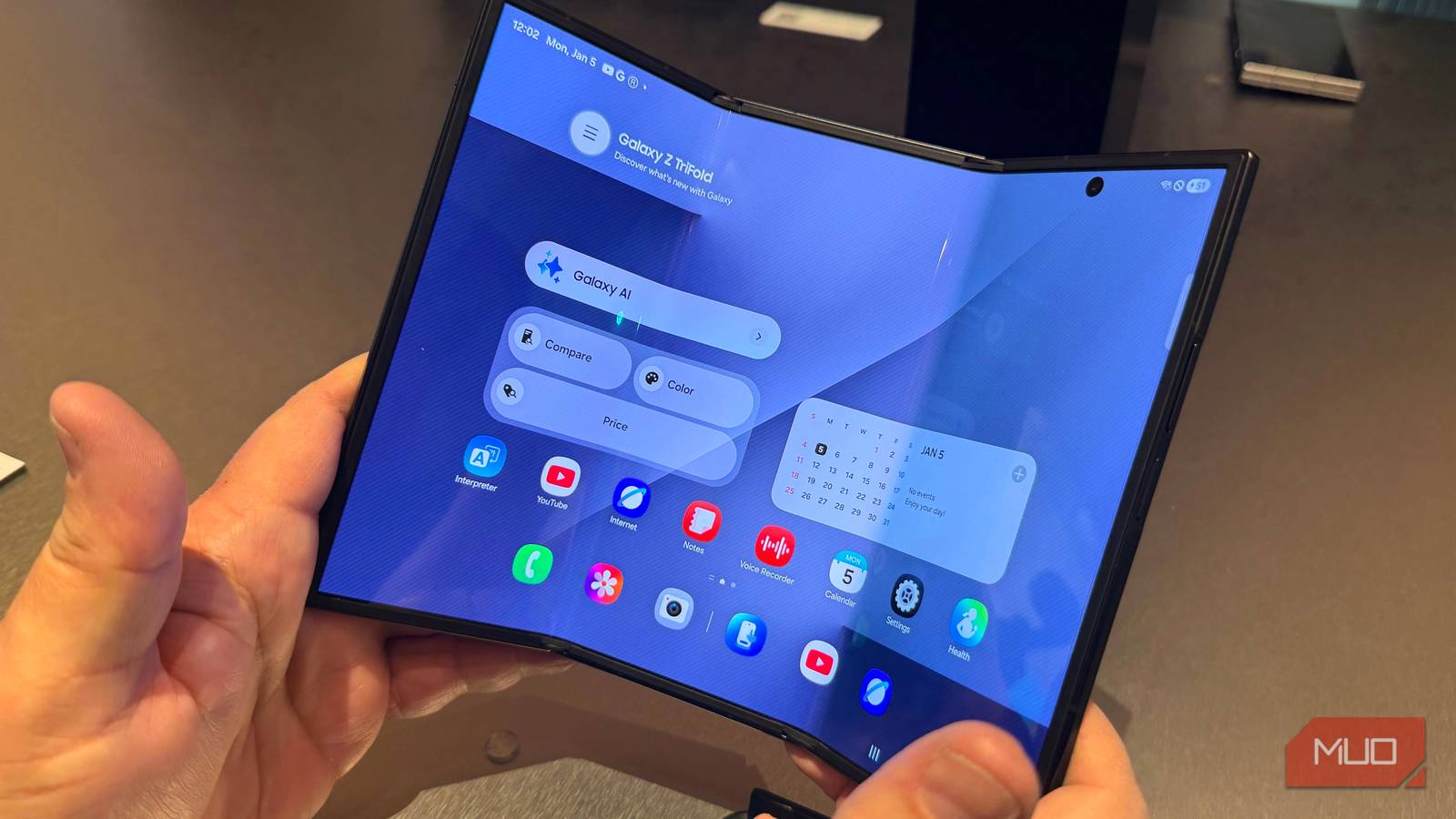

For years, foldable phones have promised to replace your smartphone and tablet in one wonderful device. For the most part, foldables have done exactly that, and the foldable market is packed with top-tier smartphones.
But tri-fold smartphones have taken that one step further, adding a second folding hinge to create a device that unfolds into something resembling a full tablet rather than the comfortable middle-ground.
Tri-folds are impressive, don’t get me wrong. The engineering to make them functional is pushing the boundaries of foldable tech. But in practice, the tri-fold market is dead before it’s really gotten going, and one company is directly behind the fall: Samsung.
Tri-folds are too expensive for real people
Reality bites

In mid-March 2026, Samsung unexpectedly announced it would phase out its triple-screened Galaxy Z TriFold just months after its official launch, and less than two months after it finally arrived in the US, sounding the death knell for the tri-fold market before it’s really even fully underway.
The biggest truth the tri-fold market cannot escape is price. The Samsung Galaxy Z TriFold launched for $2,899 in the US, and even then, it’s basically impossible to get hold of. A senior product reviewer at The Verge reportedly spent $4,399 to pick one up in early March, despite them having been on sale since late January.
It’s an unfathomable amount of money for a folding smartphone when you can pick up a Samsung Galaxy 26 Ultra for $1,300 and a Galaxy Tab S11 Ultra for $1,200 and have basically the same experience. Okay, you don’t have that experience in a single device, but guess what? Most folks don’t need both anyway, and much cheaper options exist.

The only other tri-fold phone to successfully hit the market isn’t really available in the US: the Huawei Mate XT Ultimate Design. Although Huawei’s wonderful-looking tri-fold is still available to buy, picking one up in the US will set you back more than double the original Chinese asking price, which, in fairness to Samsung, was also around $2,800 (20,000CNY).
That’s without even considering how much it would cost to replace the screen on a tri-fold. Huawei’s official site lists a Mate XT Ultimate Design screen replacement at more than $1,000.
More hinges, more problems
Durability complexity

Foldables already face scrutiny over durability. Adding another hinge doesn’t just double the complexity—it multiplies the potential failure points.
Tri-fold designs rely on multiple precision hinge systems working in tandem, often combining inward and outward folds. Huawei’s system, for example, uses dozens of moving components to manage the folding motion. The additional complexity introduces several issues:
- More wear over time
- Greater risk of mechanical failure
- Higher repairs costs
As mentioned in the previous section, a screen replacement for the Huawei XT Mate will set you back at least one thousand bucks, and that’s if you can even find someone to fix it in the US. As a friend who owns a Huawei XT Mate Ultimate Design was explaining to me, they had to travel to a specific location in Mexico to get their screen replaced, and the fix itself may have completely destroyed the device if it went wrong.
It’s a high-risk device for most folks when much easier-to-use and maintain alternatives are readily available.
What’s the actual point of a tri-fold?
Justify their existence

Really, and most importantly, the justification for tri-folds doesn’t add up. Dual-fold devices have forged a productivity and entertainment niche and can be quite useful as a form factor. But tri-folds push even further into that niche and potentially make them less attractive compared to devices that just do that job better.
It’s a balance. Dedicated devices have large, uninterrupted displays, better app optimization, lower cost, and no fragile hinges. Then there are other issues, such as app support; finding apps that can make proper use of the tri-fold form factor isn’t easy.
I will concede it’s early days for the tri-fold market, and this situation will change. But then by extension, Samsung’s canceling its TriFold sets the market back again, especially in Western markets, as the Huawei tri-fold isn’t pushing design.

This foldable proves that folding phones can have few compromises
The biggest battery, a stylish design and an excellent camera are just some of the reasons to like the Honor Magic V6.
Tri-folds are pushing the limits
2026 is make or break
Tri-fold phones are engineering feats, and that’s why they may eventually overcome the weight of problems facing these devices.
Take Samsung’s Galaxy Z TriFold. With Samsung’s engineering prowess and a year to catch up to Huawei, the TriFold weighed 309g, folding down to 13mm thick. Some will say that’s too much, but given more time, tri-folds will decrease in weight.
For comparison’s sake, the iPhone 17 Pro Max weighs 233g, while the Huawei Mate XT Ultimate weighs 298g. Even Honor’s wonderful Magic V6 weighs 219g, which makes Samsung’s TriFold with a whole extra screen look positively reasonable.
However, competitors aren’t exactly flocking to catch up to Huawei and now Samsung. Honor’s long-rumored tri-fold is still just that, and while Tecno has brought two iterations of its tri-fold concept to MWC 2025 and 2026, the company was tight-lipped about when it might eventually make it to production.
And here we are back in a full circle: too expensive to develop, too expensive to sell, too fragile to justify. Unless something fundamentally changes—pricing, durability, or a genuinely compelling use case—they’re likely to remain exactly what they are right now: a flashy idea.

- RAM
-
16GB
- Storage
-
512GB or 1TB
- Operating System
-
Android 16; One UI 8
- Dimensions
-
159.2 x 75.0 x 12.9 mm folded; 159.2 x 214.1 x 3.9 mm unfolded
- Display type
-
Dynamic AMOLED 2X
- Weight
-
309 g
Samsung’s Galaxy Z TriFold is a triple-folding flagship with a dual-hinge design that expands into a 10-inch tablet-sized AMOLED display. It runs on Snapdragon 8 Elite with 16GB RAM, packs a 5,600mAh battery, and supports multi-window multitasking, effectively blending a smartphone and tablet into one device.
