

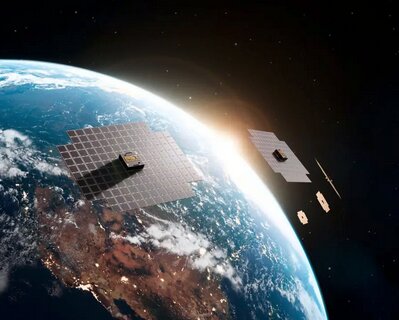

Blue Origins New Glenn’s New Glenn-3 (NG-3) will carry AST SpaceMobile’s next-generation Block 2 BlueBird satellite to low Earth orbit. The launch is scheduled for no earlier than late February from Launch Complex 36 at Cape Canaveral Space Force Station.
AST SpaceMobile cannot provide full continuous service until ~45-60 satellites are in orbit (targeting end-2026), requiring a few months for positioning and testing post-launch. Continuous service by late 2026 in the US, Europe, Japan, and other markets, supporting voice/video calls, texting, and streaming at 120 Mbps per cell for millions of daily connections. Full global rollout needs 90+ satellites.
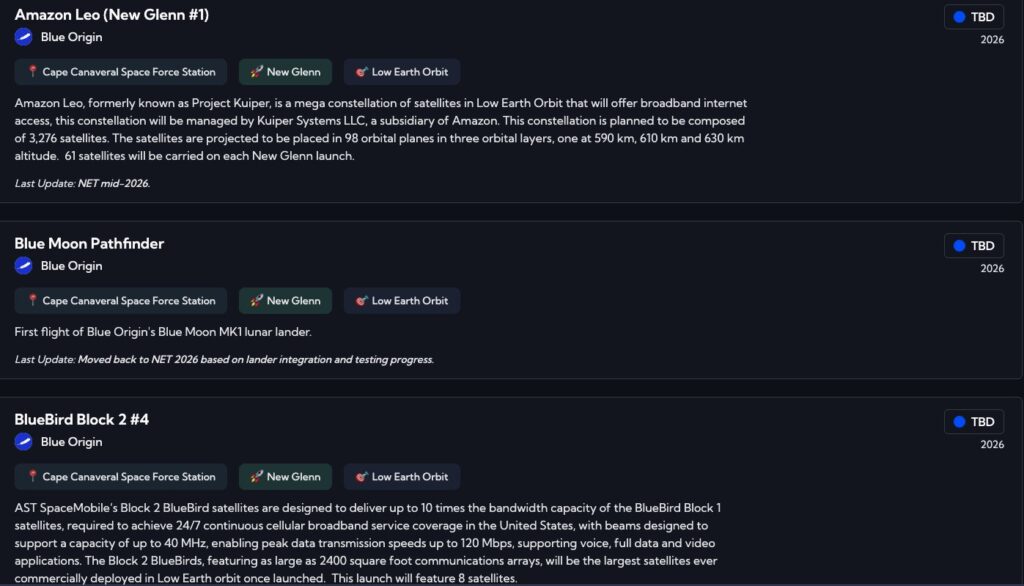
AST SpaceMobile’s Block 2 BlueBird satellites are designed to deliver up to 10 times the bandwidth capacity of the BlueBird Block 1 satellites, required to achieve 24/7 continuous cellular broadband service coverage in the United States, with beams designed to support a capacity of up to 40 MHz, enabling peak data transmission speeds up to 120 Mbps, supporting voice, full data and video applications. The Block 2 BlueBirds, featuring as large as 2400 square foot communications arrays, will be the largest satellites ever commercially deployed in Low Earth orbit once launched. The NG-3 launch will feature 1 satellite, BlueBird 7/BlueBird Block 2 FM2. This will be the second Block 2 AST satellite.
Blue Origin prioritizes Amazon satellites. Amazon Leo, formerly known as Project Kuiper, is a mega constellation of satellites in Low Earth Orbit that will offer broadband internet access, this constellation will be managed by Kuiper Systems LLC, a subsidiary of Amazon. This constellation is planned to be composed of 3,276 satellites. The satellites are projected to be placed in 98 orbital planes in three orbital layers, one at 590 km, 610 km and 630 km altitude. 61 satellites will be carried on each New Glenn launch.
Blue Origin is trying to reuse a booster. The GS1-SN002 will try have a 2nd flight. It was first flow 106 days prior IF the late February launch is not delayed.
AST has five orbital launches anticipated by the end of Q1 2026.
After the NG-3 Blue Origin mission there will be an Amazon LEO launch and then a NASA Pathfinder launch and then an attempt to launch 8 AST SpaceMobile satellites.
Tim Farrar, satellite analyst and president at TMF Associates, has been skeptical for some time about AST SpaceMobile meeting its ambitious goal of 45 to 60 satellites by the end of 2026, given it has a history of delays and missing targets. He does not expect AST to deliver a continuous service across the US this year. Further, he questions how many people will be willing to pay for D2D services.
After the launch of BlueBird 7 (targeting february), AST wants up to 13 launches total through the end of 2026. Farrar think seven launches this year after BlueBird 7 would get between 21 and 42 satellites launched. AST will be lucky to have 30 Block 2 satellites by the end of 2026. Blue Origin New Glenn is new. Any delays from 2026 with New Glenn and 8 AST satellites will get pushed to 2027.
STARLINK NEWS: Today, Japan’s largest mobile phone operator, NTT Docomo, announced a partnership with SpaceX to launch Starlink Direct-to-Cell service in early 2026. Docomo serves over 92.2 million mobile subscribers!
The name “Docomo” comes from “do communications over the… pic.twitter.com/sZFQwOl3U7
— S.E. Robinson, Jr. (@SERobinsonJr) February 10, 2026
SpaceX Starlink signed up NTT Docomo as a partner. SpaceX now has DTC (direct to cellphone partners) who has about 600 million subscribers. This is less than the 2-3 billion who partnered with AST. SpaceX has 650 V2 mini satellites offering DTC that is global and working at 2G-3G speeds and working for low resolution video calls, text and voice and slow data. AST only has test service with one commercial satellite.
Starlink partners are seeing 10-15% initial penetration for DTC.
Brian Wang is a Futurist Thought Leader and a popular Science blogger with 1 million readers per month. His blog Nextbigfuture.com is ranked #1 Science News Blog. It covers many disruptive technology and trends including Space, Robotics, Artificial Intelligence, Medicine, Anti-aging Biotechnology, and Nanotechnology.
Known for identifying cutting edge technologies, he is currently a Co-Founder of a startup and fundraiser for high potential early-stage companies. He is the Head of Research for Allocations for deep technology investments and an Angel Investor at Space Angels.
A frequent speaker at corporations, he has been a TEDx speaker, a Singularity University speaker and guest at numerous interviews for radio and podcasts. He is open to public speaking and advising engagements.
