

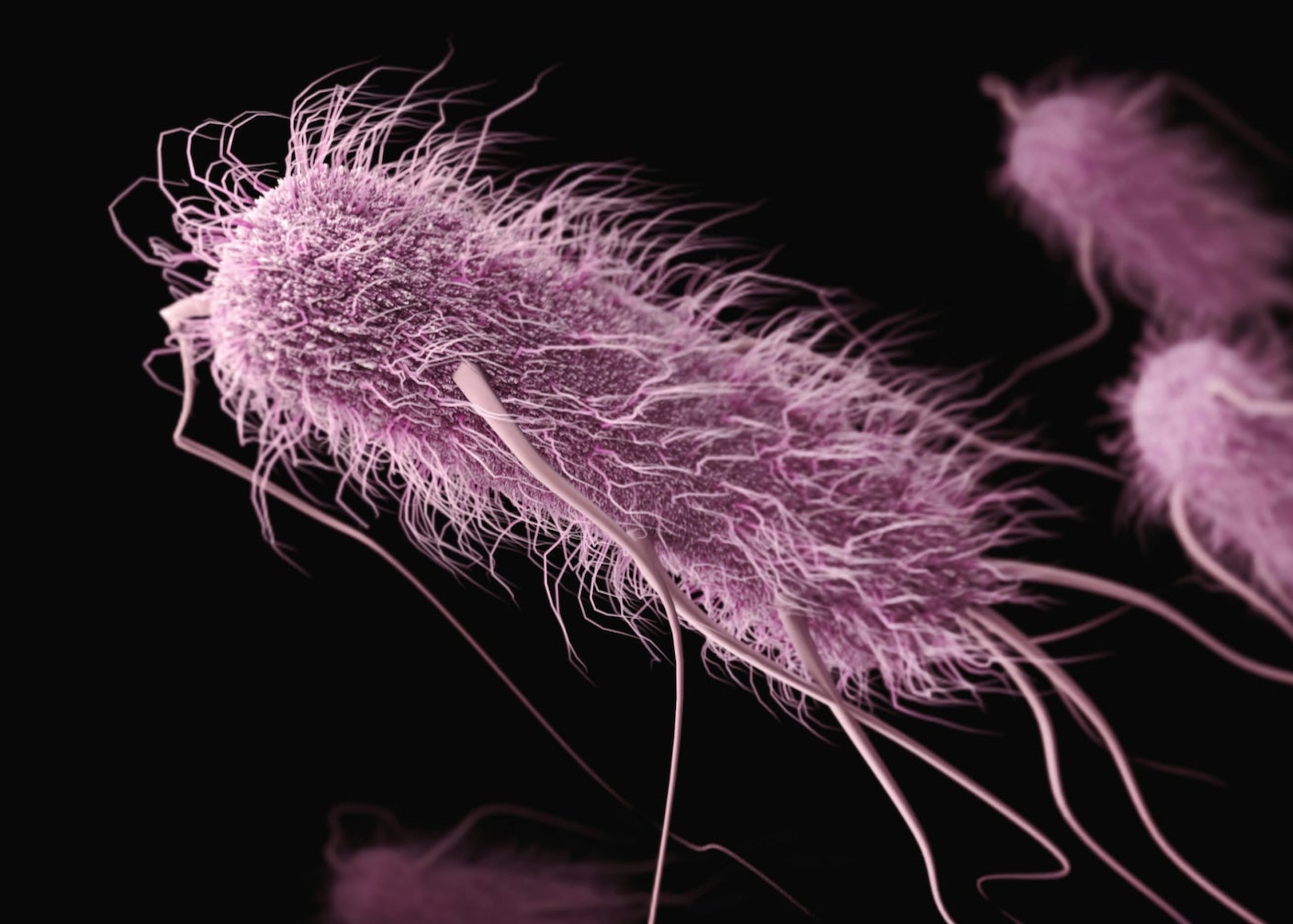

The bacteria grew, thrived, and divided for hundreds of generations. But they were unlike any other living creatures on Earth. These synthetic cells, called Ec19, were the first to have had one protein “letter”—or amino acid—partially removed.
All life today relies on a set of 20 amino acids to make proteins. Some exotic microbes can use 22, but no one has yet found any that use less. Like letters in a book, amino acids string into coherent protein “sentences” that relay messages and do work within cells. Deleting an amino acid is like trying to type without the letter “e.” The text becomes gibberish.
Or does it? A team from Columbia University and collaborators stripped one amino acid, isoleucine, from ribosomes in Escherichia coli (E. Coli) bacteria. These cellular machines translate DNA into proteins, and they’re among the most complex structures in cells.
Deleting any amino acids could be catastrophic. But with some help from AI, Ec19 was born.
“This is a meaningful and stringent test of the consequences of removing isoleucine from a proteome’s alphabet, because the ribosome is one of life’s most complex and indispensable macromolecular machines,” wrote Charles Sanfiorenzo and Kaihang Wang at the California Institute of Technology, who were not involved in the study.
For the past decade, scientists have been probing the boundaries of life by shrinking genomes in a variety of microbes, adding synthetic amino acids to living cells, and even creating the building blocks for “mirror life.” But they’ve rarely tinkered with the canonical 20 amino acids.
Ec19 rewrites the script, but not for scientific curiosity alone. The findings pave the way for AI to help scientists engineer designer proteins and cells with added capabilities for use in biotechnology and medicine. It could also give us a peek into the earliest life on Earth.
“It’s very exciting that it’s possible,” Julius Fredens at the National University of Singapore, who was not involved in the research, told Nature.
Alphabet Rewrite
Life has its own language. DNA’s four molecular letters—A, T, C, G—encode the genetic blueprint. Three-letter units of DNA, called codons, call for each of the 20 amino acids, along with a stop signal that ends protein making.
But the system is redundant. Evolution created 64 codons, with some encoding the same amino acids. Scientists have begun rewriting genomes by assigning redundant codons to synthetic amino acids, yielding working proteins never seen in nature. Because they’re foreign to our bodies, these could escape being broken down—an advantage for drugs designed to last longer. Other researchers are tinkering with the genetic code in bacteria, yeast, and worms, building chromosomes from scratch or probing the limits of a minimal genome that can still support life.
Even the most ambitious tests for synthetic life have avoided whittling down the canonical set of protein letters. But study author Harris Wong was intrigued by the prospect. Some amino acids have similar shapes and chemistry, hinting they could stand in for one another. And mounting evidence suggests early life may have operated using a smaller vocabulary.
The team analyzed nearly 400 proteins essential to E. coli, tracking how often each amino acid was naturally swapped without breaking the protein. Isoleucine took the crown. The bulky, branched molecule was frequently replaced by two cousins similar in shape and chemical behavior. If any amino acid could be removed, isoleucine was it.
The next problem was scale. Previous studies recoded the E. coli genome. But building a stripped-down version of the bacteria would require edits at more than 81,000 genomic sites, a daunting challenge that could take years.
Instead, the researchers focused on the ribosome. It was still a lofty goal. The machines that make proteins are essential to life and are themselves made up of 50 proteins. Removing an amino acid would be like ridding metal from every part of a car engine and expecting it to run.
“Successfully removing isoleucine from such a large and essential RNA-protein complex would raise the possibility of entire genomes functioning with simplified, noncanonical amino acid alphabets,” wrote Sanfiorenzo and Wang.
The team’s first attempt hit a wall. In multiple bacterial strains, they replaced isoleucine codons with a close natural substitute, an amino acid called valine. Out of the 50 ribosome proteins, 32 edited proteins either hindered growth or triggered death.
Almost ready to shelve the project, the team turned to AI. Like the large language models that power chatbots, these algorithms can be trained on DNA and protein sequences. They can then dream up new amino acid sequences and predict how they fold into working proteins.
In this case, the advantage was creativity. AI came up with unintuitive ways to replace isoleucine without catastrophically damaging a protein’s structure. It sometimes suggested ways to compensate for amino acid swaps by making tweaks located far away in the genome. The team then tested promising designs to see if the bacteria survived and how well they grew.
Eventually, they landed on 47 working ribosome proteins without isoleucine. The remaining three took some elbow grease. They replaced amino acids, one by one, until they found a recipe that worked.
Simplified Life
In the end, the team recoded every protein in the ribosome and built a single E. Coli bacteria, Ec19, carrying 21 of the modified proteins. Its growth slowed a smidge compared to unaltered bacteria, but the bacteria retained the altered ribosome across more than 450 generations.
It wasn’t a full rewrite, but the study is a step toward living cells that can run on 19 amino acids. This would open the door to new kinds of synthetic organisms. Removing isoleucine would free up the codons dedicated to it, making them easier to re-assign to designer amino acids and creating proteins with new chemical properties for medicine, materials, and biotechnology.
Ec19 also challenges our assumptions about life itself. We don’t yet know if the molecular language in modern cells is necessary for survival or is just what evolution settled on. If it’s the latter, how far can we expand that code—and should we?
As scientists use more AI, progress in synthetic biology may speed up. But the models aren’t in the driver’s seat yet. “Human intuition and intervention are still necessary, at least for now, to yield viable biological designs,” wrote Sanfiorenzo and Wang.
