


Last week, OpenAI shocked the mathematical community by revealing that one of its internal artificial intelligence models had found a counterexample to a famous conjecture made by legendary Hungarian mathematician Paul Erdős in 1946.
The planar unit distance problem, or Erdős problem 90, has intrigued mathematicians for decades. The new result is no mere curiosity. Canadian mathematician Daniel Litt described it as “the first result produced autonomously by an AI that I find interesting in itself.”
The breakthrough, produced with a general-purpose AI model rather than one specialized for mathematics, also highlights how AI is changing mathematical research itself. Days after OpenAI’s paper, US mathematician Will Sawin followed the same line of reasoning to an improved result. Also last week, a team from Google DeepMind used one of their own models to resolve nine lesser open problems left by Erdős.
At the same time, results like this show us what kind of mathematics current AI models are good at—and where their capabilities are still uncertain.
Dots and Lines
Paul Erdős was one of the most prolific mathematicians of the twentieth century. He was famous for asking deceptively simple questions whose solutions often resisted decades of effort.
At first glance, the underlying problem seems relatively straightforward. Suppose you have some number of points—call the number n—drawn on an infinitely large piece of paper. Given you can arrange the points any way you like, how many pairs of points can be positioned exactly one unit of distance away from each other?
If you try this problem yourself (on a presumably finite piece of paper), you may quickly gravitate towards a square grid as a promising candidate for the best arrangement. The spacing of the grid naturally creates many pairs at a regular distance apart.

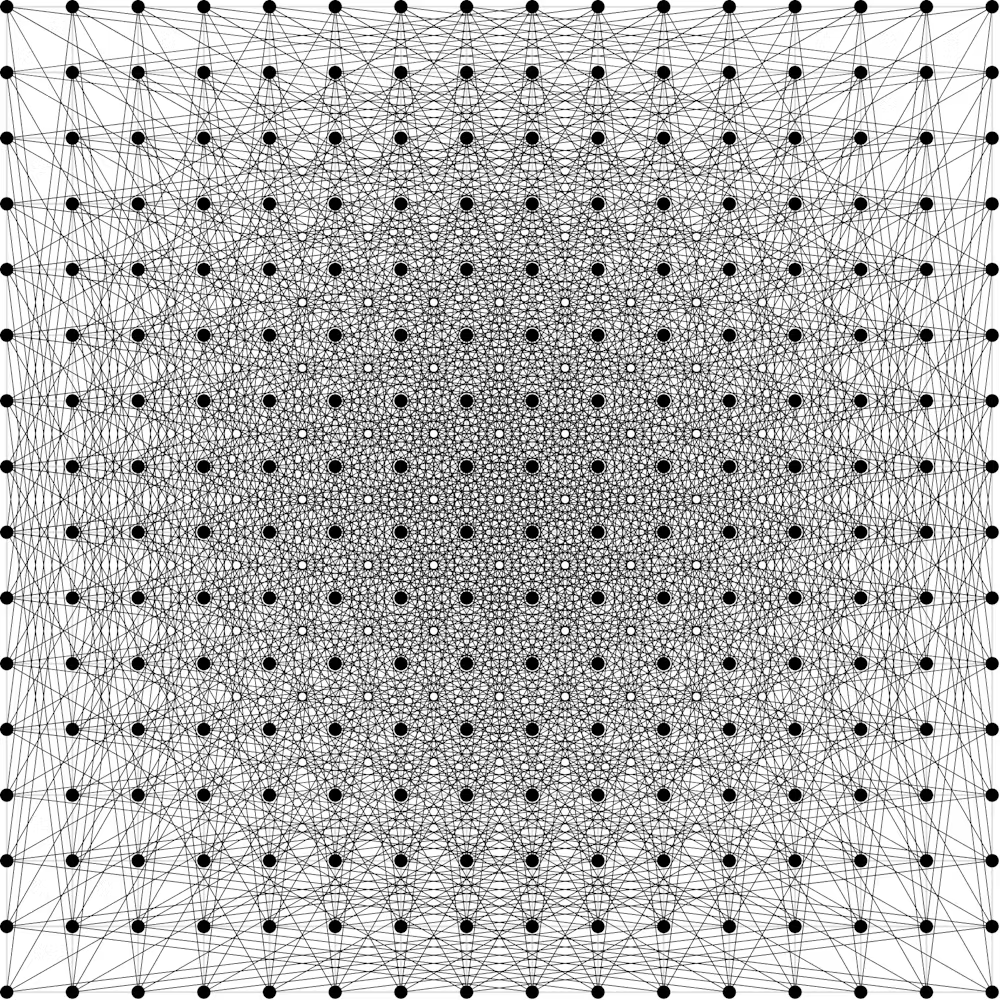
A square grid intuitively looks like a good solution to the planar unit distance problem. OpenAI
This intuition influenced much of the early thinking about the problem. As the number of points grows, grid-like arrangements continue to appear to be remarkably effective.
For decades it was widely believed these highly regular structures were about as good as it gets. Erdős himself conjectured that no construction could improve substantially on these intuitive arrangements, even for an extremely large number of points. (The new best result, by Sawin, reportedly only starts to yield improvements for around 102000000 points—that’s a one followed by two million zeroes.)
Over the past 80 years, mathematicians have tried to prove Erdős either right or wrong. Their efforts have linked the problem to other areas of mathematics called incidence geometry, graph theory, and extremal combinatorics. While a full proof remained elusive, there was a general feeling that Erdős’ conjecture was probably true.
However, OpenAI’s recent breakthrough proved Erdős’ intuition wrong. The new result uses tools from an area of mathematics called algebraic number theory to show there are patterns of dots that involve many more unit-distance pairs than the square grid, for infinitely many values of n.
No Hesitation
In an article OpenAI published alongside the new paper, several leading mathematicians remarked on the result.
Fields Medalist Timothy Gowers wrote that if a human researcher had submitted the paper with this result to the prestigious journal Annals of Mathematics, he would have recommended publication “without any hesitation.” He also added that no previous AI-generated proof had come close to this level of sophistication.
This breakthrough also represents the first major mathematical open problem solved with AI with minimal human intervention beyond the initial prompt. The accompanying paper shows the prompt given to the model, as well as a recount of the “chain of thought” conducted by the model.
This has renewed broader questions about the capabilities of AI to aid in, and perform, mathematical research.
Three Keys to Mathematical Research
Research mathematicians have been using computers for a long time, but their work is rarely driven by computation alone. Most major breakthroughs emerge from a delicate combination of three things: expertise developed over years, sustained effort to apply that expertise creatively to explore ideas (many of which turn out to be dead ends), and occasional conceptual leaps that suddenly reorganize how a problem is understood.
The first two are domains where AI models excel: as noted by Gowers, large language models such as ChatGPT have an “encyclopedic knowledge of mathematics.” Moreover, they can follow huge numbers of speculative lines of inquiry, even those unlikely to lead anywhere, without human time constraints.
The latter seems to be what provided the key to success here. In hindsight, it seems an expert given a small number of hints would be likely to be able to reach the same proof. As Gowers notes:
“Many of the ideas needed for the proof were present in the literature already, and for such ideas either no hint is needed, since the expert is aware of that piece of literature, or a highly generic ‘look it up’ hint would be enough.”
Lightbulb Moments
The harder question is how much AI can contribute to genuine conceptual leaps. These acute moments of insight, where a lightbulb moment reframes a problem in an entirely new way, are often seen as the most human part of mathematics.
These leaps are hard to formalize and even harder to predict. It remains unclear whether AI models can replicate them, even with recent advances.
What is clear is that AI models are causing a seismic shift in the way mathematics is discovered.
For centuries, progress in mathematics depended almost entirely on human creativity and persistence. Now, for the first time, researchers are working alongside systems capable of autonomously exploring enormous spaces of ideas and contributing to problems once thought accessible only to human insight.
This article is republished from The Conversation under a Creative Commons license. Read the original article.
