


HDMI is the closest thing we have to a universal video connector in 2026 — it’s used to connect TVs and A/V receivers to various input sources and output devices. However, if you’re only using the HDMI ports on your TV or A/V receiver, you might be missing out. Home theater equipment features a collection of digital and analog inputs and outputs all tailored to specific use cases. HDMI might be the best connection protocol for one kind of device, but it could be poorly suited for another.
Unfortunately, many user manuals for TVs or receivers lack the proper guidance about which ports and connection protocols to use for each situation. They might name and identify the ports on the back of your gear, but they probably won’t tell you how to use them. I recently upgraded from a basic audio amplifier and receiver to the Dolby Atmos-compatible JBL MA710, and I’ve been diving into all its ports and features. These are the seven ports and connector types you’ll find on many TVs and receivers, and how to make the most of every one.
I saved hundreds on a Dolby Atmos system using this simple strategy most people miss
Some audiophiles swear by buying new gear, others live or die on the resale market. There’s a better way, and it’s the perfect middle ground.
HDMI: 8K, 4K, ARC, eARC
Your A/V receiver probably has different HDMI port types

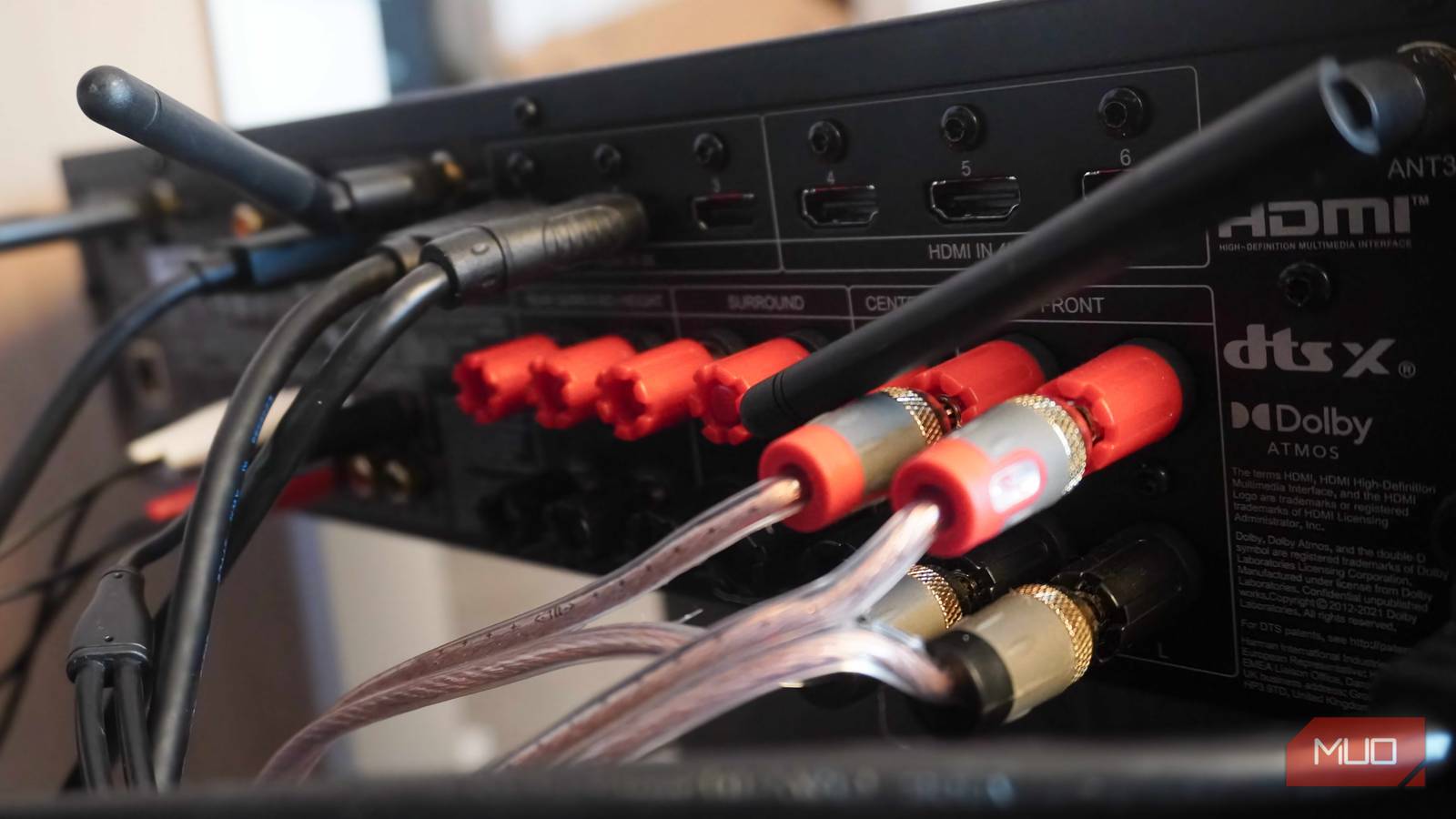
HDMI is the most common port found on modern home theater gear, and your TV or receiver probably has more than one of them. Many people make the mistake of assuming all the HDMI ports on their video hardware are equal. Your TV or receiver might have HDMI ports with support for different resolutions, like 8K or 4K. These supported resolutions hint at the ports’ HDMI versions. For example, the three 8K ports on my receiver are HDMI 2.1 and the three 4K ports are HDMI 2.0.
If you’re using an A/V receiver, there will be separate HDMI ports for video inputs and outputs. You’ll see multiple HDMI inputs for connecting video sources, like set-top boxes, streaming boxes, or Blu-ray players, and at least one output for hooking up your TV. This output may have support for the ARC (Audio Return Channel) or eARC (enhanced Audio Return Channel). Using the ARC or eARC ports on your TV and A/V receiver is crucial to allow your television to send audio back to your receiver over a single HDMI cable.
RCA
Great for connecting analog audio sources and subwoofers

Your TV or receiver might have RCA jacks, and they serve a variety of different purposes. Older TVs and game consoles use RCA inputs and outputs for both audio and video. The red RCA plug is for the right audio channel, while the left audio channel can be a white or black plug. A third, yellow RCA plug handles composite video transmission — but this is limited to standard-definition picture quality. RCA jacks often deliver analog audio and video, although coaxial RCA is the exception that we’ll cover later.
RCA inputs are ideal for connecting analog audio sources to your A/V receiver. For example, a turntable or tape player’s analog audio output can be sent straight to your receiver without being converted to digital in the process, assuming your receiver is set to Pure Direct mode. You might also see a separate pair of RCA jacks labeled “Phono.” This is for connecting a turntable without an active preamplifier. In this mode, your receiver will handle the task of amplifying the weak audio signals relayed by your turntable’s cartridge.
You could also see separate RCA jacks labeled “Zone 2.” These are commonly found on midrange and higher end A/V receivers, and they allow you to hook up a pair of powered speakers in another room. Unlike A/B speakers, Zone 2 allows you to play the same or different audio sources on each speaker setup simultaneously. This is ideal for watching movies in surround sound at the main listening station while streaming Hi-Fi music with Tidal in a separate room, for instance.
A single RCA jack may also be used to connect a powered subwoofer to your A/V receiver.
Binding posts
Versatile connectors for hooking up your wired speakers
The primary job of an A/V receiver is to connect inputs to their respective audio and video outputs, including passive speakers. These speakers require amplification and connect using copper speaker wire. A robust surround sound system needs a lot of speaker wire, and the receiver manages all of it.
There are two main ways A/V receivers connect to passive speakers: spring-clip terminals and binding posts. Five-way binding posts support five different ways of accepting speaker wire connections, including wrapping wire around the post, inserting wire through the post, or using banana plugs, spade lugs, or pin connectors.
Optical audio
For fiber-optic connections that won’t suffer from electromagnetic interference

TVs and A/V receivers often support optical audio inputs or outputs, otherwise known as TOSLINK. There are many uses for TOSLINK, but a big one is to send return audio from a TV to a soundbar when one or both devices lack ARC or eARC support. The other benefit to using optical audio is that it is safe from electromagnetic interference (EMI) and radio frequency interference (RFI). It’s a way of stopping speaker hums and hisses in their tracks.
Compared to analog inputs, optical audio adds support for compressed surround sound audio formats, like Dolby Digital. However, it lacks the bandwidth required for lossless Dolby Atmos and similar audio formats.
Coaxial
Higher-bandwidth, wired audio inputs for older devices and formats

RCA jacks are usually analog, unless they’re labeled as coaxial (or COAX). This audio connector uses a single RCA jack and cable, unlike analog RCA, which requires separate plugs for left and right audio channels. It uses the Sony/Phillips Digital Interface (S/PDIF) to send audio data using electrical signals.
Although it offers more bandwidth than legacy ports and adds support for surround sound, it doesn’t support lossless formats such as Dolby Atmos. Unlike TOSLINK, coaxial audio cables aren’t immune from EMI and RFI.
Ethernet
Used for stable wireless streaming and snappy app control

TVs and A/V receivers might include Ethernet ports, which provide a faster and more stable connection than Wi-Fi. You may not want to connect your home theater equipment to the internet at all, especially if you’re worried about your TV “phoning home” to the manufacturer using Automatic Content Recognition (ACR). However, a network connection can enable remote app control and wireless casting through protocols like AirPlay or Google Cast. If you plan to use these features, wiring your TV or A/V receiver over Ethernet may be worthwhile.
USB
Used for digital music playback, installing updates, diagnostics, and more

Finally, there’s probably a USB port on the back of your TV or A/V receiver. This is the easiest port to write off and ignore, thinking it’s only for diagnostics or updates. While a USB port may be used for these things, it can do much more. Hook up a phone or USB stick up to a compatible TV or receiver, and you can play back digital audio files. Certain TVs even let you display photo albums or record live TV using their USB port.
Why you should use all the ports on your AV receiver
The best home theater equipment ties your entire setup together. My JBL MA710 receiver works just as well with my turntable as it does with my Blu-ray player or Apple TV 4K. However, you only get the perks of your TV or receiver’s versatility while using the right port for the job. For example, optical audio cables’ support for pure digital bitstream is preferable for digital sources, although RCA cables’ analog audio support is better for physical media sources. You don’t have to use them all, but using the best one for your input or output device matters.

- Type
-
7.2 Dolby Atmos, DTS:X
- Bluetooth
-
Bluetooth 5.3, Low Energy
- Wi-Fi
-
Wi-Fi 5
- Amplifier
-
110W x 2ch @ 8ohms, 90W x 7ch @ 8ohms
- Connectivity
-
3 x HDMI 2.1, 3 x HDMI 2.0, 1x LAN
JBL’s MA710 is an AV receiver designed for home theater use with support for Dolby Atmos, DTS:X, and a maximum 8K video resolution. It includes six HDMI inputs and one HDMI output, plus five audio-only inputs. Whether you’re looking to build a Dolby Atmos audiophile listening station or a 7.2 surround sound home theater setup, this receiver can handle it all.
