

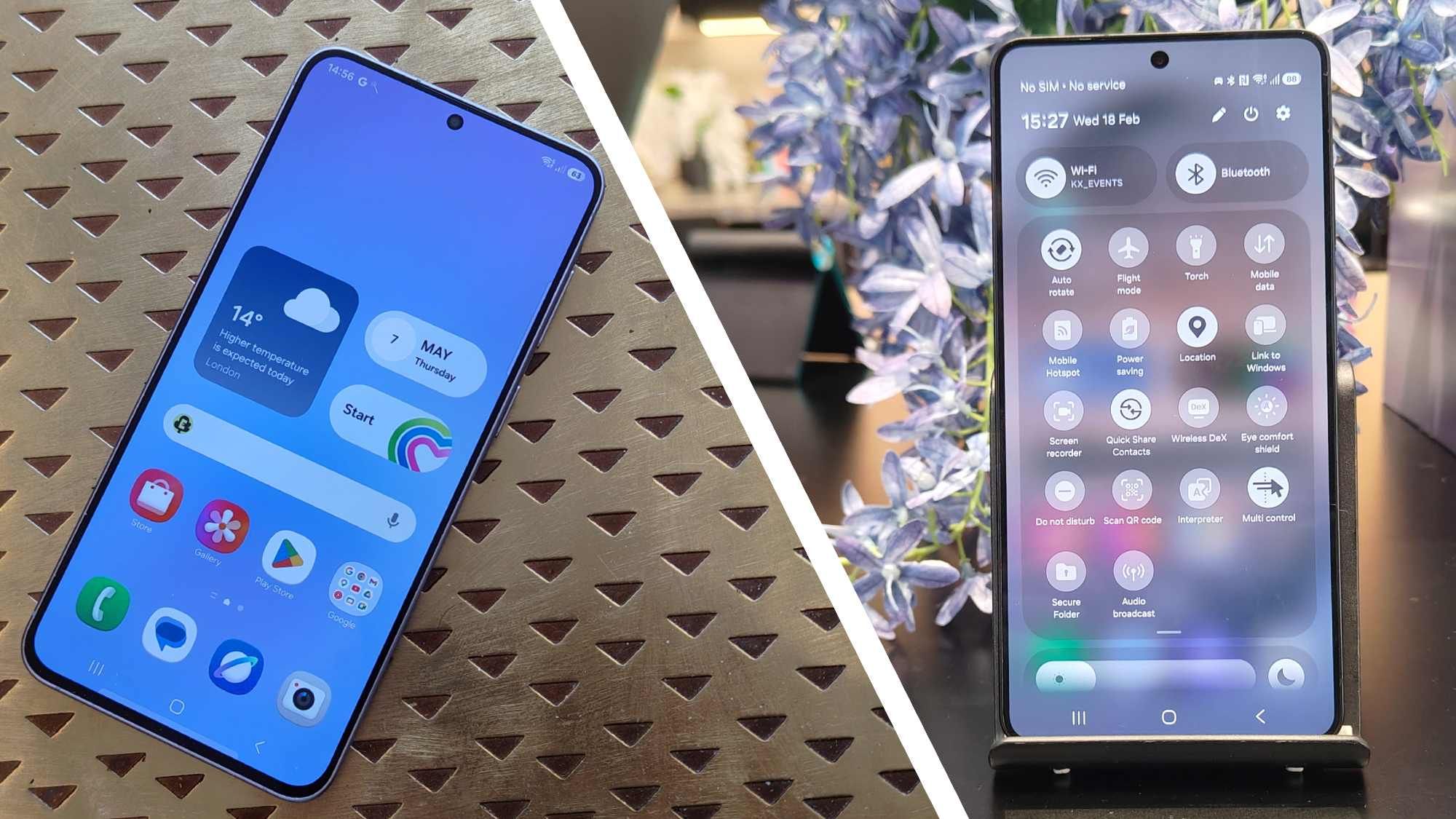

When I was doing all the testing for our Samsung Galaxy A57 review, I enjoyed how streamlined its software was compared to that of the best Samsung phones. But since publishing that review, I’ve been jumping back and forth between the A57 and another Samsung flagship, and I’ve got a more nuanced view.
Before the A57 (and, for a little while, after it), I was using the Samsung Galaxy S26 Ultra, which is pretty much the best Android phone money can buy. It has similar hardware specs to the Galaxy S25 Ultra, with its biggest advancements instead coming in the form of new software tools and features.
Now, I know the Galaxy A57 and S26 Ultra aren’t exactly comparable. The former is a mid-range phone starting at $549 / £529 / AU$749, while the latter is a premium phablet which costs a minimum of $1,299 / £1,279 / AU$2,199. That’s over twice as much.

But from the right angle, they’re the same phone. Both are the top models in their respective Galaxy categories, and they’re undoubtedly the two best Samsung phones released in 2026 so far. If you’ve got the budget, you buy the S26 Ultra, while the A57 is designed to be a great corner-cutting alternative.
And for the most part, Samsung made the right corner-cutting calls. Zoom cameras? Gotta go. Blazing chipset? Not here. Stylus? Styl-off. But when I tested the A57, there were definitely a few absent software features that I missed from the S26 Ultra.
So come on, Samsung — please add these 5 software features to cheaper phones like the Galaxy A57 in future software updates.
Audio Eraser

Audio Eraser is a really nifty AI feature. It basically works as an on-device noise cancellation tool for videos you’re watching.
The use case Samsung demonstrated during the feature’s announcement — which I’ve since tried myself on several occasions — was for live sports events or recaps. Usually, the crowd is so loud that you can barely hear what’s going on. Audio Eraser can identify the crowd noise and strip it from the audio, letting you hear the commentary and even sports noises.
It’s also useful for eliminating environmental sounds, like the rush of the sea or roaring wind, helping you hear spoken words better.
Given that Samsung designs its hardware around its AI features these days, I wouldn’t be surprised if iAudio Eraser is dependent on the power of the S26 Ultra’s chipset. Still, surely a scaled-down version can make its way to the A57. Right, Samsung?
Search with Finder

I found Search with Finder so useful on the Galaxy S26 Ultra that I’m surprised it isn’t available in all smartphones.
On Android phones, Finder is the search bar in the app drawer. When you can’t find an app because you have no organizational system to speak of (no shame, I’m the same), you search for it in Finder.
But Search with Finder, as Samsung calls it, supercharges this little tool on the Galaxy S26 Ultra. It will search your entire phone for your target; boarding passes, tagged photos, and email attachments are all within its purview.
This feature was designed for messy organizers like me. I have no central system for organizing files, apps, or documents, and I’m often engaged in wild goose chases trying to find things on my phone. Not with Finder on the Galaxy S26 Ultra: if I’d lost something on my phone, it could find ‘er (sorry).
Let me tell you, going from the S26 Ultra to the Search with Finder-less Galaxy A57 was quite a shock; in fact, its absence is what prompted me to write this article.
Search with Finder is basically just an in-depth search function, and I was really surprised when the A57 couldn’t find documents I’d received in emails or videos I had saved to its internal storage. It feels like a natural function to bring to all of Samsung’s phones, not just the A57.
Bixby to control your phone

This one’s less of a “feature I love” kind of deal, but something that really makes sense when you think about it.
Bixby is given more responsibilities on the Samsung Galaxy S26 Ultra. Oh, you haven’t met Bixby yet? It’s Samsung’s on-board assistant, which most people either forget about or don’t realize they’re using.
In the S26 Ultra, Bixby can now directly change settings on your phone. If you tell it you’re having a problem seeing the screen, or your eyes are aching, it can automatically turn up the brightness or apply the eye comfort shield mode…
… in theory. I found it quite unreliable at implementing any such changes. Much of the time, it just prompted me to do it myself, telling me to go into settings, even though the whole point of this new feature is that Bixby should do it for me.
Anyway, onto the Galaxy A57. This sort of phone is bought by those whose budgets don’t stretch to the top Samsung model, but also by general users who just need a mobile from a brand they trust and aren’t interested in top-tier features.
This kind of buyer is, if I’m not being too rude, a little technophobic. They don’t know the correct word for certain features available on their phone — or perhaps even that those features exist in the first place.
A smart assistant that can directly tweak settings on your behalf makes sense, therefore, in a phone like the Galaxy A57. I can see seniors, for instance, getting loads of mileage from this kind of Bixby tool.
And, yes, I know I’ve said that it doesn’t work all that well on the Galaxy S26 Ultra, but I am quite surprised that the A57 doesn’t offer more in the way of smart assistant tweakery like this.
Now Brief

What you’re looking at above is Now Brief, a feature of Samsung’s recent S- and Z-series phones. I like to call it ‘Random Affirmations mode’ because… well, you can see from the picture. The phone, an inanimate object, is wishing me well?
The point of Now Brief is that it gives you a brief overview of things you need to know. Commonly, it’d show me the weather, and usually a random news article yanked from a publication I’d never touch, as well as some other odd things if relevant: calendar events, reminders I’d made, fitness information I’d tracked, and so on.
I’m not going to pretend that Now Brief is a great feature just yet. It feels like it’s missing one or two (or ten) extra data points before it’s able to fulfill its purpose of providing a daily (or multi-daily) briefing of things I need to know. In the two months I used the S26 Ultra, Now Brief — more often than not — didn’t seem to really understand what I wanted to know, and didn’t pull information from many of my apps and tools.
But I see this being the kind of feature that Samsung refines over the next few years and One UI updates, and possibly (hopefully), in a while, it’ll be a pivotal part of the smartphone experience.
Now and then, Now Brief became just that for me: I’d look at it and know everything I needed to know. I could put my phone back down, ready for the day (or at least the next hour). These instances were rare, mind, but they did occur.
Now Brief is a big miss on the Galaxy A57. People buying this kind of phone probably aren’t power users like those who buy the S26 Ultra. They just want to be able to pick up their handset, see a quick summary of their notifications, events, and interests, and put it back down.
That’s why I think Now Brief — even in its current, basic form — would fit really well on Samsung’s cheaper phones.

Follow TechRadar on Google News and add us as a preferred source to get our expert news, reviews, and opinion in your feeds. Make sure to click the Follow button!
And of course you can also follow TechRadar on TikTok for news, reviews, unboxings in video form, and get regular updates from us on WhatsApp too.
