


Global international tourism is massive with around 1.5 billion arrivals per year. This covers flights, cruises, road/rail travel, and more. Domestic tourism adds even more volume, but international arrivals give a solid benchmark for around the world leisure/business travel.
Carbon Footprint of Global Tourism
A comprehensive 2024 study (using 2019 data) estimates the total global tourism carbon footprint at 5.2 Billion tons CO₂-e (gigatonnes of CO₂-equivalent, including direct and indirect emissions). This represented 8.8% of total global anthropogenic GHG emissions (or 9.9% excluding land use).
Total global tourism direct emission is 1.8 billion tons per year. Aviation is ~52% of direct emissions (~0.94 Gt CO₂), with passenger air transport a major driver. Overall commercial aviation was ~0.9–1 Gt CO₂ in recent pre- and post-pandemic years. Non-CO₂ effects (contrails) add extra warming.
Road transport is ~18% of direct (~0.32 Gt), plus substantial private vehicle use (~0.9 Gt additional when including combustion and fuel production).
Other Indirect emissions (~2.5 Gt) from accommodation (utilities), supply chains, etc.
Cruises/ships have a much smaller in total. Global shipping emits ~850 Mt CO₂/year (mostly cargo), but cruises are a tiny fraction—likely in the range of 20–50 Mt CO₂-e annually worldwide based on major operators’ data (hundreds of ships). Per-passenger, cruises are often worse than flying for equivalent distance due to high fuel use and amenities, but the absolute global total is modest compared to aviation.
Ground transport (cars, buses, trains) is significant in aggregate due to volume, but far lower per passenger-km than flying or cruising. Trains and efficient buses are among the lowest-impact options.
Per-tourist average is ~3–4 tonnes CO₂-e per international arrival (rough order-of-magnitude from 5.2 Gt ÷ ~1.5B), but this varies enormously—short domestic trips are low-impact; long-haul flights + hotels push individuals to 5–10+ tonnes easily.
Tourism emissions grew fast (3.5% per year 2009–2019) because demand outpaced efficiency gains.
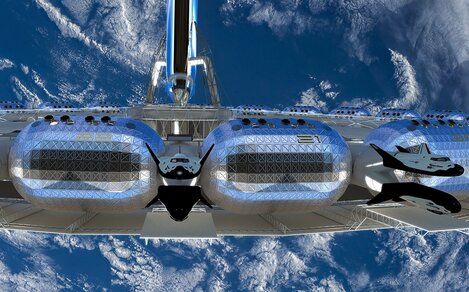
IF there were Hhypothetical 5 Million Orbital (LEO) Tourists per Year. This is a futuristic scenario. Current space tourism is tiny (dozens of people total, mostly suborbital or rare ISS visits). Scaling to millions would require revolutionary reusable vehicles like Starship.
Starship (SpaceX’s fully reusable system) is designed for up to ~100 passengers on crewed/orbital missions in optimistic future configurations.
For 5 million tourists/year would be ~50,000 launches per year (5M ÷ 100). Current global launch rate is a few hundred per year total.
Starship per launch estimates range from a few thousand tonnes CO₂ (direct combustion, methane/LOX propellant) to ~76,000 tonnes CO₂-e (one academic-style estimate including water vapor, soot, and other effects at altitude). Falcon 9 comparisons are lower (hundreds to tens of thousands of tonnes).
Total for 50,000 launches would potentially 0.15 Gt (low/direct estimates) up to several Gt CO₂-e (higher/full-impact estimates). This could be a noticeable fraction of current aviation or even total tourism emissions. This is about 3% of current global tourism carbon impact.
Space Industry as a Potential Long-Term Mitigator
There is upside potential for reducing Earth’s pollution burden.
Moving Industry and mining offworld would be huge for global pollution.
Off-world mining and resources
Lunar and Asteroid mining operations could supply metals/rare materials with far less terrestrial habitat destruction, deforestation, and pollution than Earth mines.
Orbital industry and manufacturing would move energy-intensive or polluting processes off-planet. Space offers abundant solar power and radiative cooling (no atmosphere to trap heat).
AI data centers will be Orbital or lunar facilities could use constant solar + space-based cooling, potentially slashing Earth-side energy/water demands.
Broader space economy is the Space-based solar power, in-situ resource utilization (making fuel/propellant from space resources), and multi-planetary infrastructure could eventually decouple some growth from Earth’s biosphere.
All of the indirect pollution would get out of the atmosphere when space tourism moves further away.

Brian Wang is a Futurist Thought Leader and a popular Science blogger with 1 million readers per month. His blog Nextbigfuture.com is ranked #1 Science News Blog. It covers many disruptive technology and trends including Space, Robotics, Artificial Intelligence, Medicine, Anti-aging Biotechnology, and Nanotechnology.
Known for identifying cutting edge technologies, he is currently a Co-Founder of a startup and fundraiser for high potential early-stage companies. He is the Head of Research for Allocations for deep technology investments and an Angel Investor at Space Angels.
A frequent speaker at corporations, he has been a TEDx speaker, a Singularity University speaker and guest at numerous interviews for radio and podcasts. He is open to public speaking and advising engagements.
