


SpaceX can achieve daily flight turnaround even with imperfect tiles. The shuttle’s problem was not just that the tiles were expensive. But one bad tile would cause loss of the vehicle. SpaceX Starship metal structure and ablative layers means a single lost tile in most places does not lose the ship. Starship tolerant to losing tiles — through ablative sublayers, gap sealing, and margin over the steel — inspection converts from 100% verification to statistical sampling. SpaceX inspection just needs to see if a tile or a section of tiles are good. If in doubt replace the tile or the section.
This is what SpaceX does for 13000+ Starlink satellites that were launched. Each one costs $1 million or less and when had any problems SpaceX threw them away. Over 2500 were thrown away (aka de-orbited). Inspection and debugging is hard and expensive, so set up the system where you can do minimal inspection. Keeping many satellites working is difficult if each one costs $1 billion and you can only launch ten per year versus 3000 to 4000 per year.
Replacing 50 Shuttle tiles per launch was $300k for the materials. It was taking at least 4+ months to inspect, fit in custom puzzle pieces and then using toxic materials for re-waterproofing. 4+ months on a $6-10 billion per year program with only 5 launches per year.
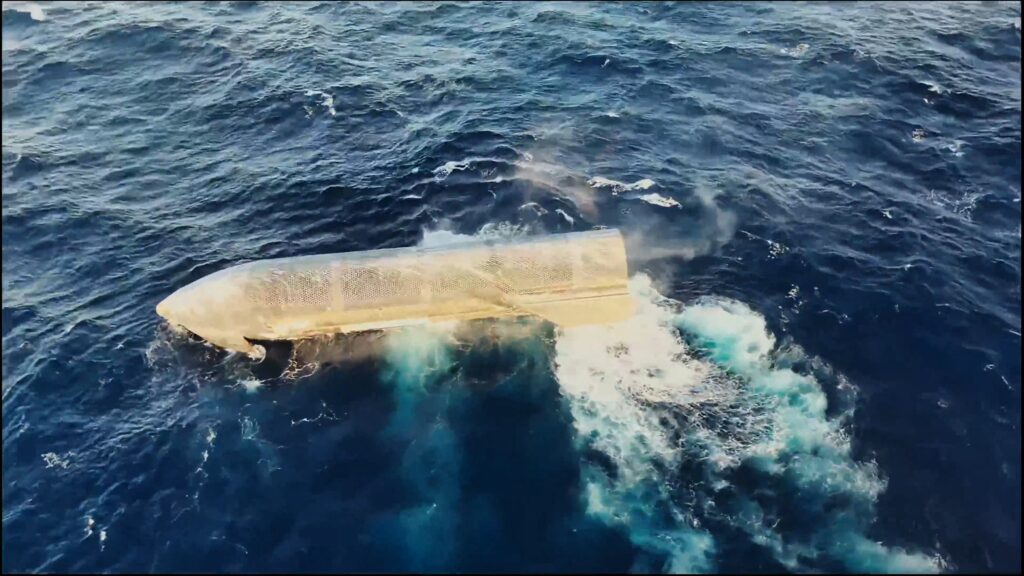
Orbital mechanics. A ship returning to a specific launch site can only line up with it when the ground track passes over — that’s typically a window every ~12–24 hours for a given orbit, not every hour. Even a perfect vehicle waits. The boosters have no heat shield issues and so long as they are caught can potentially turnaround for hourly reflights. There are operational issues around reloading and refueling.
It would suck if spaceX had to remove and reapply the tiles on Starship after every flight. Last time we watched them do that it took 2 weeks.
That would mean Starship reflight would *only* be 4 times faster than the Space Shuttle. pic.twitter.com/EHTjbvaezr— Scott Manley (@DJSnM) July 30, 2026
A fleet of 50 Starships could fly 1000 times per year with the 2 week full replacement. Robotic automation would reduce a full replacement to 1 week.
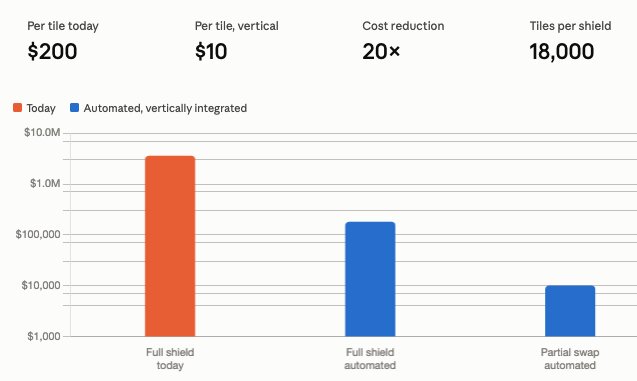
Per tile costs will go from Space Shuttle $6000 to todays $200 per tile and will get to $10 per tile. The labor and overhead per tile is already drastically less and will get lower. Tesla didn’t get cheap cells by buying them, it got cheap cells by needing millions of them and making them itself.
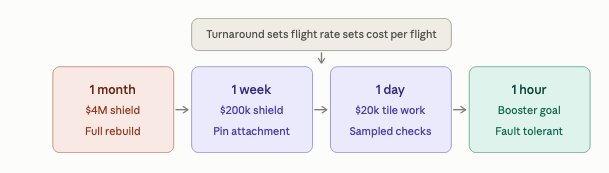
Starship will get even cheaper than Falcon 9 by having getting launch rate up and turnaround time down. Worst case goal is lowering current $4 million for tile and tilework and 1 month to replace a heat shield down to $200,000 or less and one week for complete heat shield and possibly $20,000 tiles and tile work and one day or less turnaround per flight even with imperfect tiles. Daily turnaround on Starship is good enough for a fleet to have 10,000 to 30,000 flights per year.
Replacing all 18000 tiles with $10 per tile cost and robotic processes for one day or one week will be cheaper than the material costs for 50 Shuttle tiles and there would be no inspection. If inspection and getting to only a handful of tiles is only useful if it does save time.
Manual inspection is not required so this is not a dead end.
Costs, Cadence and Differences from Shuttle Heat Shield
The Space shuttle averaged roughly $1 billion per flight in today’s dollars, and it got there partly because the flight rate stayed near five per year instead of the promised weekly cadence. Turnaround was the binding constraint, and hand-inspecting 20,000+ unique bonded tiles plus a mandatory toxic re-waterproofing cycle that locked technicians out of the processing facility was a large part of why turnaround ran months. Starship’s bet is that standardized, pin-mounted, mass-produced tiles break that constraint.
NASA’s own estimates put the program at $209 billion in 2010 dollars, or nearly $1.6 billion per flight, with the fleet never flying more than nine missions in a single year.
Space Shuttle 22,000 hand-installed, individually unique tiles at $6K each after inflation adjustment ($2–3k in shuttle prices at the time), every one inspected twice per flight, ~50 replaced per mission, plus a mandatory toxic re-waterproofing cycle that gated all other work — against ~18,000 standardized hexagons on mechanical pins.
Waterproofing wasn’t just labor hours, it was a schedule gate. Rewaterproofing was the one TPS (thermal protection system) operation that could interfere with turnaround of every other vehicle system. DMES vapors severely restricted personnel access to the Orbiter Processing Facility. The cycle itself was inject, seal the vehicle in plastic, wait 24 hours.
NASA could never turn the shuttle around in less than four months because of all the TPS critical path time consuming steps. Pielke’s figures put actual annual shuttle program costs at about $4.7 billion in 2010 dollars for 1991–2010, against $6.2 billion predicted. Inflate that and you get roughly $7B/year in 2026 dollars. Taking NASA’s own $209 billion (2010 dollars) total and spreading it over the operational era gives about $10B/year in today’s money at the very top end.
Flight Cadence Collapse Versus Falcon 9 Cadence and Planned Cadence
Shuttle 4.7 actual flights per year while annual costs actually came in under forecast. NASA had a later goal of 9 flights per year but original plans were weekly flights.
It cost too much per flight because the denominator collapsed. Turnaround — hand-inspected unique bonded tiles, toxic waterproofing gating the facility drove the low flight rate.
Now the contrast. SpaceX completed 165 Falcon 9 missions in 2025, averaging one flight every 2.2 days at 100% success. At that cadence, even $2B/year of fixed cost amortizes to ~$12M per flight. Same fixed-cost structure, 35× the denominator.
Brian Wang is a Futurist Thought Leader and a popular Science blogger with 1 million readers per month. His blog Nextbigfuture.com is ranked #1 Science News Blog. It covers many disruptive technology and trends including Space, Robotics, Artificial Intelligence, Medicine, Anti-aging Biotechnology, and Nanotechnology.
Known for identifying cutting edge technologies, he is currently a Co-Founder of a startup and fundraiser for high potential early-stage companies. He is the Head of Research for Allocations for deep technology investments and an Angel Investor at Space Angels.
A frequent speaker at corporations, he has been a TEDx speaker, a Singularity University speaker and guest at numerous interviews for radio and podcasts. He is open to public speaking and advising engagements.
