


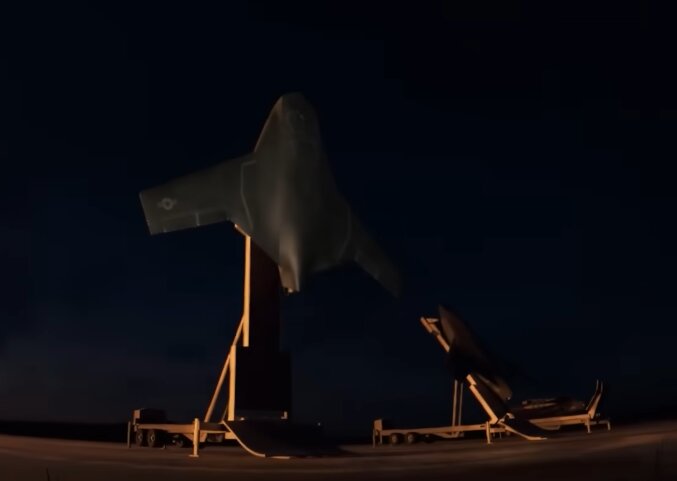
Shield AI states that three X-BATs (with their Launch and Recovery Vehicles / LRVs) fit in the deck space of one legacy fighter or helicopter. Arleigh Burke-class destroyers have a flight deck + dual hangars designed for up to two MH-60R Seahawk helicopters. They could each hold six X-BATS in the space used for two helicopters. They would each have a supersonic drone airwing.
X-BAT folded/storage dimensions are given as roughly 40 ft × 14 ft × 6 ft.
An MH-60 folds to roughly similar length (~41 ft) but wider rotor/overall footprint when operating. The 3:1 claim implies the hangar space for two helicopters could theoretically support on the order of ~6 X-BATs for storage, with the flight deck used for sequential or parallel vertical launch/recovery via the self-contained LRV trailers (which include blast deflection).
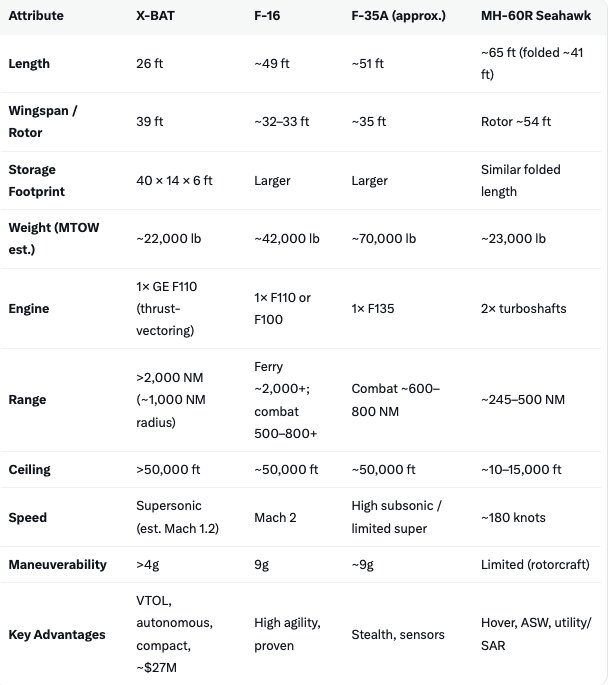
Adding 6 or more recoverable, jet-powered X-BATs would transform the a destroyer from a surface combatant with limited organic aviation into a distributed, mini-carrier-like node. 70 destroyers could add 420 XBat Drone fighters.
Long-range strike capability. Reusable platforms launching LRASM/JSOW-class weapons or similar at ~1,000 NM combat radius — far beyond typical helo reach and independent of carrier air wings.
Organic air-to-air / self-defense with AMRAAM/AIM-174B capability extends the ship’s defensive bubble and allows offensive counter-air.
ISR + EW Persistent high-altitude sensors and jamming in contested environments, including GPS/comms-denied ops via Hivemind autonomy.
Force multiplication & survivability. Multiple attritable aircraft create dilemmas for an adversary. The destroyer can project power without needing a full carrier strike group nearby. A single human operator can manage teams of them.
Operational flexibility with Vertical launch/recovery from the existing helicopter pad enables rapid sortie generation without catapults or arresting gear.
Standard Weapons / Missiles
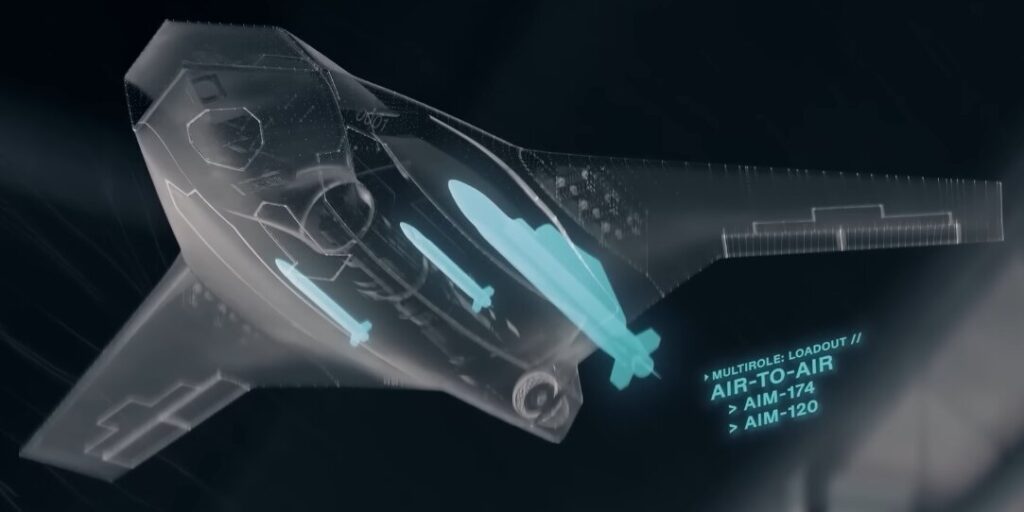
X-BAT has internal weapons bays plus external hardpoints. They carry standard U.S. inventory weapons.
Air-to-air AIM-120 AMRAAM (shown in pairs internally).
AIM-174B “Gunslinger” (very long-range, SM-6-based, external).
Air-to-surface / anti-ship AGM-158C LRASM (Long Range Anti-Ship Missile, external).
AGM-154 JSOW C-1 (glide munitions, pairs shown).
AGM-88G AARGM-ER (anti-radiation) has appeared in some renders. Modular EW suites, ISR sensors, and active/passive radar modes. It generates ~80 kW of electrical power to support jamming or advanced payloads.
Amphibious Assault Ships (LHA/LHD helicopter carriers)~60 X-BATs
Shield AI has explicitly stated that helicopter carriers, U.S. America-class LHA or Wasp-class LHD amphibious assault ships, could carry 60. These ships have large flight decks that already support 20+ F-35Bs or mixes of MV-22s, CH-53s, and helicopters in various configurations.
Cargo / Merchant / Container Ships Can Carry Dozens
Cargo ships and non-traditional surface vessels as viable hosts.

Brian Wang is a Futurist Thought Leader and a popular Science blogger with 1 million readers per month. His blog Nextbigfuture.com is ranked #1 Science News Blog. It covers many disruptive technology and trends including Space, Robotics, Artificial Intelligence, Medicine, Anti-aging Biotechnology, and Nanotechnology.
Known for identifying cutting edge technologies, he is currently a Co-Founder of a startup and fundraiser for high potential early-stage companies. He is the Head of Research for Allocations for deep technology investments and an Angel Investor at Space Angels.
A frequent speaker at corporations, he has been a TEDx speaker, a Singularity University speaker and guest at numerous interviews for radio and podcasts. He is open to public speaking and advising engagements.
