


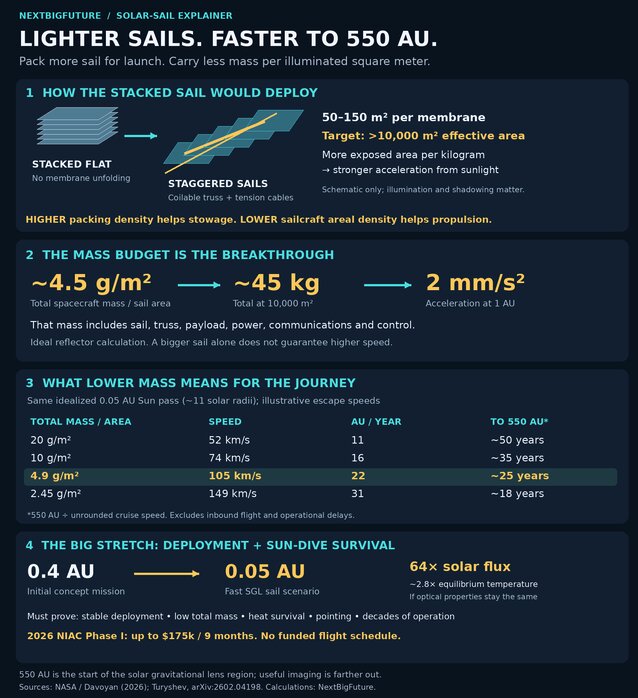
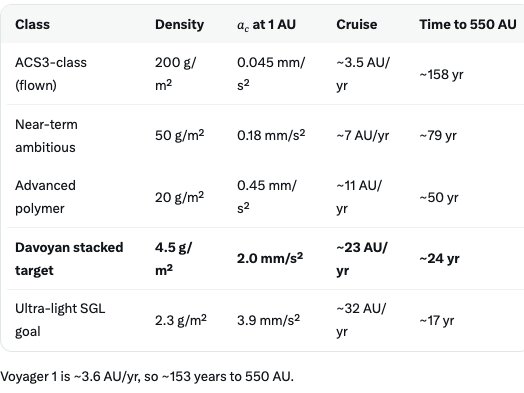
NASA Advanced innovation study will try to enable the next generation of solar sails featuring very high characteristic acceleration–potentially up to 2 mm/s²–and large effective areas exceeding 10,000 m², to support future ultra–high delta-V missions. These advanced solar sails would significantly transform space exploration and utilization, making possible a range of missions currently beyond the capabilities of conventional chemical and electric propulsion.
IF this works, we could send telescopes out 20 times further than Pluto so the Suns gravity would become a lens to focus images 10 billion times. Small telescopes out the edge of the solar system could look on the other side of the sun to see islands and make megapixels and toward gigapixel images of planets in other solar systems.
There could be an Earth and Venus pole-sitter spacecraft, solar polar imagers, and low-cost, fast-transit probes to the outer planets and interstellar medium. Achieving high characteristic accelerations (above 0.3 mm/s²) has long been a central goal of solar sailing. However, this objective has not been possible largely due to challenges associated with scaling up sail size. As sail area increases, so do the mass and complexity of deployment mechanisms. In particular, unfolding large sail membranes during deployment remains a key technical hurdle.
To overcome these challenges, researcher propose a fundamentally new solar sail architecture that eliminates the need for membrane unfolding and simplifies deployment.
The concept integrates two core technologies
(i) A lightweight, coilable truss structure that deploys a stack of sail membranes, each with an area between 50–150 m² (limited by the rocket fairing), and
(ii) Tensegrity engineering to maintain the structural integrity and shape of the deployed system.
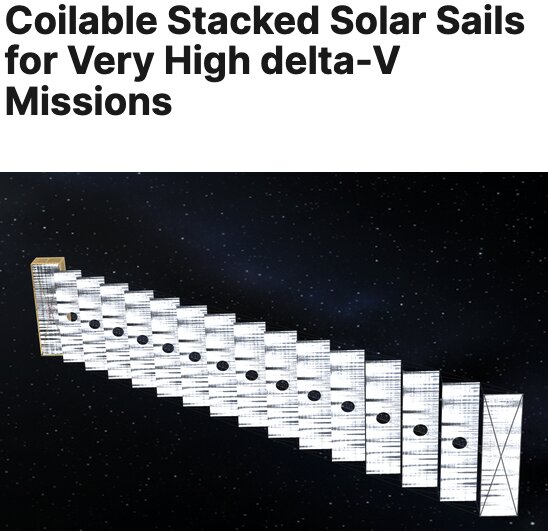
In the deployed configuration, the sail membranes form a “staircase” structure supported by a central coilable truss that passes through the center of each frameless sail.

Brian Wang is a Futurist Thought Leader and a popular Science blogger with 1 million readers per month. His blog Nextbigfuture.com is ranked #1 Science News Blog. It covers many disruptive technology and trends including Space, Robotics, Artificial Intelligence, Medicine, Anti-aging Biotechnology, and Nanotechnology.
Known for identifying cutting edge technologies, he is currently a Co-Founder of a startup and fundraiser for high potential early-stage companies. He is the Head of Research for Allocations for deep technology investments and an Angel Investor at Space Angels.
A frequent speaker at corporations, he has been a TEDx speaker, a Singularity University speaker and guest at numerous interviews for radio and podcasts. He is open to public speaking and advising engagements.
