


Five thousand launches a year means nearly fourteen launches every day.
At an assumed 200 tonnes of payload per V4 Starship flight, that would deliver one million tonnes to orbit annually. Under the satellite power-density assumptions in my latest video, that supports 50–100 gigawatts of new orbital AI capacity per year.
Those numbers explain why launch price is only the beginning of the space AI discussion. Making a flight affordable does not automatically create the rockets, towers, satellite factories and operating systems needed to sustain thousands of flights.
SpaceX is uniquely positioned to put those pieces together. The challenge is making the entire system operate at the required scale.
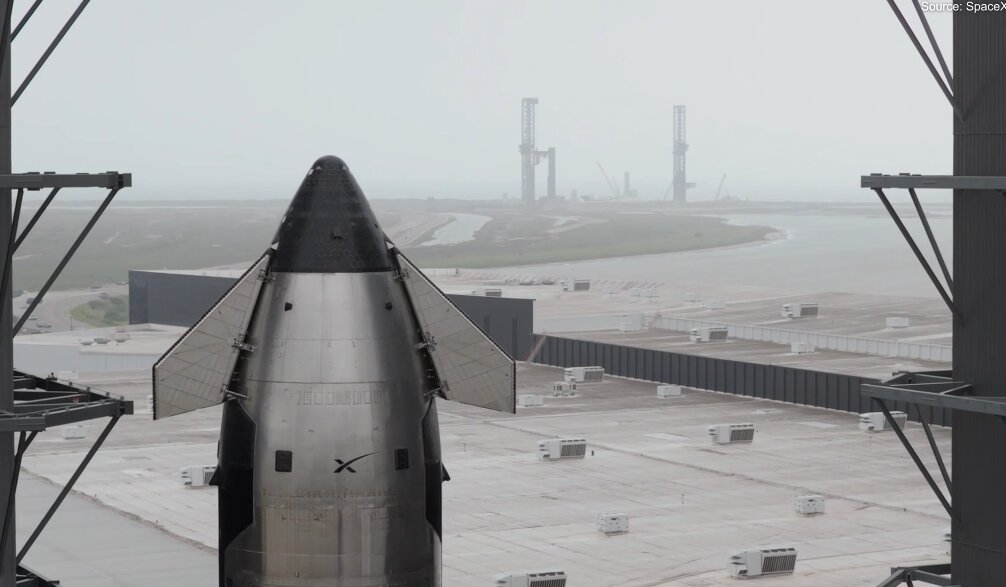
Even V4 Starship will need 50 launches for one gigawatt
Consider my 2028 scenario
V4 Starship carries 200 tonnes, while a more power-dense AI2 satellite system provides 100 kilowatts per tonne.
The calculation is straightforward:
200 tonnes × 100 kilowatts per tonne = 20 megawatts per launch.
A gigawatt is 1,000 megawatts. That means:
50 launches × 200 tonnes = 10,000 tonnes per gigawatt.
At 50 kilowatts per tonne, the requirement doubles to 100 launches and 20,000 tonnes per gigawatt.
These assumptions must apply to the complete deployed system, including the hardware needed to generate power, reject heat, communicate and run the computing equipment. Chip efficiency alone does not determine the result.
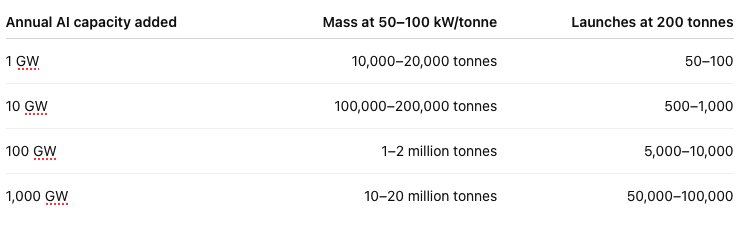
The distinction matters. One million tonnes per year supports 50–100 gigawatts under these assumptions. Reaching 1,000 gigawatts of annual additions would require another enormous increase in launch and manufacturing capacity.
Catching a rocket starts the turnaround clock
A successful catch is a major milestone. The next questions are operational.
How much inspection does the vehicle need? Which components require replacement? How quickly can the tower prepare for another launch? Can the recovered rocket fly again with consistently high reliability?
Returning a vehicle directly to the launch site can eliminate the lengthy ocean transport involved in recovering a booster on a drone ship. That advantage becomes valuable when it produces a shorter, repeatable turnaround.
At thousands of flights per year, occasional fast turnarounds are insufficient. The fleet needs dependable turnaround times across repeated missions.
Launch towers become a capacity constraint
Rockets need working ground infrastructure.
Launch mounts, catch arms, propellant systems, maintenance crews and operating approvals all affect how frequently a site can fly. A launch allowance also differs from demonstrated operating capacity: permission to fly hundreds of times does not mean the facility can immediately sustain that schedule.
Nearly fourteen launches a day would be a fleet-wide operation spread across multiple sites and towers. Enough infrastructure must remain available while other equipment is being inspected, serviced or repaired.
The tower is part of the production system.
Satellite production must match the rockets
Every available launch needs a payload.
Moving from communications satellites to large amounts of orbital AI requires manufacturing and deploying complete computing systems. Power generation, heat rejection, communications, deployment mechanisms and orbital reliability all have to scale alongside the chips.
V3 communications-satellite deployment provides relevant operating experience. It does not, by itself, demonstrate that a future AI2 satellite can achieve the power density and economics assumed in this scenario.
The satellite factory has to deliver the hardware that makes the launch calculation work.
Focus on SpaceX
SpaceX’s advantage, in my analysis, is the ability to develop the launch vehicle, ground infrastructure, satellite manufacturing and orbital operations as parts of one system.
An improvement in one part can help another. More useful payload per flight reduces the number of launches required. Higher satellite power density reduces the mass needed per gigawatt. Faster turnaround increases the output of the rocket fleet and launch sites.
But each improvement has to survive actual operation.
My 2027–2029 scenarios assume successive advances in launch capacity, satellites and AI hardware. They are conditional projections, with the higher outcomes requiring much more demanding flight rates.
The decisive question is whether SpaceX can sustain the whole operation: launch, recover, inspect, refly—and keep supplying satellites that work.

Brian Wang is a Futurist Thought Leader and a popular Science blogger with 1 million readers per month. His blog Nextbigfuture.com is ranked #1 Science News Blog. It covers many disruptive technology and trends including Space, Robotics, Artificial Intelligence, Medicine, Anti-aging Biotechnology, and Nanotechnology.
Known for identifying cutting edge technologies, he is currently a Co-Founder of a startup and fundraiser for high potential early-stage companies. He is the Head of Research for Allocations for deep technology investments and an Angel Investor at Space Angels.
A frequent speaker at corporations, he has been a TEDx speaker, a Singularity University speaker and guest at numerous interviews for radio and podcasts. He is open to public speaking and advising engagements.
