


Ukraine already has and is expanding alternatives for high-speed interceptor drones that reduce or eliminate dependence on Starlink/Starshield.
Russia has launched thousands of Iranian-designed Shahed drones at Ukraine, resulting in hundreds, if not thousands, of deaths and heavy infrastructure damage. Increasingly, they’ve been countered by Ukraine.
The main options in use or under development are.
1. Proprietary digital radio + ground-station architecture (most mature for Sting)
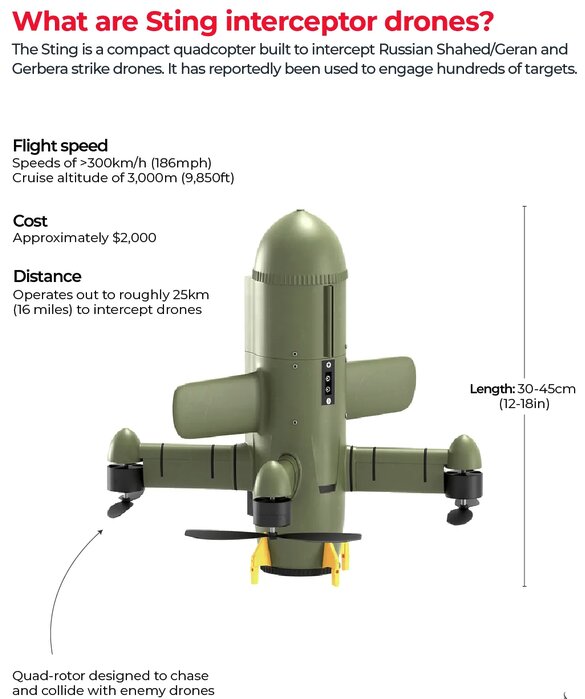
Wild Hornets (makers of the Sting interceptor) use their own Hornet Vision / Hornet Vision Ctrl system.
The interceptor itself is controlled over a local digital radio / video link.
The high-bandwidth terminal (whether Starlink or something else) sits at a stationary ground station, not on the fast-moving drone. The ground station acts like a cell tower that relays between the remote pilot and the interceptor.
This means the speed restriction on a moving Starlink terminal does not directly affect the interceptor’s flight.
They have expanded the system to 25 independent channels and produce their own higher-power video transmitters (HV VTX Pro) for better range and electronic-warfare resistance.
Remote control of Sting interceptors from hundreds or even ~2,000 km away has already been demonstrated with this architecture.
Wild Hornets has publicly stated that their own communications system provides the basic connection and that they are deliberately reducing single-point reliance on Starlink.KyivpostEuromaidanpress
2. Onboard AI and reduced real-time link requirements
Several systems are designed to operate with less continuous high-bandwidth control:
Computer-vision and automatic target recognition so the interceptor can lock and pursue a Shahed with limited or intermittent guidance.
Heat-seeking or beacon-based terminal guidance.
Examples include systems from Perennial Autonomy (Merops and related interceptors) and Quantum Systems’ SPYS interceptor, which uses ground-based beacons and onboard AI and does not rely on Starlink.
3. Conventional and advanced radio links
Direct digital radio control from nearby ground stations or vehicles.
Mesh radio networks that relay the signal through intermediate nodes (other drones or ground relays) to extend range.
Higher-power and frequency-agile radios to improve resistance to jamming.
Fiber-optic control is more common on strike drones but provides complete immunity to electronic warfare for shorter-range engagements.
4. Other satellite and terrestrial backhaul
LTE/5G where coverage exists.
European satellite alternatives (Eutelsat has been mentioned as a potential backup).
Longer-term domestic satellite efforts (such as UASAT), though these are not yet comparable to Starlink in bandwidth, latency, or availability for tactical use.
Practical picture
For many current Sting-style interceptors, the architecture already separates the high-speed flight link (local digital radio) from the long-haul backhaul (which can be Starlink, another satellite, or terrestrial internet). This is why some manufacturers said the October speed restrictions primarily affected platforms that carried a Starlink terminal onboard the fast-moving drone, rather than the main Sting operating concept.
Fully independent, high-bandwidth, long-range, low-latency links that match Starlink’s performance do not yet exist at scale, so hybrid approaches (local radio + flexible backhaul) and increased onboard autonomy are the practical alternatives Ukraine is using and expanding.
Brian Wang is a Futurist Thought Leader and a popular Science blogger with 1 million readers per month. His blog Nextbigfuture.com is ranked #1 Science News Blog. It covers many disruptive technology and trends including Space, Robotics, Artificial Intelligence, Medicine, Anti-aging Biotechnology, and Nanotechnology.
Known for identifying cutting edge technologies, he is currently a Co-Founder of a startup and fundraiser for high potential early-stage companies. He is the Head of Research for Allocations for deep technology investments and an Angel Investor at Space Angels.
A frequent speaker at corporations, he has been a TEDx speaker, a Singularity University speaker and guest at numerous interviews for radio and podcasts. He is open to public speaking and advising engagements.
