

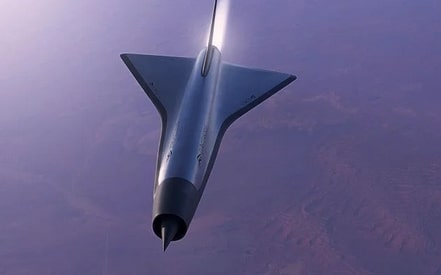

Kratos Defense will utilize the Hermeus high-speed Quarterhorse aircraft as part of its support work for the U.S. Navy and Missile Defense Agency’s Multi-Service Advanced Capabilities Hypersonic Testbed (MACH-TB) program. The rapid expansion of the Kratos Defense hypersonic test team follows the award of a $1.45 billion contract in January 2025 to support the MACH-TB program—a five-year initiative.
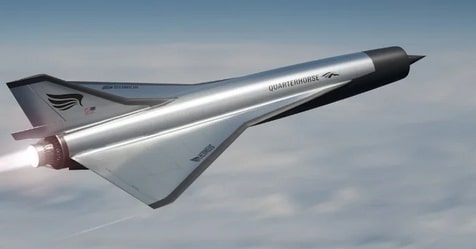
The remotely piloted Quarterhorse Mk. 2 will be able to reach about mach 2.5 supersonic speeds. The demonstrator is currently undergoing integrated systems testing following installation of its Pratt & Whitney F100-229 engine.
The MACH-TB team does include Stratolaunch’s air-launched, reusable Talon-A hypersonic test vehicle which has already completed multiple Mach 5-plus flights.
The Hermeus Quarterhorse Mk 3 will target near hypersonic speeds of about Mach 4. It will use the Chimera II propulsion system, which is a turbine-based combined cycle (TBCC) engine.
The mark 3 is expected to be developed in 2026. Mark 3 is the first vehicle to fully integrate the Chimera II propulsion system, focusing on in-flight demonstration of turbine-to-ramjet mode transition—a critical breakthrough for seamless low-to-hypersonic operations. Flight is targeted for 2026, building on the success of prior models. The Mk 3 incorporates lessons from Mk 1’s May 2025 flight and Mk 2’s ongoing supersonic assembly.
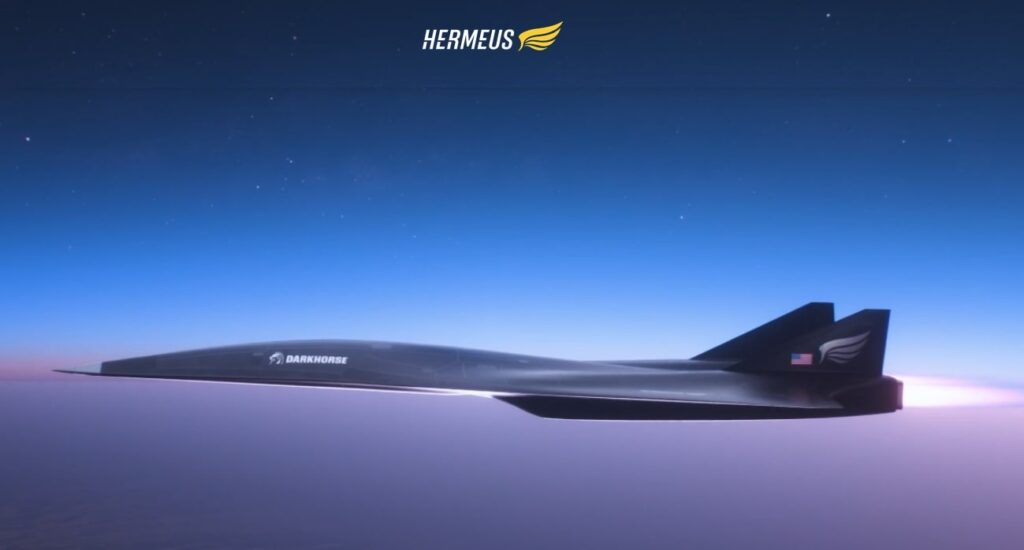
Dark Horse is Hermeus’ autonomous, reusable hypersonic unmanned aerial system (UAS) for defense applications, such as intelligence, surveillance, and strike missions. It’s designed for Mach 5+ speeds with significantly larger payloads than Quarterhorse (up to 1,000+ lbs). As of March 2025, it’s in early design, powered by a more powerful Chimera variant—potentially dual F100-based engines for enhanced thrust. A conceptual milestone test flight is slated for March 2027.
Chimera Precooler Technology
The Chimera precooler is a proprietary heat exchanger technology developed by Hermeus, an aerospace company focused on hypersonic flight. It is a core component of the Chimera engine, a turbine-based combined cycle (TBCC) propulsion system designed to enable seamless acceleration from subsonic takeoff to hypersonic speeds (Mach 5+). By addressing the thermal challenges of high-speed flight, the precooler extends the operational envelope of traditional turbine engines, bridging the gap between turbine and ramjet modes without requiring rockets or air-launch systems.
How the Precooler Works
At supersonic and hypersonic speeds, air entering the engine inlet is compressed adiabatically, causing its temperature to skyrocket—potentially exceeding 1,000°C (1,832°F) at Mach 2+. This extreme heat limits turbine engines, as it can damage compressor blades and reduce efficiency before combustion.
Boosts turbine operation from ~Mach 1.5 to Mach 2.5+, delaying the need for ramjet transition and improving fuel efficiency at mid-supersonic speeds.
Assembly of Quarterhorse Mk 2 is advancing, with the precooler-F100 setup integrated for supersonic demos. A Mk 2.1 variant, featuring an enhanced precooler configuration, is slated for the U.S. Air Force’s MACH-TB program in partnership with Kratos, focusing on tactical booster applications. Full Chimera integration (with precooler-enabled transition) is on track for Quarterhorse Mk 3 in 2026, aiming for Mach 4+ and SR-71 speed records. Challenges like material durability under cyclic heating are being iterated via HEAT data, with no major setbacks reported.
Brian Wang is a Futurist Thought Leader and a popular Science blogger with 1 million readers per month. His blog Nextbigfuture.com is ranked #1 Science News Blog. It covers many disruptive technology and trends including Space, Robotics, Artificial Intelligence, Medicine, Anti-aging Biotechnology, and Nanotechnology.
Known for identifying cutting edge technologies, he is currently a Co-Founder of a startup and fundraiser for high potential early-stage companies. He is the Head of Research for Allocations for deep technology investments and an Angel Investor at Space Angels.
A frequent speaker at corporations, he has been a TEDx speaker, a Singularity University speaker and guest at numerous interviews for radio and podcasts. He is open to public speaking and advising engagements.
