


Close Menu

    Subscribe to Updates

    Get the latest Tech news from SynapseFlow

    What's Hot

    US Destroys All Military Targets on Kharg Island Which Is Iran’s Oil Export Hub

    March 14, 2026

    The vivo X300 Ultra will upgrade audio quality on all levels

    March 14, 2026

    This Supreme Court decision is bad news for Hollywood’s AI ambitions

    March 14, 2026
    Facebook X (Twitter) Instagram
    • Homepage
    • About Us
    • Contact Us
    • Privacy Policy
    Facebook X (Twitter) Instagram YouTube
    synapseflow.co.uksynapseflow.co.uk
    • AI News & Updates
    • Cybersecurity
    • Future Tech
    • Reviews
    • Software & Apps
    • Tech Gadgets
    synapseflow.co.uksynapseflow.co.uk
    Home»Future Tech»Mysterious Interstellar Visitor Object Abruptly Lights Up
    Mysterious Interstellar Visitor Object Abruptly Lights Up
    Future Tech

    Mysterious Interstellar Visitor Object Abruptly Lights Up

    The Tech GuyBy The Tech GuyNovember 3, 2025No Comments3 Mins Read0 Views
    Share
    Facebook Twitter LinkedIn Pinterest Email
    Advertisement


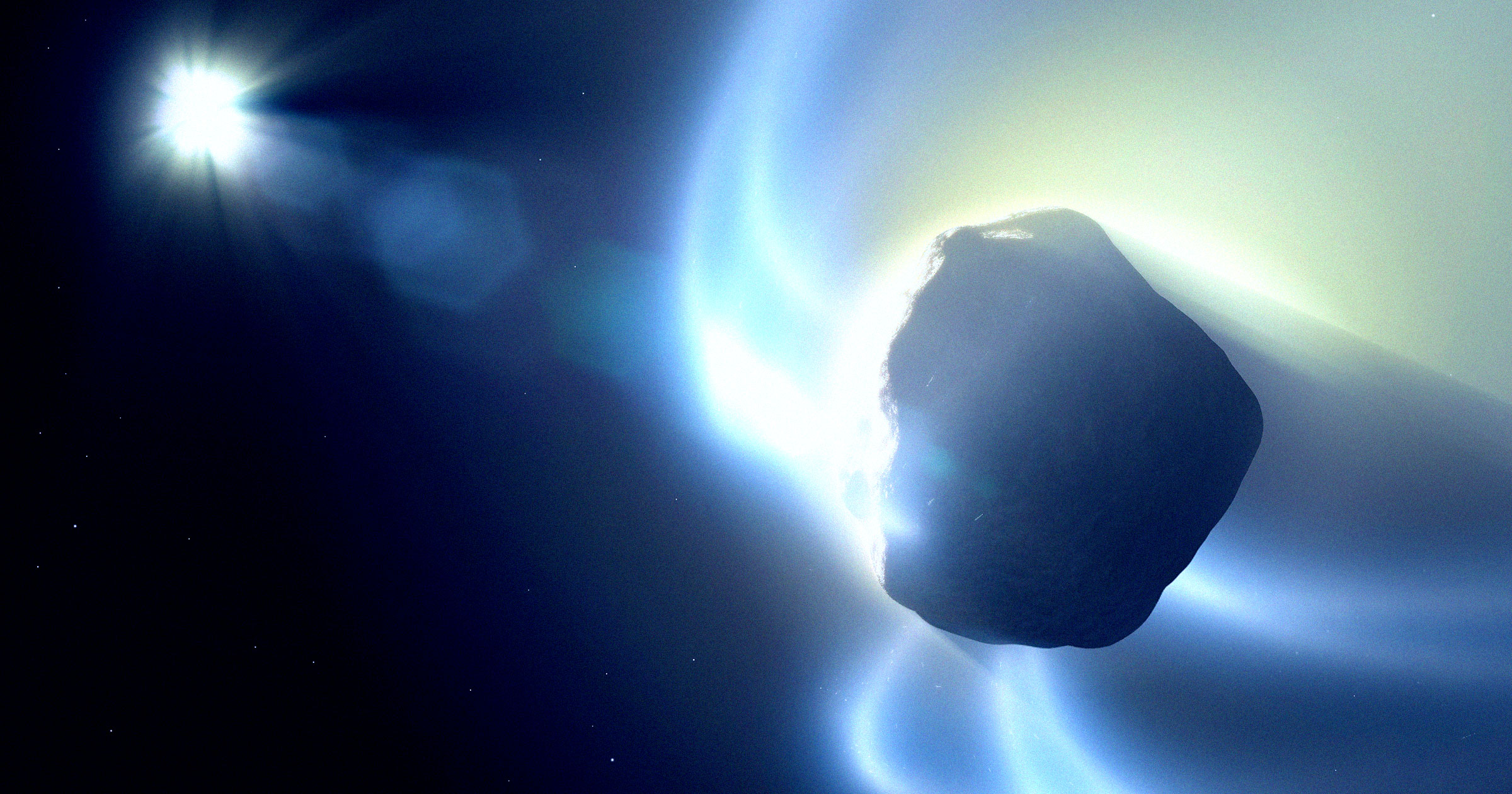
    Since it was first spotted in early July, scientists have been fascinated by 3I/ATLAS — the third object in history to have been spotted cruising through our solar system from interstellar space.

    Advertisement

    The visitor, which is generally suspected to be a comet, has been racing through our star system at a blistering velocity, reaching its closest point to the Sun on October 29.

    During that close approach, scientists were surprised to note that 3I/ATLAS brightened much faster than they anticipated. Comets commonly form a tail of gas and dust as they approach the Sun, as its radiation causes solid ice to sublimate into gas, causing material to be stripped from their surface that then reflects more light.

    However, astronomers were caught off guard by how quickly 3I/ATLAS’ luminosity grew in observations by two solar observatories, NASA’s Solar Terrestrial Relations Observatory (STEREO), and the European Space Agency’s Solar and Heliospheric Observatory (SOHO), as well as the National Oceanic and Atmospheric Administration’s GOES-19 weather satellite.

    Relying on these observatories is a stopgap measure, since Earth-based observatories won’t be able to track the object until it reemerges from behind the Sun in early December.

    “The reason for 3I’s rapid brightening, which far exceeds the brightening rate of most Oort cloud comets at similar [radial distance], remains unclear,” Naval Research Laboratory astrophysicist Karl Battams and Lowell Observatory postdoctoral fellow Qicheng Zhang wrote in a yet-to-be-peer-reviewed paper about the “rapid brightening.”

    However, they provided several theories as to why 3I/ATLAS may have lit up much faster than expected. For one, it could be the object’s immense speed. It’s been traveling at a speed of roughly 137,000 mph, significantly faster than either of the two previously discovered interstellar objects.

    Or it could have something to do with the object’s composition itself.

    “Oddities in nucleus properties like composition, shape, or structure — which might have been acquired from its host system or over its long interstellar journey — may likewise contribute [to the rapid brightening],” Zhan and Battams wrote.

    The astronomers also found that 3I/ATLAS is “distinctly bluer than the Sun,” which is “consistent with gas emission contributing a substantial fraction of the visible brightness near perihelion.”

    Yet many questions remain, and we’ll have to await future observations to shed more light on the matter.

    “Without an established physical explanation, the outlook for 3I’s postperihelion behavior remains uncertain, and a plateau in brightness — or even a brief continuation of its preperihelion brightening — appears as plausible as rapid fading past perihelion,” the researchers added.

    For now, astronomers will have to remain patient as 3I/ATLAS continues to be hidden from Earth’s view behind the Sun.

    “Following its 2025 October 29 perihelion, 3I makes a return to twilight and subsequently dark, night skies over 2025 November–December,” the paper reads, which could allow us to once again “characterize the comet in far greater detail than possible with the data we have presented.”

    More on 3I/ATLAS: Nine Reasons This Scientist Is Suspicious the Object Screaming Past the Sun Is a City-Sized Alien Spacecraft

    Advertisement
    Share. Facebook Twitter Pinterest LinkedIn Tumblr Email
    The Tech Guy
    • Website

    Related Posts

    US Destroys All Military Targets on Kharg Island Which Is Iran’s Oil Export Hub

    March 14, 2026

    NASA Selects Finalists in Student Aircraft Maintenance Competition – NASA

    March 13, 2026

    The US Plans to Break Ground on a Permanent Moon Base by 2030. Here’s What It Will Take.

    March 13, 2026

    Robot Escorted Away By Cops After Terrorizing Old Woman

    March 13, 2026

    SpaceX Space AI Ramp | NextBigFuture.com

    March 13, 2026

    Tiny NASA Spacecraft Delivers Exoplanet Mission’s First Images

    March 12, 2026
    Leave A Reply Cancel Reply

    Advertisement
    Top Posts

    The iPad Air brand makes no sense – it needs a rethink

    October 12, 202516 Views

    ChatGPT Group Chats are here … but not for everyone (yet)

    November 14, 20258 Views

    Facebook updates its algorithm to give users more control over which videos they see

    October 8, 20258 Views
    Stay In Touch
    • Facebook
    • YouTube
    • TikTok
    • WhatsApp
    • Twitter
    • Instagram
    Advertisement
    About Us
    About Us

    SynapseFlow brings you the latest updates in Technology, AI, and Gadgets from innovations and reviews to future trends. Stay smart, stay updated with the tech world every day!

    Our Picks

    US Destroys All Military Targets on Kharg Island Which Is Iran’s Oil Export Hub

    March 14, 2026

    The vivo X300 Ultra will upgrade audio quality on all levels

    March 14, 2026

    This Supreme Court decision is bad news for Hollywood’s AI ambitions

    March 14, 2026
    categories
    • AI News & Updates
    • Cybersecurity
    • Future Tech
    • Reviews
    • Software & Apps
    • Tech Gadgets
    Facebook X (Twitter) Instagram Pinterest YouTube Dribbble
    • Homepage
    • About Us
    • Contact Us
    • Privacy Policy
    © 2026 SynapseFlow All Rights Reserved.

    Type above and press Enter to search. Press Esc to cancel.

    Ad Blocker Enabled!
    Ad Blocker Enabled!
    Our website is made possible by displaying online advertisements to our visitors. Please support us by disabling your Ad Blocker.