

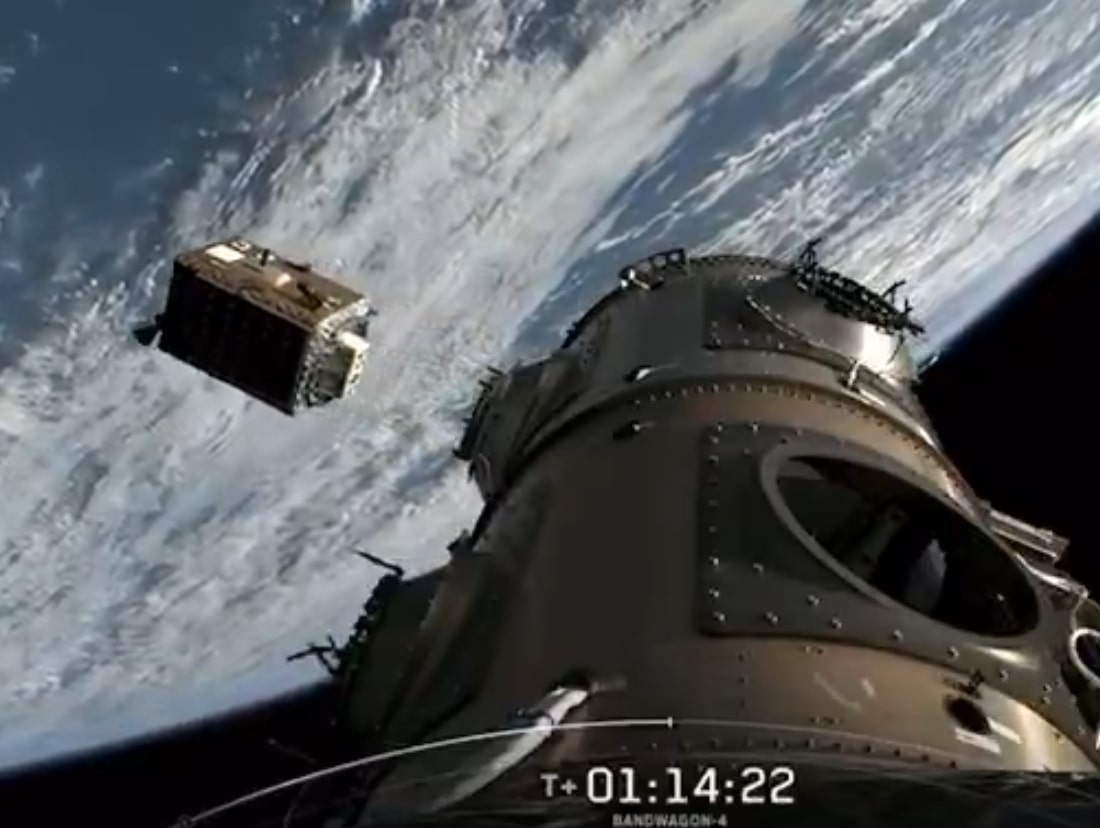

The Starcloud-1 satellite launched this Sunday and has successfully separated from the SpaceX rocket that brought it to orbit.
About the size of a small refrigerator, the 60kg satellite features the first Nvidia H100 GPU in space.
StarCloud CEO Philip Johnston said Starcloud was founded only 21 months ago and this satellite hosts the first Nvidia H100 in space, which will provide high powered inference and fine tuning capabilities for other satellites.
It’s the first in a much larger ambition to build almost all new data centers in space, taking advantage of the abundant energy and cold temperatures in space. This will also reduce the strain on energy and water from data centers on Earth.
Deployment of all payloads confirmed pic.twitter.com/bfcRyexYHu
— SpaceX (@SpaceX) November 2, 2025
SpaceX launched the Falcon 9 rocket from Cape Canaveral Space Force Station at 1:09 a.m. ET on November 2, 2025, successfully deploying 18 payloads to low-Earth orbit via its SmallSat Rideshare Program. Key payloads included Starcloud-1, featuring the first NVIDIA H100 GPU for orbital AI computing, Vast’s Haven-1 Demo for commercial space station technology, and KOREA ADD’s reconnaissance satellite. The first stage booster landed flawlessly at the launch site, marking SpaceX’s 140th Falcon 9 flight of the year.
The 60 kg satellite, about the size of a mini-fridge, carries an NVIDIA H100 GPU, marking the first time a data center-class GPU has operated in space. The GPU will process data and run AI models in orbit, including Google’s Gemma models, which aims to provide real-time insights from Earth observation data, such as wildfire detection, faster than traditional methods that require data to be downlinked to Earth for processing.
The mission will test the use of abundant solar energy and the vacuum of space for cooling, which Starcloud projects could result in 10 times lower energy costs and significant carbon-dioxide savings compared to Earth-based data centers.
This is an initial demonstrator mission, with plans for a larger micro data center, Starcloud 2, launch in 2026, and a long-term vision to build a 5-gigawatt orbital data center.
Elon Musk is Targeting 100 GW in Space by About 2030
Starship could deliver 100GW/year to high Earth orbit within 4 to 5 years if we can solve the other parts of the equation.
100TW/year is possible from a lunar base producing solar-powered AI satellites locally and accelerating them to escape velocity with a mass driver.
This will be about 1 million AI V3 Starlink or AI V4 Starlink in higher Sun Synchronous orbits.
SpaceX needs to cross over to get lower cost per kwh for space solar than terrestrial.
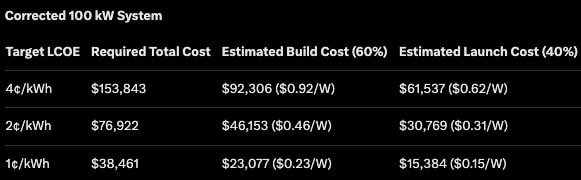
To achieve the targeted levelized cost of electricity (LCOE) thresholds—4 cents/kWh (baseline), 2 cents/kWh (half), and 1 cent/kWh (quarter)—the total upfront capital cost (build + launch). Using the same assumptions as before (4.5-year lifetime, 97.5% capacity factor, ~3.846 million kWh total output for 100 kW), the required totals scale linearly with capacity. Research indicates the current space-qualified solar build costs are ~$1,000+/kW (full system), and launches to sun-synchronous orbit (SSO) are ~$2,000–3,000/kg with Falcon 9. The main issue is getting a fully reusable Starship to drop the price to launch from $2000 per kg to $10-100 per kilogram. The remaining solar costs would then be less than the target.
The build and launch cost of 100 kw for the space solar needs to drop to about $153,000 per 100 kilowatt or about $1.53 per watt to build and launch. This is $1530 per kilowatt. It is reported that we are already under that price for the $1000 per kilowatt quotes. The $1000 per kilowatt means 100 kilowatts is $100,000 and 400 kilowatts is $400,000. If the systems lasts for 4.5 years then the cost for space power is about 3 cents per kwh. The 2030 100 Gigawatt for 1 million satellites should have less than 3 cents per kwh and perhaps 1.5 cents per kwh.
Long-term projections for the 2030s from NASA and Caltech, which envision build costs approaching $200–500/kW via ultra-lightweight, radiation-hardened thin-film solar cells.
The 20 kilowatt on a Starlink V2 mini is reportedly about $500-700k including the rest of the satellite.
The V3 will be 50-100 kilowatts and will be mass produced at about $1.2 million. But we do not have the satellite and solar cost and precise weight.
the Starship launch can for 60 V3 would be launching $72 million in satellites. If the launch cost is under $1 to 10 million with full reusability, then the cost per ton would be about $1000 to $10000 per ton. A 2 ton satellite would have $2000 to $20,000 for launch from Starship.
Crossing over on the solar cost threshold happens (once Starship is working) if the 100 kilowatt V3 needs about 12% of the cost of the whole satellite for the solar energy system.
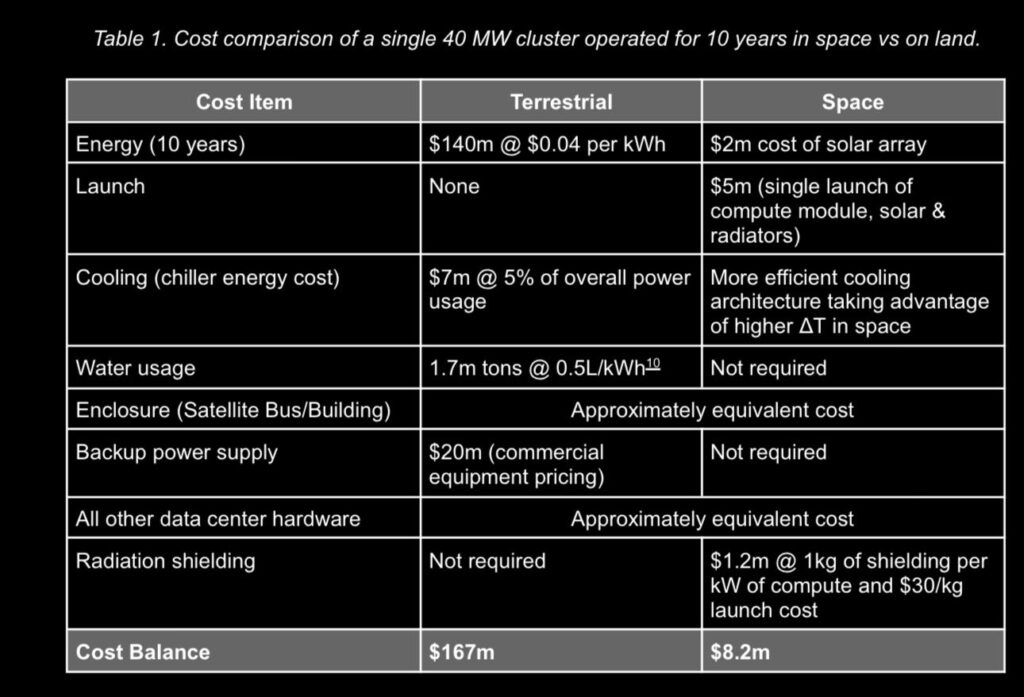
Lunar mining could reduce the cost of satellite manufacturing and deployment by about 90%.
Starship could deliver 100GW/year to high Earth orbit within 4 to 5 years if we can solve the other parts of the equation.
100TW/year is possible from a lunar base producing solar-powered AI satellites locally and accelerating them to escape velocity with a mass driver.
— Elon Musk (@elonmusk) November 2, 2025
Microsoft just committed $80 billion in fiscal 2025 AI infrastructure—the largest buildout in tech history. They’re renting capacity, not owning hardware.
The Deals:
• Nebius → $17.4B (100,000+ Nvidia GPUs, expandable to $19.4B)
• Nscale → ~$14B (200,000 GB300 GPUs across Europe/US)
• IREN → $9.7B (GB300s at renewable-powered facility)
• Lambda → Multibillion (Tens of thousands of GB300 NVL72 systems)
• UAE/G42 → $15.2B through 2029 (Datacenters + training 1M+ people, $1.5B equity stake)
• CoreWeave → Part of $33B neocloud allocation (Rentals through 2030)
• Wisconsin → $7B+ total (Two campuses, Blackwell GB200 GPUs, opening 2026+)
• OpenAI → $250B Azure commitment through 2032 (27% Microsoft stake in for-profit OpenAI)
Seven providers across multiple continents.
Every deal is built around Nvidia hardware.

Brian Wang is a Futurist Thought Leader and a popular Science blogger with 1 million readers per month. His blog Nextbigfuture.com is ranked #1 Science News Blog. It covers many disruptive technology and trends including Space, Robotics, Artificial Intelligence, Medicine, Anti-aging Biotechnology, and Nanotechnology.
Known for identifying cutting edge technologies, he is currently a Co-Founder of a startup and fundraiser for high potential early-stage companies. He is the Head of Research for Allocations for deep technology investments and an Angel Investor at Space Angels.
A frequent speaker at corporations, he has been a TEDx speaker, a Singularity University speaker and guest at numerous interviews for radio and podcasts. He is open to public speaking and advising engagements.
