

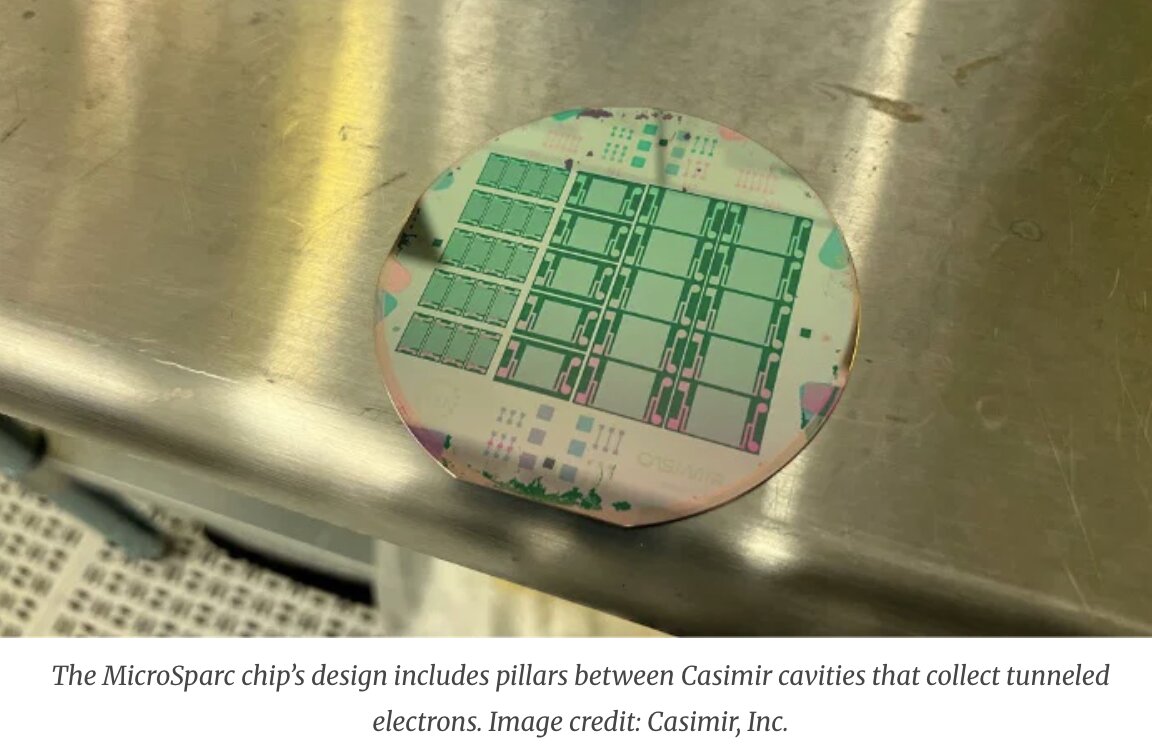

A prototype MicroSparc chip was fabricated, the Casimir team tests it using low-noise experimental setups designed to reduce electromagnetic interference. Dr. White said these tests were performed in dark, RF (radio frequency)-sealed enclosures over several weeks “using precision electrometers capable of measuring signals down to microvolt and attoamp sensitivities.” They observed device outputs ranging from millivolts to volts at picoamp current levels, well above the instrumentation’s noise floor. The team also directly measured polarization fields at the microscale in individual custom Casimir cavities using Atomic Force Microscopy, which White noted was operating in “Kelvin Probe Force Microscopy mode.”
The team placed a series of what they described as ‘micropillars’, or antennas. Similar to the conductive plates, these intentionally placed pillars are also electrically connected to one another. Critically, MicroSparc’s micropillars are electrically isolated from the cavity walls and also anchored so that they remain completely stationary under pressure. The casimir effect is leveraged to create a tiny one way flow of electrons that can get captured for constant power from vacuum energy.
The Casimir team will use the next phase of development and the new infusion of capital to focus on rapid design iteration, material system optimization, and facilitate a transition toward scalable semiconductor manufacturing.
“Over the next two years, we plan to work across multiple nanofabrication partners and material approaches aimed at increasing tunnel current magnitude and overall device performance, while developing the commercial pathway for first-generation products,” White explained.
As part of the announcement, the team said its primary target is a 5mm × 5mm semiconductor chip capable of producing approximately 1.5 volts at 25 microamps. Dr. White said this goal represents “roughly 40 microwatts of continuous power.”
Once they reach the minimum viable performance target of 1.5 volts and 25 microamps from a 5mm × 5mm chip, they can multiply output through multi-layer chips, die stacking, and chip aggregation,” White explained, adding that a single, identically sized chip “can deliver roughly 200 times the power, moving us into the milliwatt range.”
From there, White said that the Casimir team could simply aggregate numerous chips onto printed circuit boards “to reach higher power levels.”
In one proposed example, the researcher stated that a 0.5-watt Casimir generator based on their design could provide a continuous trickle charge to a smartphone battery. In this scenario, White said that the phone would be fully recharged in roughly 24 hours under normal use, “effectively making the device immortal for typical daily operation.”
After scaling the power, they plan to reduces costs to “around $100 per watt,” which they presently see as a viable target, Casimir could construct a 500-watt charging assembly approximately the size of a loaf of bread capable of delivering around 12 kilowatt-hours per day.
Okay folks, this qualifies as BREAKING NEWS!
Harold “Sonny” White, the warp drive pioneer behind NASA’s EagleWorks Lab, just stepped out of stealth with Casimir Inc. to unveil MicroSPARC: the first battery free chip to harvest continuous electrical power straight from the… https://t.co/hS2z9A2Lwj pic.twitter.com/WRTWKiEAYQ
— Owen Lewis (@is_OwenLewis) May 13, 2026
Physical Review Research – Emergent quantization from a dynamic vacuum Adding quadratic temporal dispersion to a dynamic-vacuum acoustic model yields a fully analytic, exactly isospectral mapping to the hydrogenic Coulomb problem. They make a compact set of explicit assumptions that together fix the governing operator, the spectrum, and the mapping to observation. No postulate of angular-momentum quantization is required.

Brian Wang is a Futurist Thought Leader and a popular Science blogger with 1 million readers per month. His blog Nextbigfuture.com is ranked #1 Science News Blog. It covers many disruptive technology and trends including Space, Robotics, Artificial Intelligence, Medicine, Anti-aging Biotechnology, and Nanotechnology.
Known for identifying cutting edge technologies, he is currently a Co-Founder of a startup and fundraiser for high potential early-stage companies. He is the Head of Research for Allocations for deep technology investments and an Angel Investor at Space Angels.
A frequent speaker at corporations, he has been a TEDx speaker, a Singularity University speaker and guest at numerous interviews for radio and podcasts. He is open to public speaking and advising engagements.
