

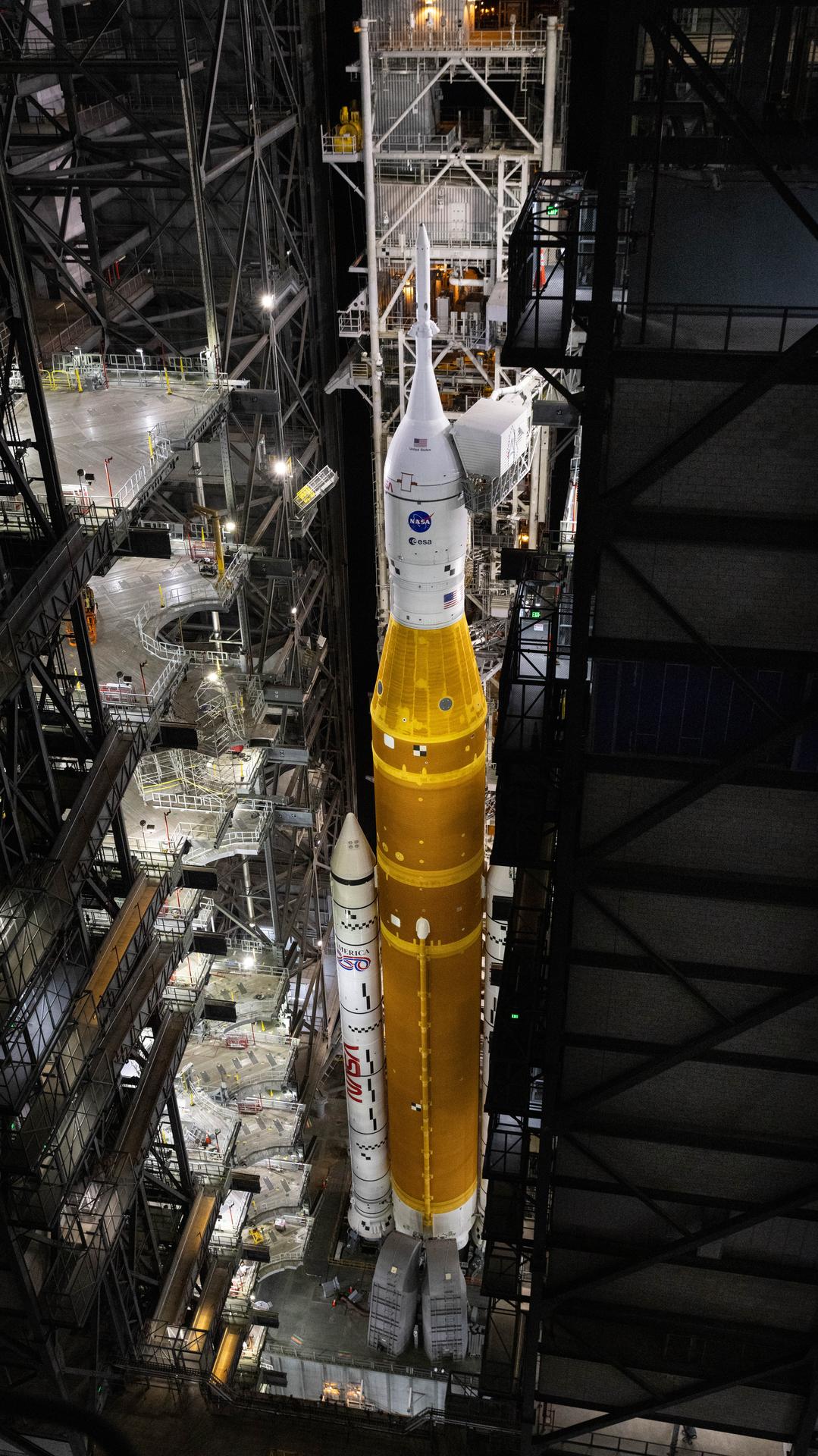

As part of a Golden Age of exploration and discovery, NASA announced Friday the agency is increasing its cadence of missions under the Artemis program to achieve the national objective of returning American astronauts to the Moon and establishing an enduring presence. This includes standardizing vehicle configuration, adding an additional mission in 2027, and undertaking at least one surface landing every year thereafter.
As teams prepare to launch Artemis II in the weeks ahead, the Artemis III mission, now in 2027, will be designed to test out systems and operational capabilities in low Earth orbit to prepare for an Artemis IV landing in 2028. This new mission will endeavor to include a rendezvous and docking with one or both commercial landers from SpaceX and Blue Origin, in-space tests of the docked vehicles, integrated checkout of life support, communications, and propulsion systems, as well as tests of the new Extravehicular Activity (xEVA) suits. NASA will further define this test flight after completing detailed reviews between NASA and our industry partners. The agency will share the specific objectives for the updated Artemis III mission in the near future.
NASA’s recently announced workforce directive is a key factor in enabling this acceleration. NASA will rebuild core competencies in the civil servant workforce including more in-house and side-by-side development work with our Artemis partners, enabling a safer, more reliable, and faster launch cadence.
“NASA must standardize its approach, increase flight rate safely, and execute on the President’s national space policy. With credible competition from our greatest geopolitical adversary increasing by the day, we need to move faster, eliminate delays, and achieve our objectives,” said NASA Administrator Jared Isaacman. “Standardizing vehicle configuration, increasing flight rate and progressing through objectives in a logical, phased approach, is how we achieved the near-impossible in 1969 and it is how we will do it again.”
“After successful completion of the Artemis I flight test, the upcoming Artemis II flight test, and the new, more robust test approach to Artemis III, it is needlessly complicated to alter the configuration of the SLS and Orion stack to undertake subsequent Artemis missions,” said NASA Associate Administrator Amit Kshatriya. “There is too much learning left on the table and too much development and production risk in front of us. Instead, we want to keep testing like we fly and have flown. We are looking back to the wisdom of the folks that designed Apollo. The entire sequence of Artemis flights needs to represent a step-by-step build-up of capability, with each step bringing us closer to our ability to perform the landing missions. Each step needs to be big enough to make progress, but not so big that we take unnecessary risk given previous learnings. Therefore, we want to fly the landing missions in as close to the same Earth ascent configuration as possible – this means using an upper stage and pad systems in as close to the ‘Block 1’ configuration as possible. We will work with our partners that have been developing the evolved block configuration of these systems to take proper actions to align their efforts towards this goal and announce the details of those changes once they are finalized. We will take a similar approach to in-space, landing, and surface EVA operations as well, as we evolve the mission sequence in the spirit of the Apollo mindset, which was obsessed with system reliability and crew safety as the keys to mission success.”
“Boeing is a proud partner to the Artemis mission and our team is honored to contribute to NASA’s vision for American space leadership,” said Steve Parker, Boeing Defense, Space & Security president and CEO. “The SLS core stage remains the world’s most powerful rocket stage, and the only one that can carry American astronauts directly to the moon and beyond in a single launch. As NASA lays out an accelerated launch schedule, our workforce and supply chain are prepared to meet the increased production needs. With a rocket designed at NASA’s Marshall Space Flight Center in Huntsville, Alabama, built at America’s rocket factory at NASA’s Michoud Assembly Facility in New Orleans, and integrated at NASA’s Kennedy Space Center in Florida, we are ready to meet the increased demand.”
The announcement came during a news conference at NASA Kennedy where leaders also discussed the status of the Artemis II mission. NASA rolled the SLS and Orion spacecraft to the Vehicle Assembly Building (VAB) on Feb. 25 for repairs ahead of the next launch opportunities for the test flight in April.
Once the Artemis II hardware was back in the VAB, teams immediately began work on the helium issue discovered on the Interim Cryogenic Propulsion Stage and prepared for several actions including replacing batteries in the flight termination system, end-to-end testing for range safety requirements, and more.
“I’m grateful to Administrator Isaacman for taking this bold step and moving quickly to assure we have the support and resources needed to launch Artemis astronauts to the Moon every year,” said Lori Glaze, acting associate administrator for Exploration Systems Development Mission Directorate at NASA Headquarters in Washington. “Our team is up to the challenge of a successful Artemis II mission, and soon thereafter, enabling a more frequent cadence of Moon missions.”
For more about the Artemis campaign, visit:
-end-
Bethany Stevens / Cheryl Warner
Headquarters, Washington
202-358-1600
bethany.c.stevens@nasa.gov / cheryl.m.warner@nasa.gov
