

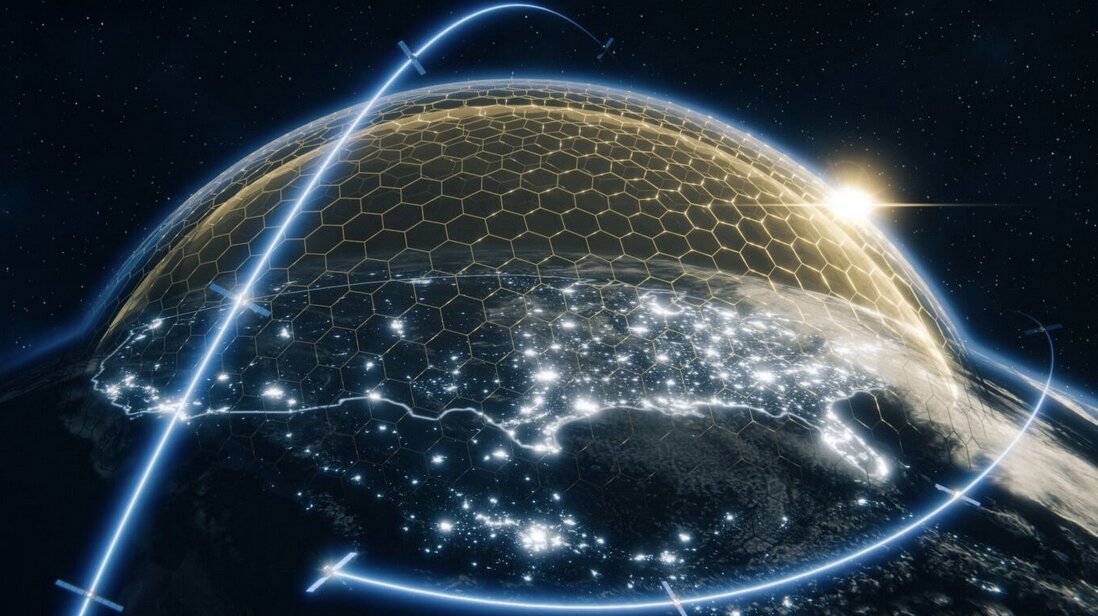

%he Trump administration has most pegged the near term price tag for Golden Dome’s objective architecture at approximately $185 billion. 60% of this will be in space for about 1200 satellites and then scaling to 7500 interceptors and then replacements every five years. Last year, President Trump put forward a $175 billion figure, which he said would include systems to be fielded in less than three years.
SpaceX just got about $6.4 billion for one of the the first parts of the Golden Dome projects. SpaceX was awarded a $4.16 billion contract from the Space Force to build satellites that track foreign aircraft and missiles as part of President Trump’s proposed Golden Dome project. $2.29 billion for the Space Data Network (SDN) Backbone: A resilient, high-speed military communications mesh in LEO (also Starshield-based) to link sensors, weapons, and command systems. Fully operational prototype by end of 2027.
If SpaceX captures 40% of the ~$600–700 billion in satellite-related acquisition costs across SBI + sensing layers (buses/platforms, integration, where it has Starshield heritage and vertical integration advantage), that alone is $240 billion. A large capture is plausible for the bus + sensor side given SpaceX’s recent wins. Spreading $240 billion of satellites and $50 billion of launch over 20 years would be about $14billion per year. 20% of the first $185 billion for the next three years or so would be $60 billion for three years or $20 billion per year.
CBO released a detailed cost estimate of what it described as a notional National Missile Defense System yesterday. CBO’s $1.19 trillion figure covers various expenses over a 20-year timeframe. This is more than double the projected price tag that CBO had put forward last year. The US will deploy and sustain a constellation of 7,800 space-based anti-missile interceptors accounts for more than 60 percent of that projected price tag.
An all-new constellation of 7,800 space-based interceptors is, by far, the largest single component of CBO’s projection. This capability is estimated to cost $723 billion to acquire, and then another $1 billion annually to operate and maintain ($20 billion over 20 years), for a total of $743 billion. This is 60 percent of the total estimated $1.191 trillion price tag, and 70 percent of the projected acquisition costs.
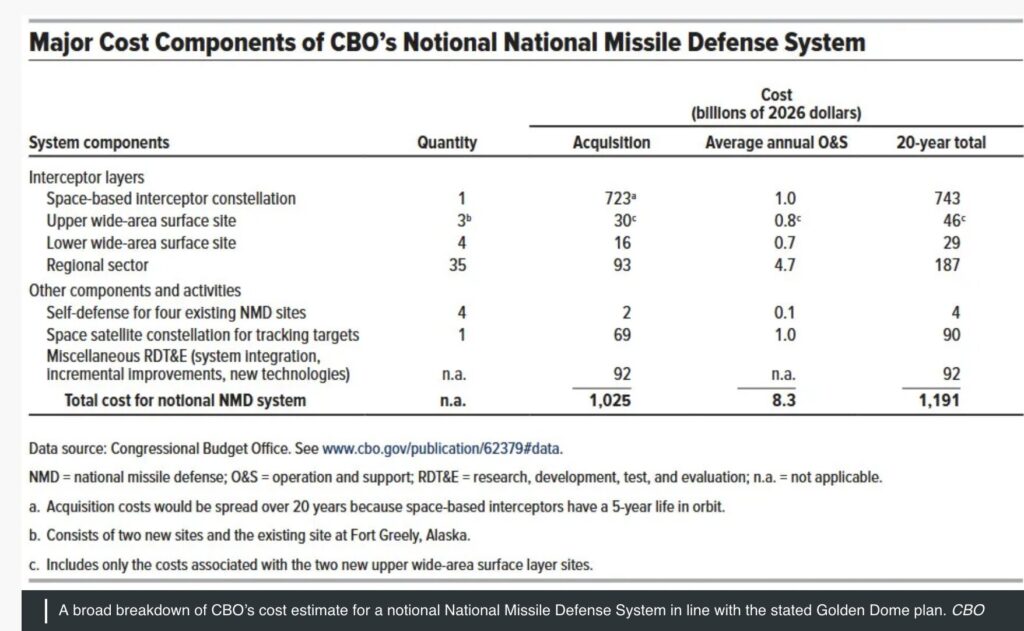
CBO provides a detailed breakdown of how it arrived at these figures.
“The average cost per SBI [space-based interceptor] satellite would be $22 million. That average is for the initial 7,800 SBIs as well as the nearly 1,600 SBIs that would be needed each year thereafter because of the satellites’ short five-year service life. The need to periodically replace SBIs means that the acquisition costs would be spread over the life of the system,” according to the cost assessment. “The total is based on a cost of $500 per kilogram to launch the SBIs into orbit. Although that launch cost is lower than typical launch costs today, it is thought to be achievable using the new generation of heavy-lift rockets, such as the Space-X [sic] Starship, that are being developed. Even lower launch costs may be realized in the future, but that could have only a limited effect on total costs for the SBI layer because, even at $500 per kilogram, launch costs account for less than 5 percent of the total.
This is about $9 billion in launches over the next three years and for the overall $1.2 trillion 20 year project it will be about $40-50 trillion just for launches. I expect SpaceX will make a lot of the satellites too.
Brian Wang is a Futurist Thought Leader and a popular Science blogger with 1 million readers per month. His blog Nextbigfuture.com is ranked #1 Science News Blog. It covers many disruptive technology and trends including Space, Robotics, Artificial Intelligence, Medicine, Anti-aging Biotechnology, and Nanotechnology.
Known for identifying cutting edge technologies, he is currently a Co-Founder of a startup and fundraiser for high potential early-stage companies. He is the Head of Research for Allocations for deep technology investments and an Angel Investor at Space Angels.
A frequent speaker at corporations, he has been a TEDx speaker, a Singularity University speaker and guest at numerous interviews for radio and podcasts. He is open to public speaking and advising engagements.
