


For most of us, a locust swarm sounds like an utter nightmare. For roboticists, it’s inspiration.
Nature abounds with creatures that cooperate with a “hive mind.” From bees gathering pollen to schools of sardines grouping to avoid predators, individuals seamlessly move together in ever-changing configurations. Roboticists inspired by these dynamics have designed microrobots—often no more than the width of a human hair—to mimic their behavior.
These tiny machines show promise in medicine and environmental cleanup. They easily sail through blood vessels to remove blood clots, deliver chemotherapy to tumors, and bring medicines to the eye and gut. In the wild, they remove plastics and heavy metals from water.

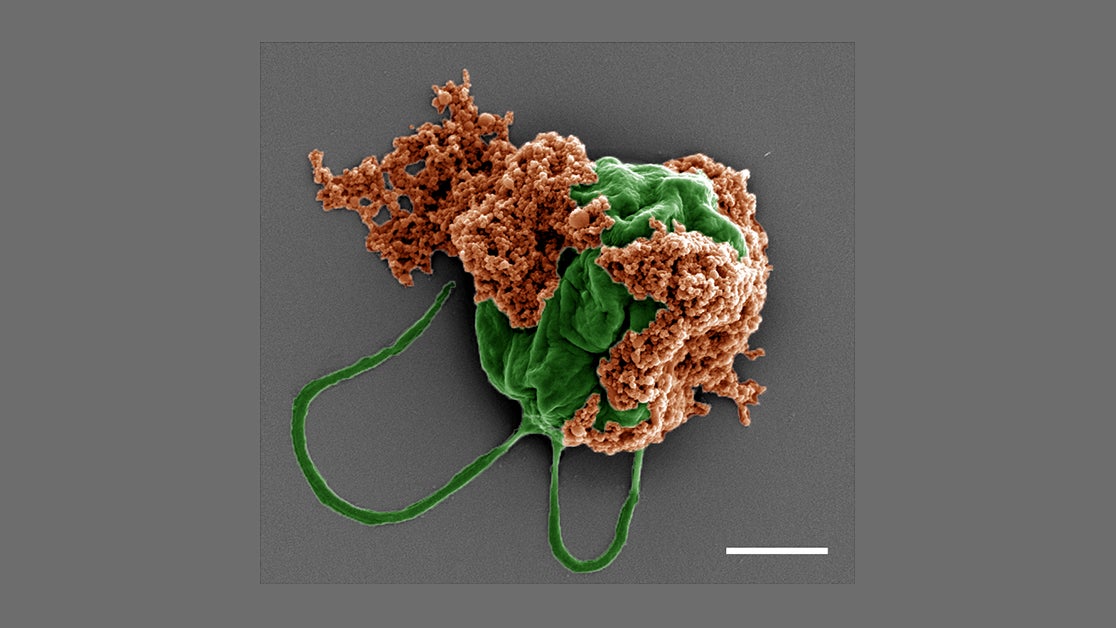
Researchers usually steer microbots with sound, magnets, or light. But few systems are able to assemble into swarms and disassemble on command. A University of San Diego team has now engineered a part-biological microbot swarm controlled by shifting colors of light. The swarm is made of living algae and nanoparticles and can coalesce into various shapes on demand.
In one test, the researchers shaped the living robots to match damaged tissue in a simulated wound. They then assembled the robots on a smart “Band-Aid” and released them into the wound, concentrating treatment exactly where it was needed.
Living Machines
Microbots that deliver drugs, perform surgery, or act as environmental sentinels are no longer science fiction. Swarms of these robots have especially captured the imagination of roboticists. Tweaking a swarm’s shape and size can allow it to tunnel into small spaces and do work that would thwart any single sophisticated robot.
Early versions use a variety of synthetic materials to mimic natural swarms. Some made of tiny iron-based particles shapeshift from chains to vortexes and ribbons after scientists strategically apply magnetic forces. Certain configurations offer strength and stability; others are more steerable, like robotic sentinels from the Matrix movies. Another class of nanomachines respond to light or sound waves for navigation.
Synthetic microbots can mimic swarm behavior, but they’re limited by a material’s physics. So researchers are turning to nature too, building biohybrid bots powered by living cells.
Swimming bacteria are a popular choice. Tethered to nanoparticles carrying drugs, these robots can navigate liquid environments to kill pathogens, trap microplastics, or deliver antibiotics. But their relatively large size makes it hard to access tight or delicate spaces.
Algae could be an alternative. These single-celled organisms swim using long, whip-like arms called flagella that act as microscopic propellers. Roughly 10 micrometers across—about the size of an average skin cell—they’re small enough to thread their way through tiny spaces.
Researchers can coat nanoparticles with drugs or chemical sensors and attach them to the algae. These bots have already been used to deliver antibiotics for bacterial pneumonia in mice. Other designs have been tested as a treatment for inflammatory bowel disease, a chronic disorder that affects millions worldwide. Here, scientists engineered nanoparticles to absorb and neutralize inflammatory chemicals in the gut. Packed into a pill, the algae-powered bots dispersed throughout the treatment area while largely avoiding other organs.
But the microbots are still hard to control. Researchers don’t understand their collective behavior and how they form assemblies, wrote the authors of the new study.
Blue Light, Red Light
The team picked Chlamydomonas reinhardtii for their robots. Commonly found in freshwater puddles and soil, these single-celled algae are a staple of lab research. They have two powerful arms and are sensitive to various colors of light, making them easy to control.
In a test, the team projected blue or red light onto petri dishes crowded with the algae. They shaped the swarms with masks—basically, stencils—patterned to look like different continents. Blue light caused the algae to cluster in swarms matching the mask . Red light dispersed them. The team shaped the living swarm to resemble the Americas and Afro-Eurasia within minutes.
Using a mask shaped like an arrow, the team moved the swarm several millimeters while maintaining its shape. Other masks transformed the swarm into stars, letters, and triangles. By further tuning the duration and intensity of red and blue light, the researchers coaxed the swarm to double its size while maintaining a circular shape or split into four smaller parts. They used the results to write an algorithm predicting how light alters swarm activity.
The team next attached the algae to nanoparticles to see if they could target a simulated wound on a dummy hand coated in lifelike “phantom skin.” A thin coat of artificial wound fluid, made up of proteins and chemicals usually found after a scrape, made the test more realistic.
They used an AI system to analyze images of the wound, segmenting regions into healthy, inflamed, or potentially infected tissue, and then laser-printed a custom mask matching the infected area. Under blue light, the microbots assembled on a piece of medical tape in the exact geometry of the wound. After applying the custom Band-Aid, a burst of red light released over 90 percent of the bots to the target area in less than two minutes.
The work is still early though. In future studies, researchers will have to load nanoparticles with medication and test how the swarms behave in real wounds and living tissue. And because the system relies on light for control, it’s currently limited to surface-level applications.
That said, because they can now more reliably control the swarms’ shape, size, and position, the technology could prove quite useful in medical applications, wrote the team.
