


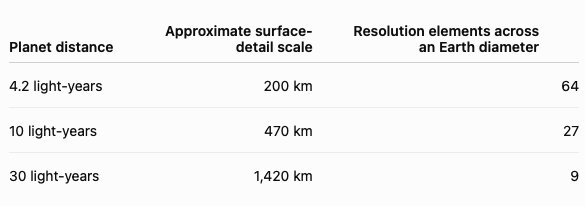
A NASA NIAC project will try to Mapping Alien Continents using formation-flying optical interferometer. Two hierarchical nullers ~100 km apart that first suppress the host star by ~10¹⁰ in visible light, then combine the leftover planet light as a Michelson interferometer. That baseline gives an angular resolution of order 1 µas at 500 nm. An Earth-sized planet at 10 pc subtends only ~8–9 µas, so you get a handful of resolution elements across the disk—enough, in principle, to see the largest albedo contrasts (continents vs. oceans) after many baselines and a lot of integration. You never have to leave the inner Solar System.
It is potentially continent-scale imaging of nearby worlds. These are angular-resolution estimates, not guaranteed reconstructed images: collecting enough photons and sampling enough baseline orientations remain essential. Two stations provide interference measurements; they do not instantly produce a complete photograph.
The Stankus mapping interferometer can be scaled to longer baselines, and it sits in the same conceptual family as Antoine Labeyrie’s hypertelescope. The two ideas are complementary rather than identical.
A 100 km baseline at visible wavelengths already gives ~1 µas resolution—enough for a handful of resolution elements across an Earth-sized planet at 10 pc. Stretching the same two-spacecraft architecture to several hundred kilometres would produce a finer grid (more pixels across continents and oceans) provided you can still hold optical-path differences to a few nanometres and keep the hierarchical nuller working at 10¹⁰ contrast.
Labeyrie’s 400 km bubble concept uses roughly 100 km effective apertures for individual targets. It is not one 400 km aperture using all 10,000 mirrors. Also, a few nanometers of path control can preserve imaging fringes, but does not by itself deliver a 10¹⁰ null. I’ll show those as separate requirements.
In practice that means adding more collector spacecraft so you sample many baselines at once (better uv-coverage) and increasing total collecting area so the planet photons do not become vanishingly scarce. Those steps turn the simple two-nuller Michelson into a sparse multi-aperture array.That is exactly the direction Labeyrie has been pursuing for three decades.
His hypertelescope is a flotilla of dozens to thousands of small mirrors (sometimes only tens of centimetres across) arranged on a virtual spherical or paraboloidal surface tens to hundreds of kilometres across. A densified-pupil combiner at the focus produces a direct snapshot image rather than requiring full aperture-synthesis reconstruction.
Labeyrie has published concepts ranging from a 57 meter ground prototype in the French Alps, through kilometre-scale “Luciola” space versions, up to an “Exo-Earth Imager” with 10 000 three-meter mirrors spanning 400 km, and even speculative 100 000 km laser-trapped graphene-mirror flotillas. Coronagraphic or nulling stages can be inserted in the combiner so the same architecture can reach the contrast needed for reflected-light exoplanet imaging.
The Stankus design is therefore a specialized, high-contrast, two-element starting point that can grow into a hypertelescope-like formation. The main engineering hurdles that grow with baseline are the same for both: nanometre-level formation flying and metrology over hundreds of kilometres, thermal and vibrational stability, and the sheer number of photons collected from an Earth analogue 10 pc away.
Labeyrie’s many-small-aperture approach helps the last problem by increasing the number of collectors without requiring giant individual telescopes.In short, longer baselines and more elements take the mapping interferometer toward the performance Labeyrie has been advocating for “hyperscopes.” Whether that is cheaper or faster than flying a modest telescope to the solar gravitational lens remains an open trade-off, but the optical architecture itself scales.
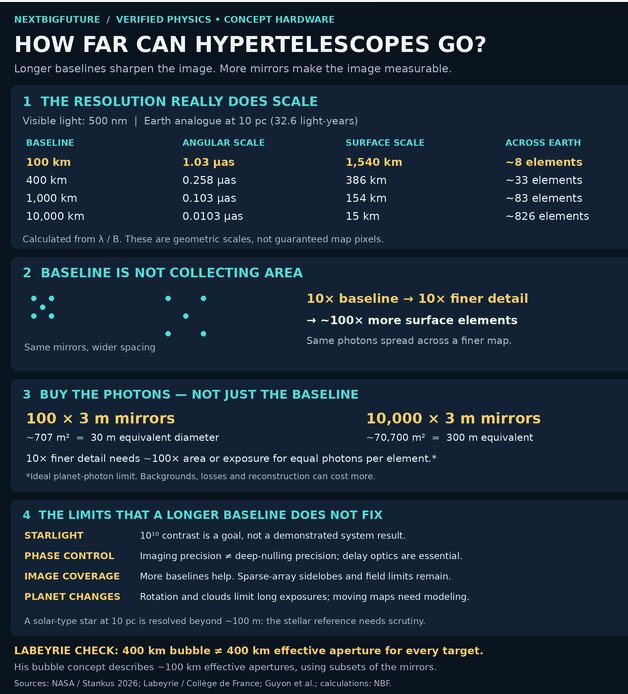
Other limits as the formation grows
Beam transport: diffraction requires adequate transmitting/receiving optics or relays. For a 1 m transmitting aperture at 500 nm, the first-zero diffraction radius is about 0.61 m after 1,000 km, about 6.1 m after 10,000 km. Actual beam profiles, losses and geometry change these values.
Formation and delay control: pointing acquisition, actuator range, vibration, thermal changes, timing and metrology signal-to-noise must close. At 100,000 km, one-way light travel takes about 0.33 seconds, complicating centralized fast feedback; local control is possible.
Spatial sampling: N apertures have at most N(N-1)/2 pairwise baselines, but not all are distinct or independently measured with equal sensitivity. Snapshot imaging requires suitable geometry and adequate photons in the required spatial modes.
Field: densification trades field of view and energy concentration. It cannot create missing spatial information. Array geometry and minimum spacings constrain the usable field.
Planet variability: Earth’s equatorial rotation speed is about 0.46 km/s. A 154 km feature moves its own width in roughly 5.5 minutes near disk center; a 15 km feature in roughly 33 seconds. These are illustrative smear times, not prohibitions: known rotation can be modeled, but evolving clouds and weather prevent indefinite static-image integration.
Large formations also add collision avoidance, maintenance, failures, communications, deployment and operational complexity. There is no supported cost or schedule advantage over an SGL mission without a common target, resolution and signal-to-noise requirement.
Brian Wang is a Futurist Thought Leader and a popular Science blogger with 1 million readers per month. His blog Nextbigfuture.com is ranked #1 Science News Blog. It covers many disruptive technology and trends including Space, Robotics, Artificial Intelligence, Medicine, Anti-aging Biotechnology, and Nanotechnology.
Known for identifying cutting edge technologies, he is currently a Co-Founder of a startup and fundraiser for high potential early-stage companies. He is the Head of Research for Allocations for deep technology investments and an Angel Investor at Space Angels.
A frequent speaker at corporations, he has been a TEDx speaker, a Singularity University speaker and guest at numerous interviews for radio and podcasts. He is open to public speaking and advising engagements.
