


Why you can trust TechRadar
We spend hours testing every product or service we review, so you can be sure you’re buying the best. Find out more about how we test.
GameSir Pocket Taco: review
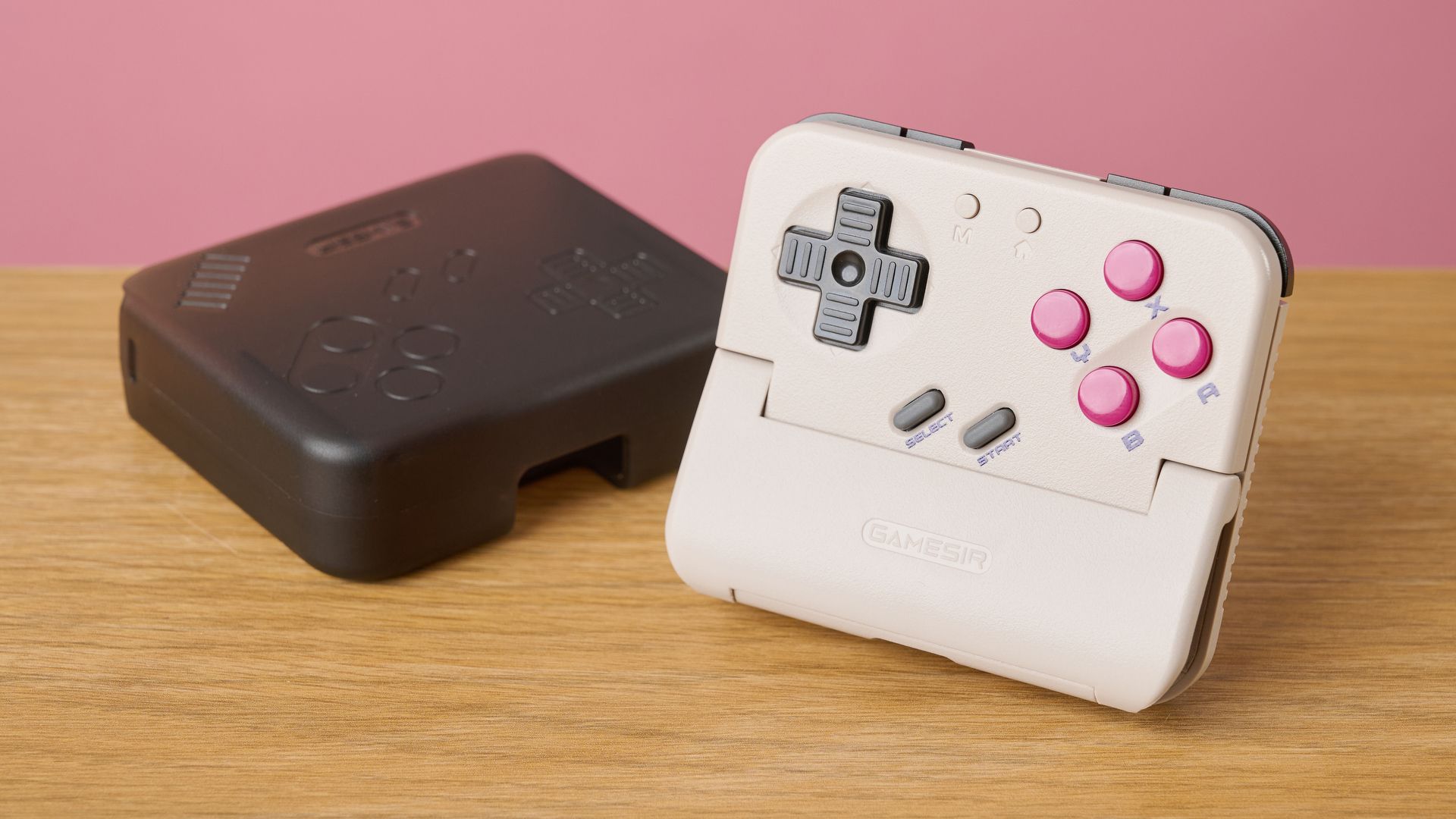
The GameSir Pocket Taco is a novel mobile controller that clips to the bottom of your phone. It’s honestly unique enough that if you’ve seen it once, you’ll definitely remember it. With it, GameSir is attempting to cater to a niche audience of retro gamers that love old 4:3 titles but hate the pillar-boxing they cause on modern screens. Sadly, this is also its biggest weakness — if it fails to 100% nail this use case, it doesn’t have the broad appeal that will encourage other gamers to grab it instead.
When it comes to its design, I’ll admit I’m totally picking up what the GameSir Pocket Taco is throwing down. The Game-Boy-aping styling — upgraded with additional X and Y buttons for later generation games — is perfectly pitched to milk my nostalgia gland. And the clickiness of the buttons and D-pad certainly feels close enough in my mind’s eye to those halcyon days bopping ants on the head in Super Mario Land 2 almost 35 years ago.
Okay, I get that clamshell form factor is not going to be everyone’s cup of tea, but it seems like a neat idea that’s not been covered by any of the best mobile controllers yet, allowing you to play retro games in the 4:3 format they were designed in.

Clasping your phone with just enough force that it won’t slide out, I was happy trusting my premium phone to this little clip, while the gap at the bottom allows you to charge your phone while gaming, which is a nice touch. On paper, it seems like a fun way to play your old retro titles in a format that feels more familiar — a vertical 4:3 handheld.

Unfortunately, the issue is that things in the real world often don’t work out how they do on paper. And using the Pocket Taco, I was quickly forced to confront the gap between GameSir’s ambitions for the device and the reality of what it was able to achieve.
First off, the overall user experience of the Pocket Taco is a hollow shell that quickly disintegrates when you bite into it. Pairing the device gives me flashbacks to the bad old days of Bluetooth connectivity. Adding new connections became a painful process of triggering pairing mode over and over and wondering why the device wouldn’t appear in my potential connections.
This isn’t helped by the fact that it has four different pairing modes for different operating systems — I assume this is to make switching between multiple devices quicker, but in reality makes it more of a chore than a single Bluetooth connection that pairs and unpairs smoothly.
Using the GameSir app is also a mixed experience. Even when I finally paired the Pocket Taco with my iPhone 16 Pro, the app often would claim that it was connected with a nondescript third-party controller, blocking me from accessing the Pocket Taco’s unique functions. Once I’d finally gotten it to recognize the device in the app, I was allowed to test the controls and set the screen ratio, allowing me to resize the screen to take into account the section covered by the device.

Except I have no idea what the purpose of this is. It doesn’t impact anything outside of the app — your phone screen’s aspect ratio is set at the device level, meaning the second you navigate away from this app, the screen ratio resets to its default and is once again half covered by the controller.
There’s simply no way to get native games on iOS and Android to crop to the top half of the screen or even, with many of them, play in portrait mode, which really limits the controller’s utility. You can still play native games using the Pocket Taco undocked, but for a lot of people, the appeal is going to be turning their phone into an all-in-one gaming device.
Now I know some people are going to roll their eyes and say that this controller is obviously intended for emulation, not running native games. Even setting aside the ethics of emulation — we’re not advocates here at TechRadar, and are all for owning your own games, and I’m not going to endorse you doing anything that could land you in legal trouble — the Pocket Taco itself seems unsure of this fact.
In the iOS app, pressing the home button takes you straight to the Games app, while on Android, you can directly link games you’ve downloaded from the Play Store to the app. So there’s clearly a bit of an identity crisis going on here.
And the added wrinkle here is that many emulators aren’t able to change the aspect ratio and positioning of the screen. While I didn’t open or play any ROMs for this review, I did try out a couple of emulator apps to test the Pocket Taco’s compatibility with them. Using one of the most popular options on Android, I found it was impossible to reposition the screen to fit the remaining portion of the display.
Fortunately, I had better luck with one iOS option, using a controller skin to nudge the display into the right position, even if it left a pretty ugly black bar between the controller and the screen. Even if it is sometimes possible, it’s not exactly elegant.

Honestly, by the time I’d been through this process of getting the Pocket Taco working, my enthusiasm had almost entirely ebbed away. And that’s a shame because, underneath it all, there’s a decent controller struggling to get out.
When I finally caved and started using the Pocket Taco undocked, it plays like a dream. I booted up the iOS version of Secret of Mana and found the Pocket Taco was pleasantly tactile to use. It’s also pretty responsive — despite a few claims I’ve read online complaining about lag, I couldn’t perceive any noticeable delay between tapping a button and Randi spanking a rabbite or mushboom with his sword. But the issue is that propping your phone up and using a separate controller is just a bit clunky — many better mobile controllers like the Backbone One 2nd Gen exist that allow you to play native games docked.
I get the feeling that the Pocket Taco dwells in a state of existential crisis, unsure exactly who it is for. Because it’s an awkward fit for native gaming, forcing you to use it undocked. And for those who are looking for a way to emulate games in 4:3, there are plenty of pocket-sized handhelds that already cater to this market without the awkward screen resizing issues you’ll encounter here. Fundamentally, that means its niche is largely going to comprise those wooed by its nostalgia-drenched concept or emulator enthusiasts that can’t quite stretch to a standalone console. Others should look elsewhere.

GameSir Pocket Taco review: price and availability
- First shipped on March 15
- List price of $34.99 / £34.99 / AU$59
- Only one colorway
Having started shipping on March 15, the GameSir Pocket Taco is available now. You can pick it up for a list price of $34.99 / £34.99 / AU$59, which is seriously cheap, even compared to other mobile controllers. By comparison, our pick for best budget mobile, the GameSir X2s Type-C, costs $44.99 / £39.99 / AU$59, so this is a very affordable device.
While some mobile controllers will give you different colorways that mimic various consoles across the ages, the Pocket Taco only comes in this GameBoy-style color palette. That’s pure catnip for someone of my age but if you’re more of an OG PlayStation or GameCube fanboi, you’re not going to be catered to here.

Should I buy the GameSir Pocket Taco?
Buy it if…
Don’t buy it if…
GameSir Pocket Taco review: also consider

How I tested the GameSir Pocket Taco
- Tested over the course of a week
- Tried it out on a variety of handsets, operating systems, and games
- I play way too many retro handheld games
I used the GameSir Pocket Taco over the course of a week. Not only did I download the GameSir app and try out all of its features and settings, but I also paired the device with both an iOS and an Android-powered handset: the iPhone 16 Pro and the Nothing Phone (4a) Pro.
When it comes to software, I used the GameSir Pocket Taco with multiple native games on iOS and Android. I also set it up with several highly rated emulators to see how compatible they were with the Pocket Taco’s screen coverage.
In terms of my own experience, I’ve been testing and reviewing gadgets for many years. I’m an avid handheld gamer, regularly playing on my Steam Deck, Switch 2, and iPhone 16 Pro. I’m also a keen retro gamer — I’ve completed games like Chrono Trigger and The Legend of Zelda: The Minish Cap more times than is strictly good for me.
