


When you use an AI to write code, you pay for tokens — chunks of text the model reads and writes. Frontier models charge a lot per token. Cheaper models charge a fraction.
Think of building a house. An architect charges $500 an hour; a bricklayer charges $40. Both are essential. But you’d go broke paying the architect to lay bricks.
That’s the whole insight. Until recently, AI coding tools did exactly that — one expensive model did the thinking and all the typing.
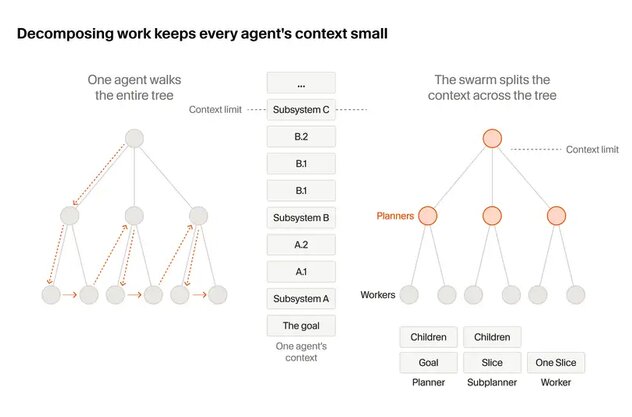
There’s a second problem. Every model has a context window, its working memory. Ask one agent to rebuild a database engine and by hour two its memory is full: it forgets what it wrote, rewrites finished work, contradicts its own decisions. In Cursor’s early experiments this produced roughly 68,000 commits of thrash in about two hours — crews tearing down walls other crews had just built.
Cursor’s fix is to split the job into a tree. Planners decide architecture and write precise specifications. Workers each get one narrow slice and execute it. Nobody has to hold the whole system in their head — which is what makes the context problem disappear.
The proof
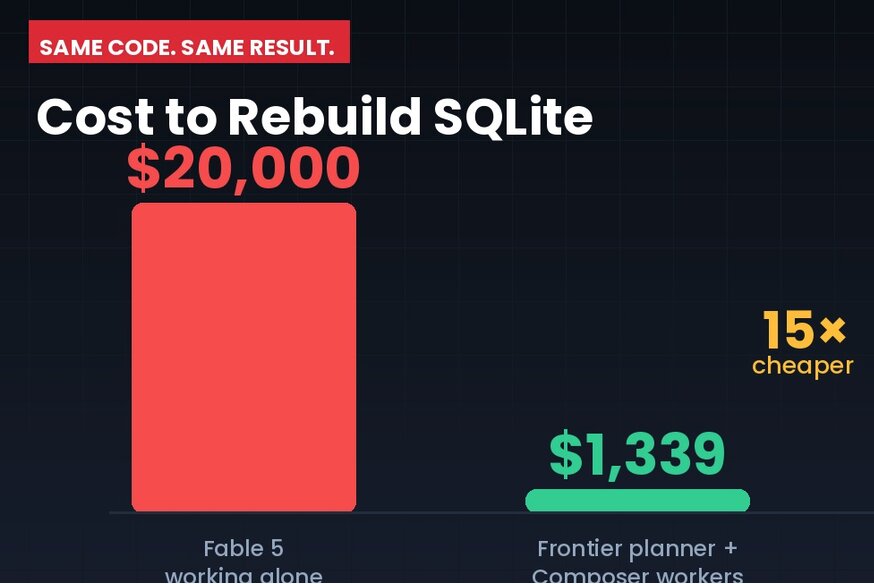
Cursor measured the cost of rebuilding SQLite. Every configuration below produces working code. Only the price changes.
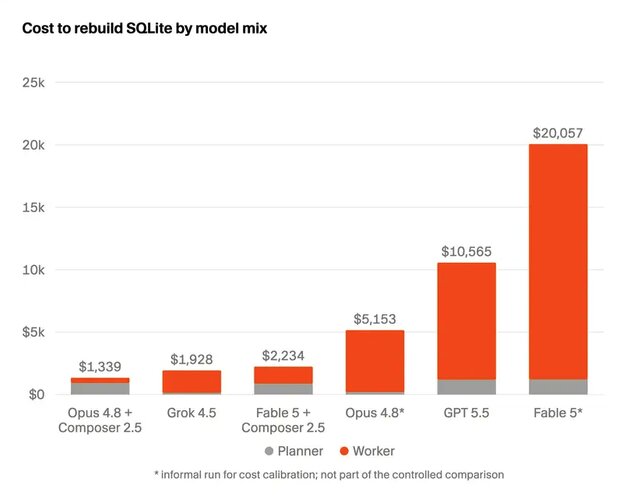
AI workers burn 69–90% of all tokens, but planners dominate the bill, because their price per token is so much higher.
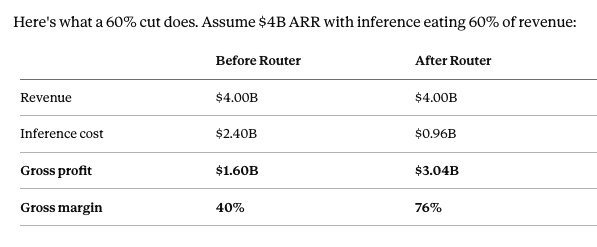
Saving money and providing value will change behavior. A task that cost $20,000 was a research demo. Getting the project done for $1,339 is something an IT group or enterprise can do every day. Swarms stop being showcases and become routine, and token volume per developer climbs steeply.
So the Router’s real job isn’t margin. It’s buying seats. Aggressive pricing is only survivable if your costs collapsed first. The margin comes later.
The SQL Lite Test Shows the Path from Detailed Problem Analysis to Automation
Composer 3 is being trained from scratch with roughly 10× the compute on Colossus, SpaceXAI’s own datacenters. Cursor intends to take the planner role in-house.
What that requires is specific, and it isn’t be the smartest model. A planner has to decompose goals into a clean tree, resolve ambiguity, and — critically — write specifications precise enough that a weaker model can follow them without drifting. They showed they can decompose the goals into a clean tree. It also has to absorb work currently done by external scaffolding and merge-conflict resolution, design reconciliation, breaking up oversized files.
Cursor and SpaceX need to grow the seats, aka win over developers. They will later grow the revenue per seat and get more API revenue.
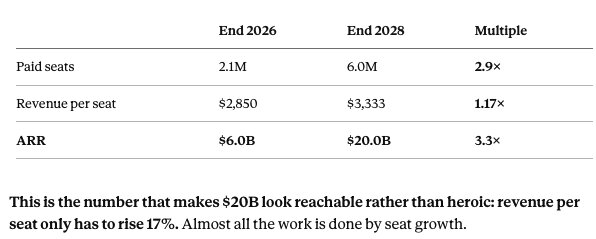
Six million paid seats is roughly 20% of the world’s ~30 million professional developers. Given Cursor already reports a high share of the Fortune 500, thousands of $100k+ customers, enterprise unlocks like always-on security review and VPC deployment, a Gartner Magic Quadrant leader placement, and a ₹649 India plan aimed straight at one of the largest developer populations on earth — 20% is aggressive but not fantasy.
The margin story matters more than the revenue story.
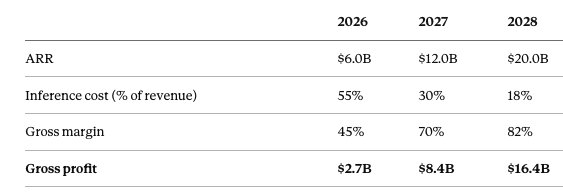
Cursor is spending phase one of that advantage on price, to win seats. Phase two — becoming its own planner — is where it stops paying its competitors and the margin arrives. Cursor already has become profitable by switching to SpaceX and drastically lowering costs. Bring profitable in AI is rare. Anthropic has had to get to over $70 billion in ARR to get to a fragile and possibly temporary profitability. OpenAI is not profitable.
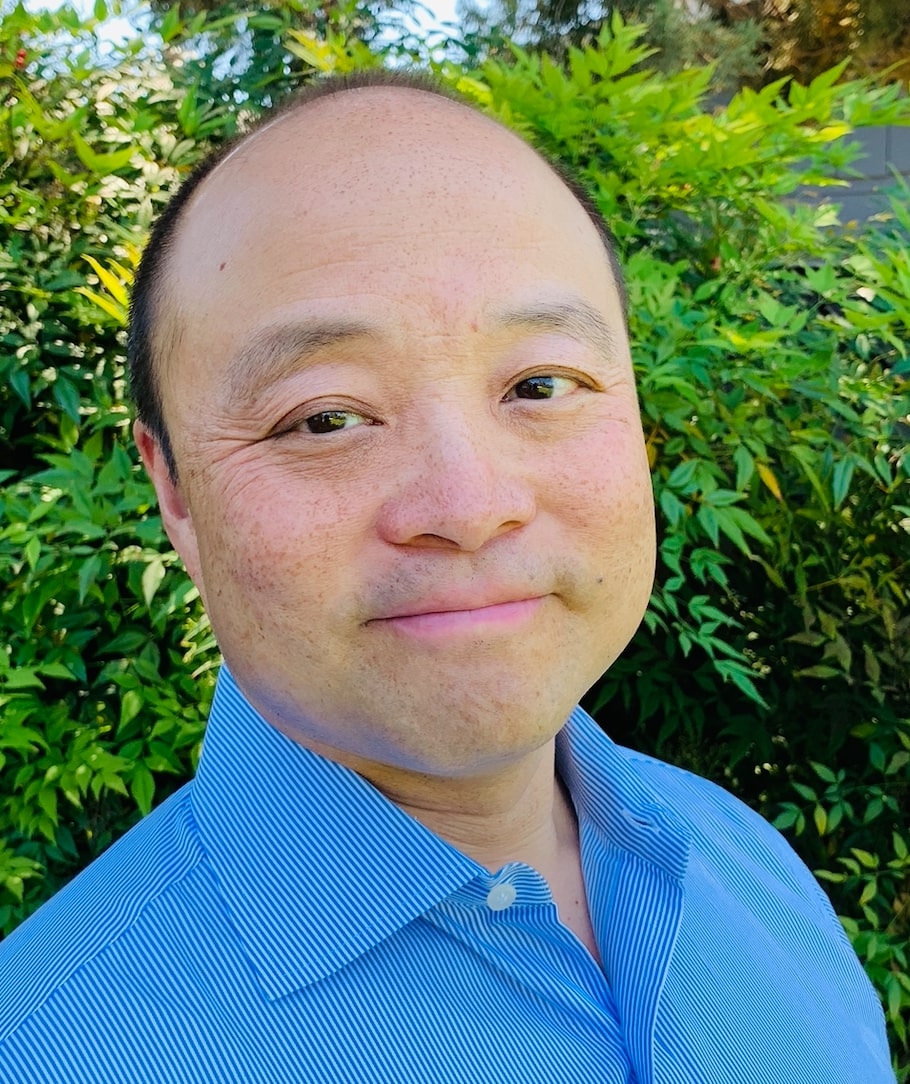
Brian Wang is a Futurist Thought Leader and a popular Science blogger with 1 million readers per month. His blog Nextbigfuture.com is ranked #1 Science News Blog. It covers many disruptive technology and trends including Space, Robotics, Artificial Intelligence, Medicine, Anti-aging Biotechnology, and Nanotechnology.
Known for identifying cutting edge technologies, he is currently a Co-Founder of a startup and fundraiser for high potential early-stage companies. He is the Head of Research for Allocations for deep technology investments and an Angel Investor at Space Angels.
A frequent speaker at corporations, he has been a TEDx speaker, a Singularity University speaker and guest at numerous interviews for radio and podcasts. He is open to public speaking and advising engagements.
